By Roy Denish.
Renewed investigations into the stalled Krrish project are revisiting allegations of bribery, money laundering and political influence in Colombo.
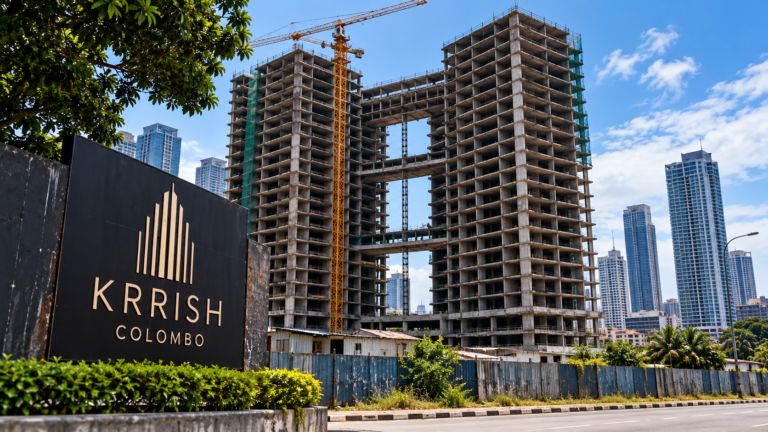
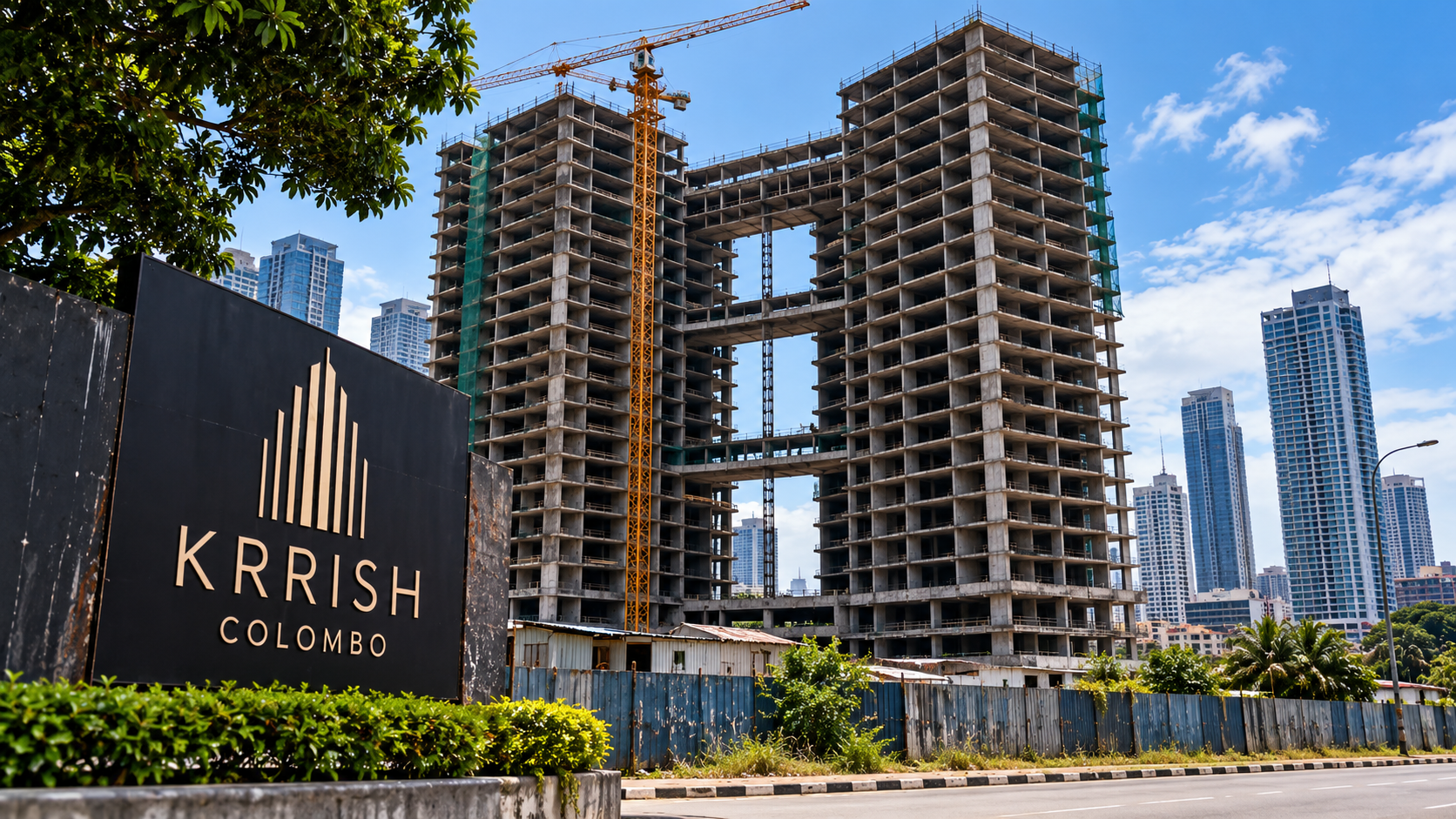
In the heart of Colombo, a skeletal, half-built concrete monolith stands as a glaring monument to alleged institutional corruption, unfulfilled promises, and political patronage.
Years after its initial collapse, the Krrish project scandal has returned to the forefront of Sri Lanka’s political and media landscape, driven by renewed investigations into allegations of money laundering, bribery, and high-level cover-ups.
At the centre of the revived criminal probe is former Member of Parliament Namal Rajapaksa, who faces allegations relating to Rs. 70 million, alongside the recent arrest and remand of former company director Janaki Siriwardena — a figure whose extraordinary trajectory reads more like political fiction than corporate history.

Siriwardena’s journey to becoming a central player in one of the island’s largest real-estate ventures began far from the boardroom.
After working overseas as a Middle Eastern flight attendant and later in Australia’s supermarket sector, she reportedly cultivated high-level connections with regional royals and elites, eventually gaining access to former Libyan leader Muammar Gaddafi, for whom she reportedly worked for a period.
During a visit to Libya by then-President Mahinda Rajapaksa, he reportedly became aware of her international network, and she was later said to have returned to Sri Lanka aboard Gaddafi’s private jet.
Leveraging political connections during the Rajapaksa administration, a prime 4.3-acre plot of land belonging to the Urban Development Authority in central Colombo was leased on a 99-year agreement.
The enterprise accelerated between 2010 and 2011 with the arrival of Indian investor Amit Kattiyar, associated with the Krrish company.
Kattiyar was reportedly linked to allegations in India concerning a Gurugram housing development.
Nevertheless, Siriwardena and local associates facilitated his entry into Sri Lanka, promising the construction of ultra-luxury hotels and residential towers under prestigious international brands.
What followed, according to allegations surrounding the project, was a complex series of financial and regulatory controversies.
Backed by tax concessions from the Board of Investment, operators were accused of diverting and selling duty-free building materials for private profit, while Rs. 70 million was allegedly transferred through commercial bank accounts in connection with rugby promotion and political facilitation.
When a change in political power brought the reformist government to office in 2015, Wasantha Samarasinghe of the Voice Against Corruption lodged formal complaints with the Financial Crimes Investigation Division.
Though Namal Rajapaksa was briefly arrested in connection with investigations, the momentum of the probe later slowed.
Subsequent allegations centred on former FCID chief Ravi Waidyalankara and Janaki Siriwardena, including claims that benefits were provided in exchange for favourable treatment.
Among the allegations were claims involving two luxury apartments, shopping allowances, and travel benefits. These remain serious allegations requiring determination through appropriate legal processes.
As financial difficulties mounted, the project spiralled into operational insolvency.
The primary Chinese construction company reportedly accepted 21 residential units in lieu of unpaid debts and withdrew, while another contractor allegedly faced similar non-payment issues, forcing construction to halt.
At the height of the financial crisis, operations were reportedly so cash-strapped that managers pawned a vehicle belonging to a local Buddhist monk to raise money for employee salaries.
Meanwhile, citizens and investors who had poured their savings into residential units faced years of uncertainty, prompting a coalition of investors led by pilot Neomal Perera to petition the courts for a liquidation order.
Today, as President Anura Kumara Dissanayake’s administration faces mounting pressure to deliver systemic accountability, the abandoned downtown structure remains a reminder of the controversies surrounding the project and the unfinished anti-corruption agenda of previous governments.
Civil society groups and investigators continue to call for accountability, protection of the prime real estate from opportunistic acquisition, and the introduction of transparent, credible investment capable of transforming the long-stalled site into a productive commercial development for Colombo.