By Roy Denish
The Gnanasara Thero protest in Colombo has been suspended after senior Buddhist prelates intervened following weeks of legal and religious controversy.
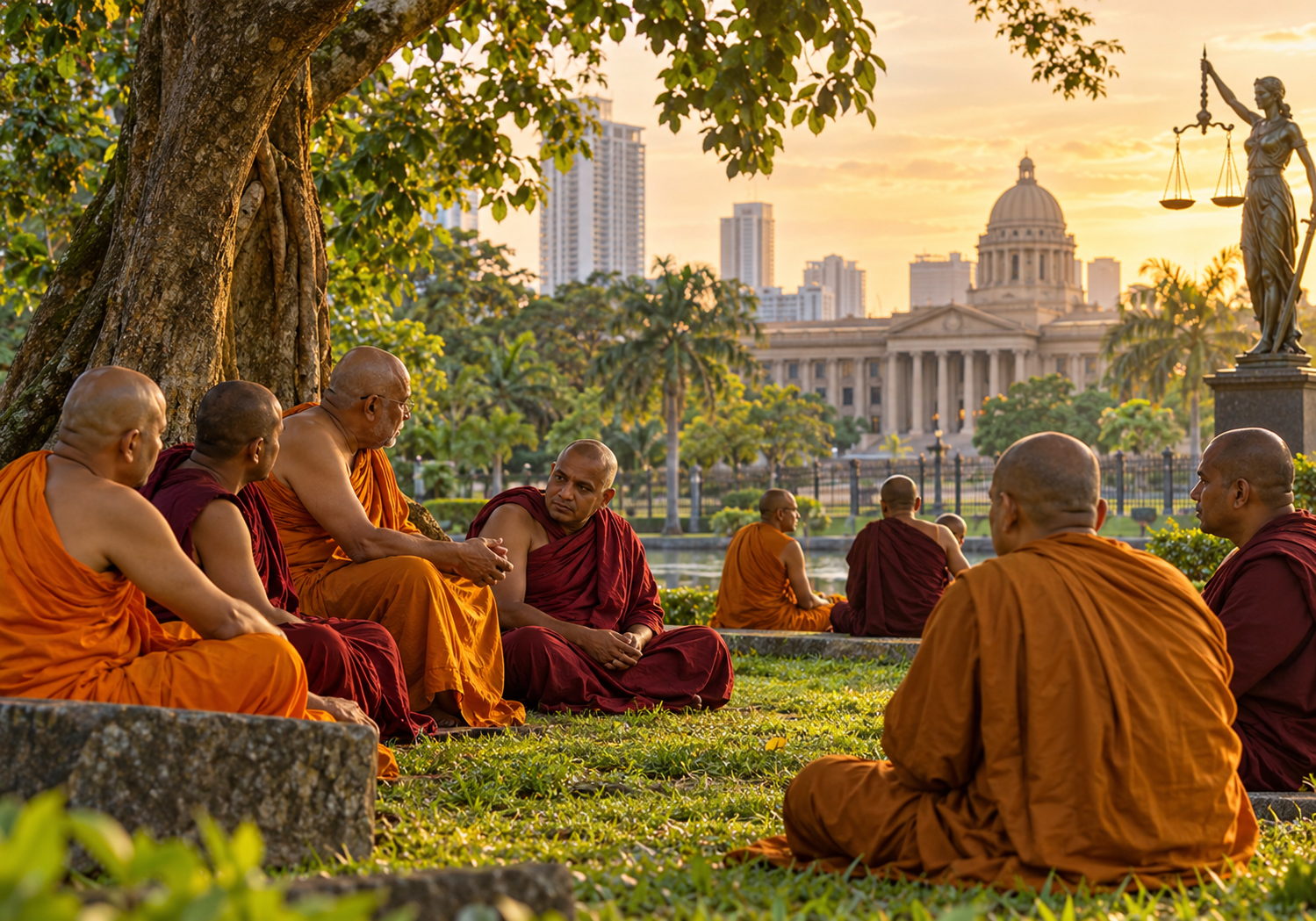
COLOMBO – A remarkable confrontation involving Buddhist monks, ancient folk rituals and the authority of Sri Lanka’s Supreme Court has entered a new phase following the temporary suspension of a protest demanding the release of imprisoned Bodu Bala Sena General Secretary Galagoda Aththe Gnanasara Thero.
The protest, conducted at Colombo’s Viharamahadevi Park, had attracted national attention after participants challenged the imprisonment of the controversial monk and objected to his appearance in civilian prison clothing rather than traditional monastic robes.
The dispute subsequently acquired an extraordinary religious dimension when followers of Pitiduwe Siridhamma reportedly conducted a ritual invoking Mahasona, a feared supernatural figure associated with graveyards in Sinhala folklore.

Ancient Rituals Enter a Modern Political Dispute
According to reporting by the Jaffna Monitor, the ritual was conducted at Viharamahadevi Park during the protest.
The ceremony involved an effigy and ritual practices associated with traditional Sinhala supernatural beliefs.
Mahasona occupies a prominent place in Sri Lankan folklore as a feared spirit historically associated with illness, death and graveyards.
While folk rituals invoking supernatural forces have existed alongside Buddhist cultural traditions for centuries, their appearance within a political confrontation involving a Supreme Court ruling raises complex questions about religious expression, public protest and constitutional authority.
The ritual should not be confused with official Buddhist doctrine or presented as representative of the practices of the wider Buddhist clergy.
Supreme Court Invalidates Presidential Pardon
The underlying dispute concerns a presidential pardon granted to Gnanasara Thero by former President Maithripala Sirisena in 2019.
In September 2026, the Supreme Court ruled that the pardon was legally invalid.
The decision resulted in the reinstatement of the monk’s six-year prison sentence for contempt of court.
Gnanasara Thero returned to prison in early October, prompting demonstrations by supporters demanding his release.
The controversy intensified when he appeared in court wearing standard civilian prison clothing.
Several senior Buddhist monks argued that requiring an ordained monk to appear without traditional robes undermined the dignity of the Buddhist clergy.
Government representatives maintained that court decisions must be respected and that the executive should not disregard judicial rulings.
Government Rejects Pressure for a Pardon
President Anura Kumara Dissanayake’s administration has maintained that the judicial process must be upheld.
On 19 October, the President’s Legal Director, W. M. Wijebandara, reportedly stated that the Government had no plans to overturn the court’s decision or grant Gnanasara Thero a pardon.
The dispute therefore developed into a wider confrontation over the relationship between religious authority and the constitutional powers of the state.
Supporters of the imprisoned monk argued that the Government should recognise the special religious status of ordained clergy.
Opponents of executive intervention maintained that allowing political or religious pressure to override judicial decisions would undermine equality before the law.
Court Intervention and Continued Demonstrations
The protest continued despite legal efforts to regulate activities at Viharamahadevi Park.
Reporting on 25 October indicated that a court order had been obtained concerning the occupation of the park and surrounding public areas.
The demonstrators nevertheless continued to demand action regarding Gnanasara Thero’s imprisonment.
New Development: Protest Temporarily Suspended
A significant development emerged on 25 October when participating monks announced that the protest would be temporarily suspended.
According to a report published by the Daily FT on 26 October, Venerable Ulapane Sumangala Thero said the decision followed information that senior Buddhist prelates were intervening to seek a resolution.
The Mahanayake Theros of the principal Buddhist monastic chapters also issued a statement urging members of the clergy to preserve monastic discipline and avoid activities that could damage the reputation of the Buddhist order.
The senior prelates indicated that discussions with the Government had commenced and emphasised the importance of pursuing a resolution through lawful means and dialogue.
The temporary suspension does not mean that the demand for Gnanasara Thero’s release has been withdrawn.
A Test of Religious Authority and Constitutional Law
The controversy illustrates the difficult relationship between religious traditions, political influence and judicial independence in contemporary Sri Lanka.
The country’s constitutional framework accords Buddhism a special place while also recognising the authority of the judiciary and the fundamental rights of citizens.
The central question is whether religious status should influence the execution of judicial decisions and, if so, how such accommodation can be reconciled with equality before the law.
With the protest temporarily suspended and senior Buddhist leaders pursuing discussions with the Government, attention now turns to whether a lawful resolution can be reached without undermining the authority of the Supreme Court.
Sources
- Daily FT — Monks Pause Protest Seeking Gnanasara Release, 26 October 2026
- Jaffna Monitor — Sri Lankan Buddhist Monks Turn to Demon Mahasona
- The Morning — Government Rules Out Pardon for Gnanasara Thero, 19 October 2026
- Newsfirst — Gnanasara Thero’s Six-Year Prison Sentence Reinstated, 5 October 2026
- CounterPoint — Government and Protesting Monks Remain at Odds, 25 October 2026