
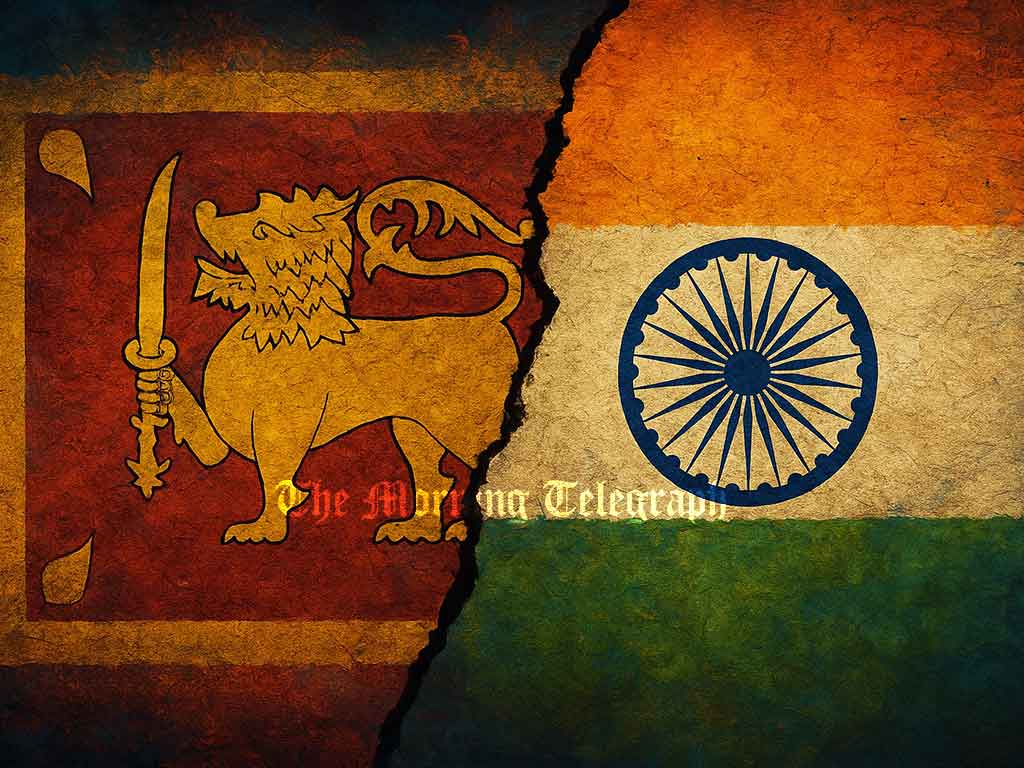
As Sri Lanka inks new defence pacts with India under a veil of secrecy, critics warn the deals could tip the island’s fragile sovereignty into dangerous dependence. From Chinese port leases to Israeli labour deals, are we witnessing strategic partnerships or slow-motion surrender.
Sri Lanka’s India MoUs: Strategic Masterstroke or National Vulnerability?
Foreign and defence policy decisions must rise above partisan politics. Strategic commercial agreements must be critically examined through a geopolitical lensespecially when their impact could echo for decades.
Sri Lanka’s foreign policy continues to navigate treacherous waters in the Indian Ocean, where proximity to India an emerging regional powerhouse carries both promise and peril. India, with its bipolar geopolitical personality, oscillates in strategic behavior, often shaped by internal political fluctuations. This volatility directly impacts how India treats its neighbours, including Sri Lanka. With Indian investments steadily rising, the signing of a recent Memorandum of Understanding (MoU) may be more than just a trade agreement, it could signify New Delhi’s mounting security concerns in the region.
Barely a breath away from China’s aggressive Belt and Road Initiative (BRI), Sri Lanka has become a geopolitical pawn between superpowers. For India, the growing Chinese footprint on the island, especially in strategic infrastructure is both an irritant and a wake-up call.
The BRI, launched by China in 2013, aims to create vast transcontinental supply chains by investing in railways, roads, ports, and energy pipelines. Sri Lanka has already become a BRI hub: China controls 85% of Hambantota Port, built the infamous white elephant that is Mattala Airport, and secured a 99-year lease for 49 acres of reclaimed land in Colombo’s Port City in exchange for developing 660 acres of sea. These deals, though hailed by some as infrastructure progress, deepen Sri Lanka’s dependency on Beijing.
Meanwhile, the United States is not sitting idle. As India and China expand their stakes, the U.S. is now viewing Sri Lanka as a potential pivot in its Indo-Pacific strategy. The increased presence of U.S. allies like Australia and the U.K. not to mention Israel, further complicates Sri Lanka’s balancing act. Surveillance, foreign base rumors, and external counterweights are all increasing. India likely perceives these moves with caution.
Israel’s Growing Shadow
Adding another dimension, Sri Lanka’s burgeoning ties with Israel are also raising eyebrows. Offering 10,000 Sri Lankans agricultural jobs, allowing Jewish-run businesses to operate with local proxies, and opening multiple Chabad Houses (including in Colombo, Weligama, and Ella) all hint at an evolving vigilance mechanism. With approximately 25,000 Israeli tourists arriving annually, the cultural and political footprint is growing. But this expansion causes concern among Muslim communities in Sri Lanka, many of whom view it as a betrayal of the country’s traditional pro-Palestinian stance. Given Israel’s widely condemned actions in Gaza, this shift is more than symbolic, it’s geopolitical.
A Secret Pact with India?
Against this backdrop, the MoU between Sri Lanka and India, particularly on defence cooperation, has stirred public anxiety. The secrecy surrounding it fuels distrust. The government’s reluctance to share details undermines its proclaimed commitment to transparency. It appears to be a strategic decision made in haste if not in desperation.
Nonetheless, the MoU should not be viewed in isolation. It fits within a broader web of power plays in the Indian Ocean. According to EconomyNext, which published the full text in May 2025, the defence cooperation MoU signed by Defence Secretary Sampath Thuyacontha and Indian High Commissioner Santosh Jha consists of 12 articles. The full document reportedly spans nine pages and includes 55 sub-clauses raising the question: is this really just an MoU?
The Indian High Commission in Colombo and Sri Lanka’s Foreign Ministry both declined to confirm its content, citing “mutual confidentiality.” However, officials stated that the agreement merely formalises pre-existing defence practices between the two nations. These include personnel exchanges, training, defence industry collaboration, technology transfer, financial cooperation, and protection of classified data. The MoU will be valid for five years but can be terminated by either party with three months’ notice.
Clause for Concern
Some experts argue the scale and depth of the agreement go far beyond a typical MoU. Article 1, titled Scope of Cooperation, outlines defence collaborations and reaffirms adherence to the UN Charter: sovereign equality, territorial integrity, and non-intervention in internal affairs. However, it also contains a clause allowing territory to be used for activities deemed “not harmful” to the other’s national security an ambiguous provision ripe for future reinterpretation.
India’s clear strategic interest in the MoU crafted primarily for its own geopolitical benefit is evident. For Sri Lanka, this could be a double-edged sword. On one hand, it signals to China and other powers that India is the key protector of Sri Lanka’s national security. On the other, if political winds shift in New Delhi within the MoU’s five-year span, Sri Lanka could find itself vulnerable or even compromised.
States like Tamil Nadu with historical influence over Indo-Lankan relations could pressure the Indian federal government, especially on issues involving Sri Lanka’s Tamil population. That kind of leverage is often overlooked but remains potent.
India’s Strategic Grip
Criticising the MoU without understanding the broader geopolitical chessboard would be short-sighted. India’s size, military power, proximity, and cultural affinity to Sri Lanka are undeniable. While the idea of “Sri Lanka First” sounds ideal, the country’s dire economic state makes full independence a luxury it can’t yet afford. Sri Lanka is recovering from one of the worst financial crises in its history. Its foreign policy must be crafted with vision, not nostalgia.
Balancing national interest and foreign cooperation is now a delicate dance. Foreign investment is vital, but so is long-term sovereignty. As such, several major agreements past and present deserve re-evaluation:
- The India MoU: If India’s political landscape changes, this deal could become problematic.
- China’s 99-year lease (2017): Reclaiming 49 acres for Colombo Port City under Chinese control may lead to creeping commercial or military encroachment.
- Hambantota Port & 15,000-acre SEZ (2017): Another long-term handover to China’s China Merchants Port Holdings.
- Israel labour deal (2020): Replacing 20,000 banned Palestinian workers with Sri Lankan ones, and offering 20,000 more jobs in 2024, may destabilize domestic harmony in a diverse nation like Sri Lanka.
Reclaiming Sovereignty
The ultimate question remains: will these decisions secure Sri Lanka’s future, or mortgage it to foreign powers? In a nation still healing from decades of internal conflict and mismanagement, the stakes are too high for short-sighted deals.
The President must be made accountable for foreign and defence affairs. The Opposition should have a seat at the decision-making table. A bipartisan Parliamentary Oversight Committee must be formed to audit these agreements.
Foreign policy should transcend party politics. Economic and strategic decisions must be evaluated holistically with eyes wide open to who really benefits. Sri Lanka must not be anybody’s pawn. A smart, forward-thinking foreign policy rooted in national dignity and strategic clarity is its only path to true sovereignty, prosperity, and peace.


? ? This man is void of common sense. How did this guy become a minister?
An ALD stooge?