By Roshan Jayasinghe
There are moments in history when policy does more than set economic terms, it reveals a worldview. The recent announcement of a 30% tariff on Sri Lankan imports to the United States is one such moment. While it is presented as a tool for protecting domestic industries and correcting trade imbalances, the deeper question remains: what kind of global future are we shaping, one of shared humanity or hardened isolation?
Sri Lanka is not a superpower. We are a small, developing island nation. Our greatest asset is not technology or vast natural reserves, it is our people. We produce goods through labor, not leverage. Our economy survives not on conquest or control, but on exchange. And in the global marketplace, we ask only to participate, not to dominate.
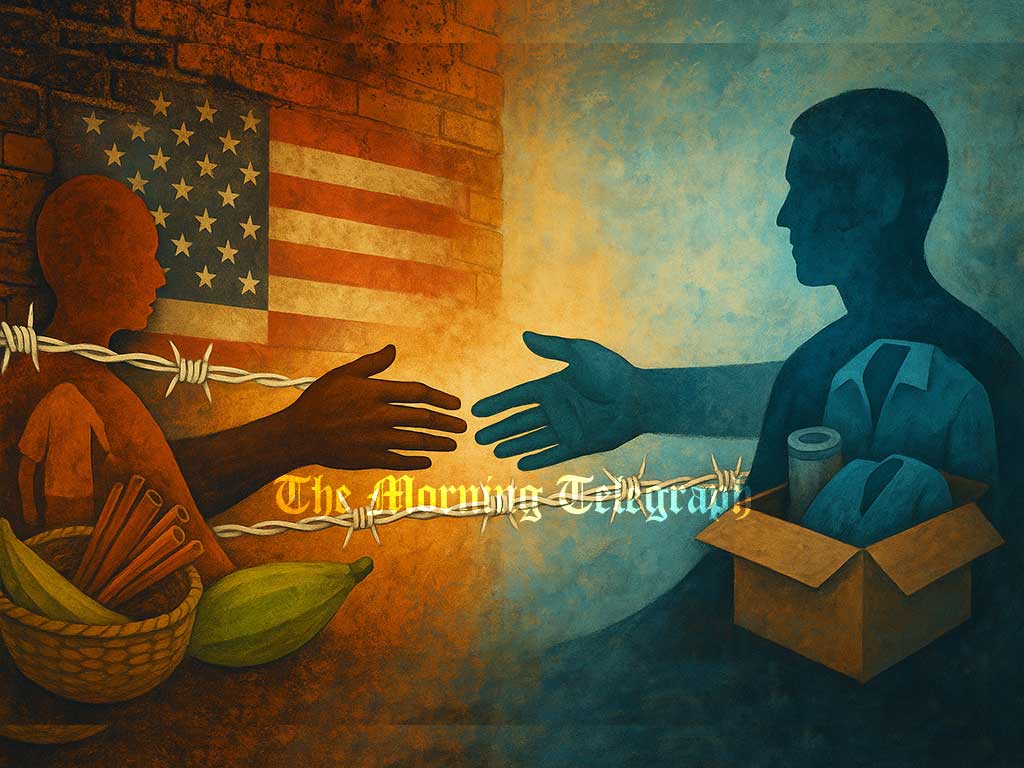
To now impose a blanket 30% tariff on every Sri Lankan product, while simultaneously suggesting that Sri Lankan businesses relocate to the United States to avoid such penalties, is not an economic correction. It is a moral distortion. It threatens the livelihoods of those who can least afford it, the village garment worker, the cinnamon farmer, the young entrepreneur seeking to build something real at home.
This is not trade. This is displacement in disguise.
The Truth About Tariffs: Who Really Pays?
Let us be clear: tariffs on Sri Lankan goods are not paid by Sri Lanka. They are paid by American importers , U.S.-based businesses who source products abroad and must now pay 30% more to bring them in. That cost, in most cases, is passed directly to American consumers.
So the question must be asked: who does this policy truly protect?
When tariffs are used to raise the price of foreign goods, the effect is not the resurrection of a domestic industry, it is the punishment of the consumer. It is a tax disguised as nationalism, framed in patriotism but executed at the cash register. If a pair of gloves, a bag of spices, or a can of coconut milk becomes 30% more expensive, it is not because Sri Lanka demanded more , it is because someone in Washington chose to build walls instead of bridges.
The Illusion of Self-Reliance in a Global World
The narrative being sold is that these tariffs are necessary to safeguard American-made goods. But this logic quickly collapses under its own weight. If every nation followed this principle, if each country only consumed what it produced within its own borders, what would become of global trade altogether?
The United States itself relies heavily on raw materials from abroad, rare earth minerals, textiles, spices, oils, and countless agricultural products that are unavailable or unsustainable domestically. It sources these inputs from the very nations now being punished with import taxes.
So the contradiction is laid bare: you cannot demand the world’s resources, and then penalize the world’s products.
You cannot pretend to be self-reliant while quietly building your prosperity on the labor, land, and raw material of others. That is not sovereignty, that is selective isolation. It is economic nationalism with a passport.
Let Us Not Mistake Power for Principle
Yes, the world is unequal. Yes, countries must protect their people. But protectionism without partnership leads to economic silos and fractured communities. When the powerful impose policies that restrict others from participation, they do not inspire self-sufficiency, they incentivize desperation, outsourcing, and eventual collapse of mutual trust.
What does it mean to lead, if not to uplift?
To our American friends, and especially to those who hold values of fairness, leadership, and human dignity, this is not an attack. This is a call to reawaken the deeper soul of your nation. A nation that once stood for opportunity and inclusion. A nation that the world still hopes will lead by example, not by exclusion.
An Invitation to All Global Citizens
So I write this not in protest, but in hope.
To the global community, citizens, consumers, policymakers, producers, I ask: let us look closely at the structures we have built. Let us see how easily greed is cloaked in policy. Let us see how natural resources are extracted, how human labor is used, and how walls are built under the illusion of strength.
The Earth was not meant to be carved into winners and losers.
It was meant to be shared.
Let us not fall into the trap of tariff wars and transactional relationships. Let us return to the vision of co-creation, where nations share what they have and receive what they need. Where the success of one does not mean the downfall of another. Where dignity travels across borders as freely as trade once did.
And let us recognize that the true strength of a nation lies not in how high it can build its walls, but in how wide it can open its doors to humanity.
The Earth is Not a Marketplace, It is a Shared Inheritance
What if we measured trade not by profit margins, but by peace of mind?
What if we asked, not how much can I gain, but how well can we all live?
Let us reject the illusion of isolation. Let us stop pretending that independence means indifference. And let us commit, as a global family, to caring for each other, across boundaries, across languages, across economies.
Because we were never meant to trade as enemies.
We were meant to care, to share, and to rise together.
Let us begin now.
About the Author
Roshan Jayasinghe is a humanist thinker and emerging writer based in California. With a background in administration and a deep passion for social equity, he explores the intersections of politics, identity, and compassion through a lens grounded in nature’s own self-correcting wisdom.

Roshan Jayasinghe
Rooted in the belief that humanity can realign with the natural order where balance, regeneration, and interdependence are inherent. Roshan’s reflections invite readers to pause, question, and reimagine the systems we live within. His writing seeks not to impose answers, but to spark thought and awaken a deeper awareness of our shared human journey. Roshan will be sharing weekly articles that gently challenge, inspire, and reconnect us to what matters most.