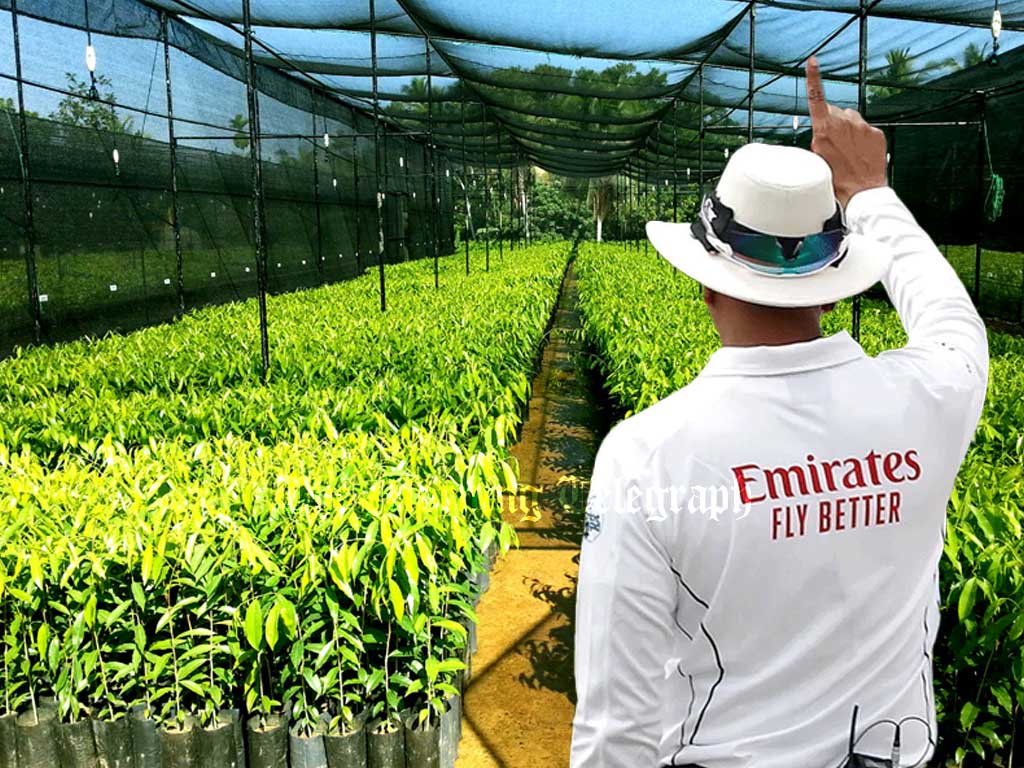
Sri Lanka’s Central Bank is investigating a high-profile cultivation project linked to a famous cricketer for discreetly accepting deposits outside financial regulations. As deposit schemes surge post-crisis, authorities warn of legal blind spots and investor risk.
A high-profile cultivation project led by a famous Sri Lankan cricketer is currently under investigation by the Central Bank of Sri Lanka (CBSL) for allegedly accepting large sums of public deposits while avoiding core financial regulations. Although this cultivation scheme does not meet the formal definition of a pyramid scheme, it appears to be operating in a highly calculated manner, pushing the boundaries of legality and raising serious concerns about accountability, oversight, and investor vulnerability.
According to a senior CBSL official, the Department of Non-Banking Financial Institutions has launched a probe into the project. The official revealed that considerable public money has been channeled into the scheme, which has attracted widespread trust primarily due to the celebrity status of the cricketer involved. However, officials warn that trust built on fame can often mask the risks buried deep within the operational model of such financial ventures.
Speaking at a recent media workshop focused on financial fraud and pyramid schemes, CBSL officials highlighted a growing trend in Sri Lanka, schemes based on agriculture and education projects that are cleverly designed to stay just within the limits of the law. These are not classic pyramid structures, yet they exhibit similar behaviors by attracting investment from people using community networks and respected figures such as monks, village officials, and even law enforcement officers to build credibility.
In one case cited by the Central Bank, people from Colombo had invested in a teak plantation in Anuradhapura without verifying land ownership or even visiting the site. Some portions of land had reportedly been sold multiple times to different buyers. The Bank stated that regardless of whether the face of the scheme is a national cricketer or not, people must take personal responsibility for safeguarding their hard-earned money. Many investors had sold their own land, sometimes as small as ten perches, just to participate in ventures that were never verified or legally secured.
The Central Bank acknowledged the widespread public frustration that stems from perceived inaction. Many believe the CBSL is failing to act swiftly or decisively, allowing such schemes to flourish. In response, officials clarified that the Central Bank’s mandate is limited to financial regulation and information dissemination. It does not have the authority to prosecute or arrest those behind questionable schemes unless a clear violation of financial law has occurred. That responsibility lies with the police and broader legal system. The Central Bank, according to its officials, cannot “get its hands dirty” by acting beyond the law.
They also acknowledged that the post-crisis environment in Sri Lanka has made the public more vulnerable to high-risk schemes. Over the past three to four years, amid rampant inflation and economic desperation, many citizens have turned to alternative financial opportunities to protect or grow their savings. The official noted that the collapse of livelihoods due to the economic crisis created a fertile environment for semi-legal or gray-area financial operations that promise fast returns with minimal oversight.
When questioned further, CBSL officials stressed that while they actively educate the public and monitor such activities, enforcement remains a challenge. They pointed out that people are often drawn in by high-return promises, and that schemes using influential public figures are particularly hard to regulate. The Bank explained that even if its governing acts were amended, the power to name, shame, or prosecute individuals involved in non-banking financial misconduct would still be limited. The law, as it stands, places that responsibility squarely on the shoulders of the country’s police and judicial system.
As the investigation continues, the Central Bank urges the public to exercise caution and perform due diligence before investing in any project that claims to offer unusually high returns, especially those endorsed by celebrities or carried out in informal settings. The legal framework may not always protect those who invest blindly, and just because something is not explicitly illegal doesn’t mean it is safe or ethical. This situation serves as a stark reminder that financial awareness and legal literacy are vital tools for citizens, particularly in times of national economic hardship.
While the cultivation project at the center of this controversy has not yet been deemed illegal, it illustrates how easily financial laws can be manipulated to avoid regulation. It also underscores the broader issue of how economic instability continues to drive ordinary people toward risky ventures with little to no legal protection. At a time when trust in institutions is fragile, and the promise of economic opportunity is thin, the use of fame to legitimize financial schemes demands urgent attention.
As Sri Lanka navigates its path out of crisis, the burden now rests on both regulators and the public to remain vigilant. The Central Bank reiterates that it cannot take over the functions of law enforcement and urges individuals to ask questions, demand transparency, and resist the allure of schemes that promise quick wealth with little accountability.