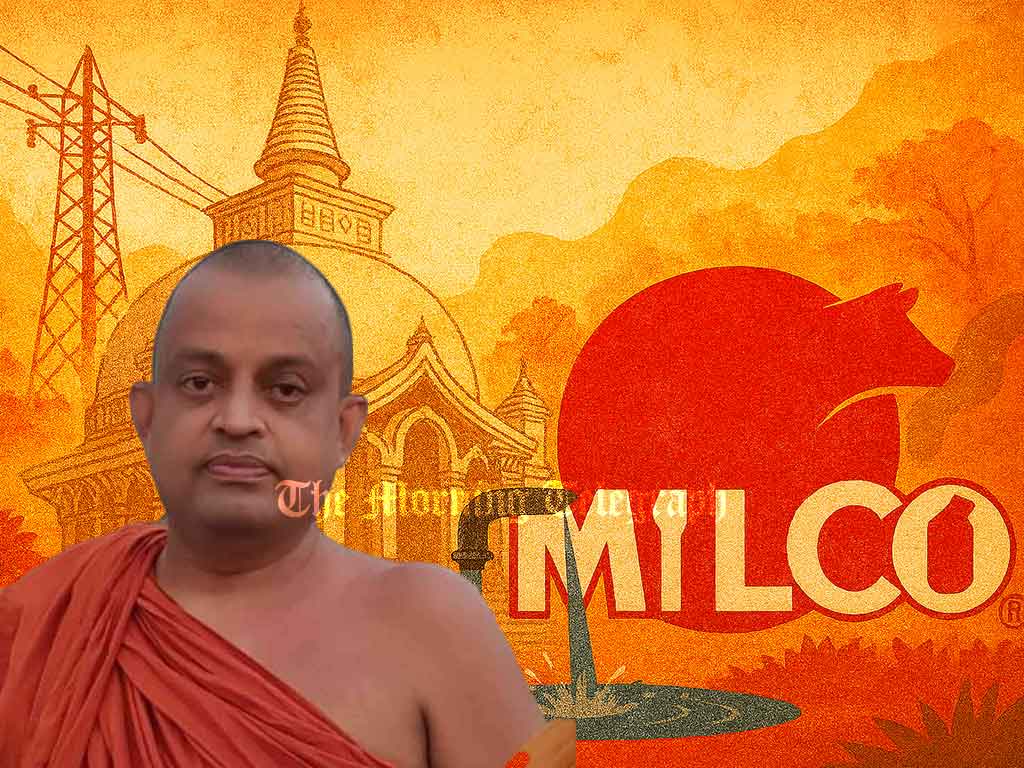
Once envisioned as a pillar of Sri Lanka’s dairy industry, Milco now finds itself entangled in a web of legacy mismanagement, as new revelations uncover how former chairpersons, under the guise of goodwill, authorized questionable acts of charity that continue to drain the company’s resources. At the heart of the controversy is a decade-old power and water leak involving a temple tied to Ven. Ulapane Sumangala Thero a prominent anti-corruption figure, which still receives electricity and water paid for by Milco. Despite changes in leadership, this irregularity has gone uncorrected, raising fresh questions about systemic abuse, institutional silence, and the high cost of unchecked benevolence in public office.
How long can a precedent of misuse continue before someone calls it what it really is state-sanctioned exploitation? That’s the question now echoing across Sri Lanka’s corridors of public accountability, as revelations emerge about the ongoing unauthorized use of Milco’s electricity supply by a temple presided over by none other than Ven. Ulapane Sumangala Thero a monk widely known as a champion of anti-corruption.
But before turning the spotlight solely on the Thero, we must first confront an inconvenient truth: this is not a one-time lapse, but rather the continuation of a culture of indulgence, one that began under previous Milco chairmen, whose questionable decisions effectively opened the floodgates for this quiet misuse to fester for over a decade.
Back in 2015, during the tenure of Keerthi Mihiripanna as Chairman of Milco, a state-owned dairy enterprise, a portion of Milco’s land was transferred to a nearby temple on the instructions of then-President Maithripala Sirisena. What followed was the beginning of a pattern: the temple quietly began drawing electricity and water from Milco’s grid, a practice never sanctioned by proper channels.
But the roots go deeper. Prior to Mihiripanna, Sunil Wickramasinghe, who held the chair from 2012 to 2014, also failed to address or even acknowledge the consumption, which had already begun under his watch. And while Lasantha Wickramasinghe, who became Chairman in 2019, made a formal attempt to correct this by requesting the temple to obtain a separate legal connection (to be funded by Milco itself, no less), his appeal was flatly rejected by the temple’s chief incumbent, none other than Ven. Ulapane Sumangala Thero himself.
This same Thero, who for years has been the public face of the Anti-Corruption Front, and who in 2015 filed a Supreme Court petition challenging the Lands Special Provisions Bill on grounds of national sovereignty and constitutional integrity, now finds himself in the midst of what critics are calling a case study in hypocrisy.
The supply of electricity and water has continued uninterrupted for years, even after the current Milco Board of Directors discovered the situation just two months ago. Despite acknowledging the use, no legal action has been taken, largely out of fear of public backlash and “emotional sensitivities” linked to confronting a religious institution.
But public sympathy is beginning to wane.
As calls for accountability grow louder, many are asking: how can someone who preaches against corruption, who has stood before the courts defending the constitution justify benefiting from a backdoor electricity and water hookup tied to a state entity? Is this a case of noble intentions compromised by convenience? Or does it expose a deeper contradiction in the public persona of Ven. Ulapane Sumangala Thero?
Even more troubling is the institutional silence around this. From the Presidential directive that initiated the land transfer, to the succession of Milco chairpersons who failed to address the irregularity, to the current board that hesitates to act, the system appears more complicit than confused.
To many observers, this is about more than just an electricity and water bill, it’s about principle, precedent, and the performance of public virtue. The Thero’s long-standing fight against corruption, including vocal criticism of foreign land ownership and opaque governance, now stands on shaky ground as the very resources of the state which he vowed to protect have reportedly powered his own sanctuary.

The question now is no longer just about Ven. Ulapane Sumangala Thero’s integrity. It is about how long Sri Lanka will allow the unwise acts of former state officers to justify the unchecked consumption of public assets. And whether those who once exposed the system will continue to quietly feed off it, in darkness and without a meter.