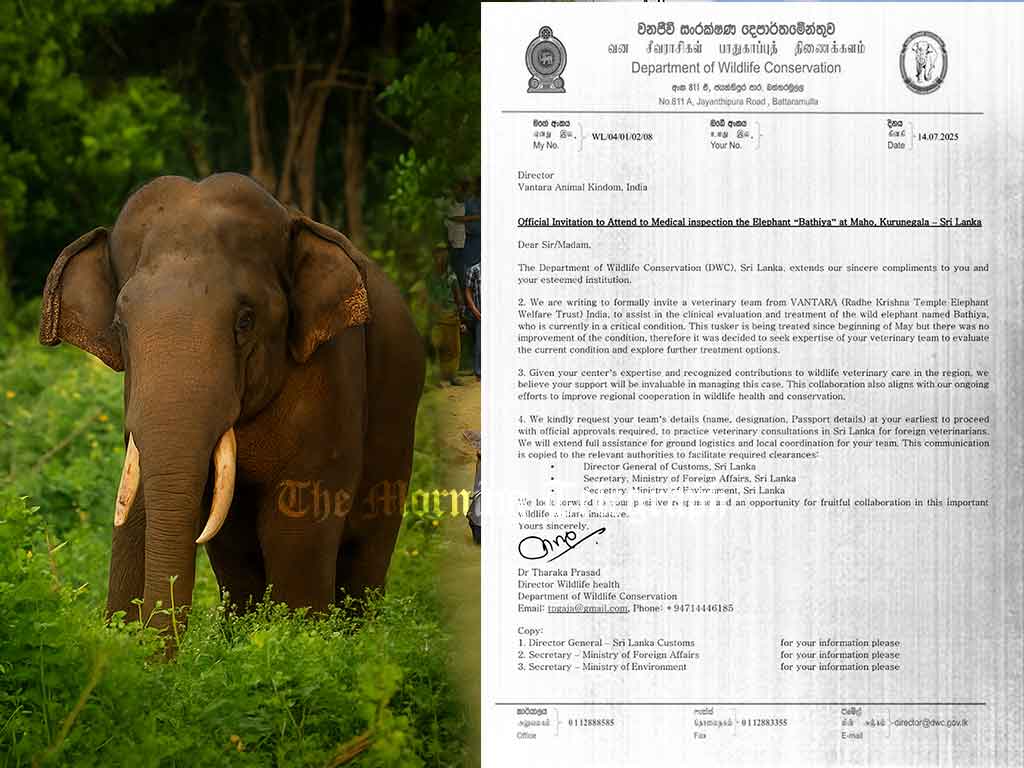
A wave of controversy has erupted over the sudden arrival of an Indian veterinary team in Sri Lanka, allegedly summoned to treat the critically wounded elephant Bhathiya. But a shocking letter and timeline suggest they may have been brought in to euthanize him instead without informing the local vets leading his care.
Bhathiya’s Last Hours: Questions Mount Over Foreign Vet Team’s Mysterious Arrival and Hidden Agenda
The death of Bhathiya, the beloved Sri Lankan tusker wounded by gunfire, has now turned into a national controversy. At the heart of it is a deeply troubling question: Was the Indian veterinary team flown in to rescue him or to put him down?
Dr. Tharaka Prasad, Director of Wildlife Health, is under intense scrutiny after bypassing the Peradeniya University veterinary team, which had been overseeing Bhathiya’s treatment since his rescue. Instead of consulting the Sri Lankan specialists who were familiar with the elephant’s condition and medical history, Dr. Prasad sent an urgent letter on July 14 summoning an Indian veterinary delegation. The letter is now public, and its timing has raised eyebrows.

The Environment Minister himself confirmed on national television that the letter was sent in the morning and the Indian vets landed by evening. Their customs and security clearances were miraculously fast-tracked an unusually expedited process for foreign personnel arriving on such short notice.
But what is even more shocking is the revelation that the Indian veterinary experts, prior to arriving, had already advised euthanizing Bhathiya. This casts serious doubt on their mission: Was it ever about healing, or was it always about ending the elephant’s life?
The local veterinary team had shown determination and hope. They had partially stabilized Bhathiya after he was found trapped and collapsed in a waterhole in Polpithigama. Saline was administered, and his condition was being monitored as he was gently moved within the pit for treatment. Every possible measure was being taken to keep him alive—until external intervention arrived.
The secrecy and haste involved in bringing in a foreign team, who were previously known to recommend euthanasia, now raises grave concerns about intent. Why were the Peradeniya veterinarians, the only team familiar with Bhathiya’s condition, kept in the dark? Why did the Department of Wildlife move so quickly to act on the Indian team’s suggestions when local experts had not declared Bhathiya’s case hopeless?
As the nation mourns the loss of this iconic elephant, many are demanding answers. Did Bhathiya die because it was truly too late or because someone chose not to fight for him?
This controversy has sparked wider debates about transparency, accountability, and the value placed on the lives of Sri Lanka’s majestic wildlife. It is now up to the authorities to come clean about who made the final call, and why it appears that Bhathiya’s life may have been decided behind closed doors.