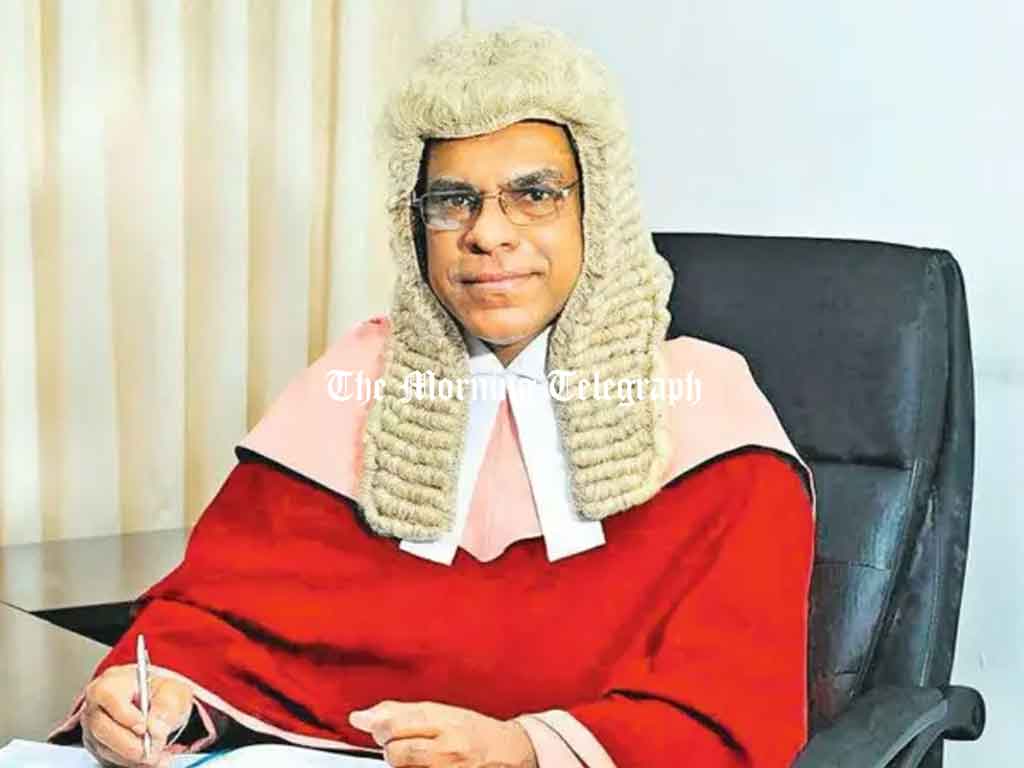
Justice Preethi Padman Surasena has officially been appointed as Sri Lanka’s 49th Chief Justice, following Constitutional Council approval. This in-depth profile explores his rise through the judiciary, key verdicts, and historic rulings on constitutional crises, drug trafficking, and political corruption.
President Anura Kumara Dissanayake has recommended the elevation of Supreme Court Justice Preethi Padman Surasena to the position of Chief Justice, a proposal that received swift approval from the Constitutional Council. As a result, Surasena becomes the 49th Chief Justice of Sri Lanka, succeeding Chief Justice Murdu Fernando, who is due to retire on July 27.
Justice Surasena’s legal journey began after graduating from the University of Colombo in 1985. He entered Sri Lanka Law College via the Law Entrance Examination and was called to the Bar in 1989. That same year, he joined the Attorney General’s Department as a State Counsel. By 2007, then-President Mahinda Rajapaksa appointed him as a High Court Judge.
His rise continued when President Maithripala Sirisena appointed him to the Court of Appeal in January 2016. Two years later, he was named President of the Court of Appeal, and in January 2019, he ascended to the Supreme Court. Since then, he has held the position of the second senior-most justice after the outgoing Chief Justice.
Among his most well-known judgments is the 2015 sentencing of notorious drug kingpin Wele Suda. As a Colombo High Court Judge, Surasena presided over the case and sentenced the defendant to death for drug trafficking and possession, following a meticulous trial that garnered nationwide attention.
Justice Surasena also played a central role during Sri Lanka’s 52-day constitutional crisis in 2018. As President of the Court of Appeal, he issued an interim injunction preventing Mahinda Rajapaksa and his newly appointed Cabinet from exercising power after they were installed by President Sirisena without parliamentary majority. His bench held that the appointments were, on the face of it, unlawful, a decision widely hailed as a judicial defense of parliamentary democracy.
Another high-profile case under his watch was the contempt of court ruling against Bodu Bala Sena Secretary Ven. Galagodaaththe Gnanasara Thero in 2018. Gnanasara was sentenced to 19 years in prison (to be served over 6 years) for interrupting court proceedings and verbally attacking judicial officers. The ruling underscored the judiciary’s zero tolerance for courtroom intimidation.
Justice Surasena also presided over the legal challenge to MP Geetha Kumarasinghe’s eligibility to serve in Parliament due to her Swiss dual citizenship. The Court of Appeal, under his leadership, declared her seat void a verdict upheld by the Supreme Court.
After joining the Supreme Court, Justice Surasena continued to make headlines. He led the bench that invalidated President Gotabaya Rajapaksa’s controversial pardon of former MP Duminda Silva. The ruling held that the presidential pardon lacked legal basis, marking a significant precedent on executive accountability.
In another landmark ruling, Justice Surasena upheld the disqualification of former Environment Minister Nasir Ahmed, who lost his parliamentary seat after voting contrary to his party’s stance. The verdict reinforced the binding authority of political party decisions on their members in Parliament.
Justice Surasena’s commitment to checks and balances extended to executive privileges. He issued an interim order halting a Cabinet decision to grant former President Sirisena a luxury residence on Malalasekara Mawatha. The court found the move violated fundamental rights, as it appeared self-serving and unconstitutional.
He also presided over the contentious e-visa outsourcing case, where the Cabinet sought to hand over visa processing to two private companies. The bench halted the process, citing threats to national security and potential financial losses. When the Immigration Controller disobeyed court orders to comply, Justice Surasena’s bench found him in contempt, resulting in remand and an impending sentencing.
With a strong record of verdicts rooted in constitutional law, transparency, and the public interest, Justice Preethi Padman Surasena is widely seen as a reform-minded judge with a firm grasp on both the spirit and letter of the law. As he steps into the nation’s highest judicial office, legal experts and citizens alike will closely watch how his legacy evolves in one of the most turbulent political climates Sri Lanka has faced in recent history.