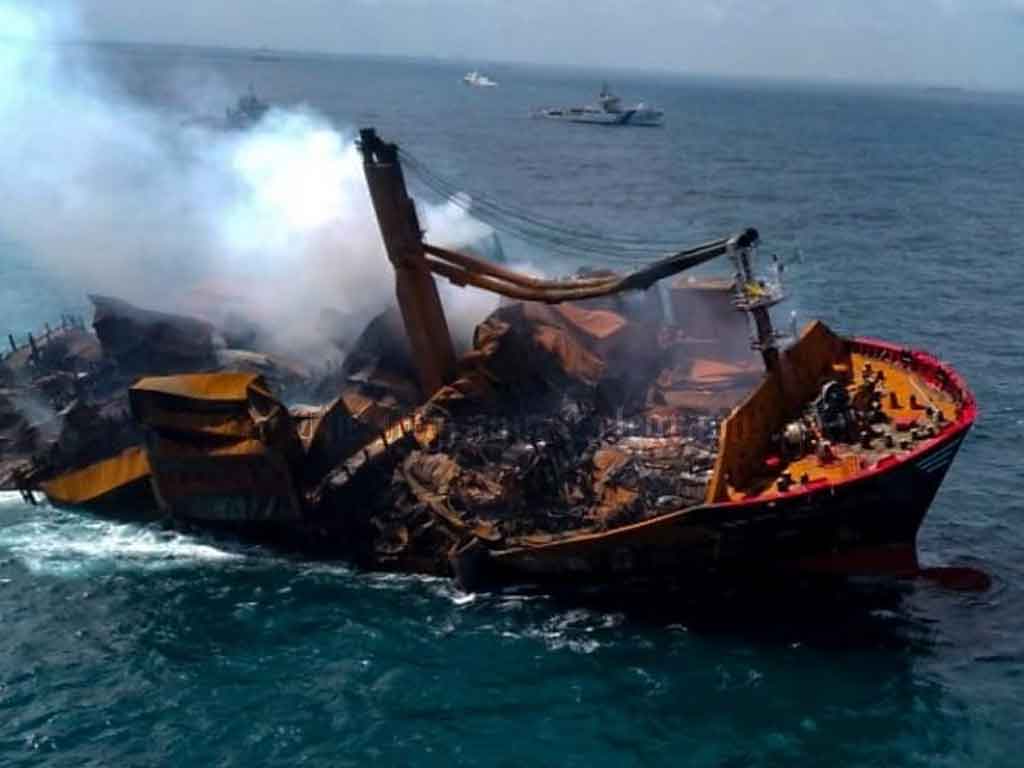
In a groundbreaking environmental verdict, Sri Lanka’s Supreme Court has ordered the owners of the MV X-Press Pearl to pay $1 billion in compensation. The court cited negligence by the ship’s captain, local agents, and key government officials who failed to act, causing the worst marine disaster in global history. Massive ecological and economic damage followed the 2021 blaze near Colombo. Criminal investigations are now underway, and a dedicated compensation commission has been ordered to aid affected communities.
In a landmark judgment, Sri Lanka’s Supreme Court ordered a staggering $1 billion in compensation from the owners of the MV X-Press Pearl, citing gross negligence, concealment of fire by the captain and local agent, and fundamental rights violations by top officials. The court slammed former State Minister Dr. Nalaka Godahewa, MEPA Chair Darshani Lahandapura, and the Attorney General for dereliction of duty, demanding urgent criminal and corruption probes into the country’s worst environmental disaster. The verdict marks a critical step in holding accountable those responsible for the 2021 chemical inferno that ravaged Sri Lanka’s coastline, devastated marine life, and crippled fishing communities.
The five-judge bench, headed by Chief Justice Jayantha Jayasuriya and comprising Justices Yasantha Kodagoda, Shiran Gunaratne, Achala Wengappuli, and Priyantha Fernando, issued the ruling after deliberating on four fundamental rights petitions filed by Archbishop Malcolm Cardinal Ranjith, the Environmental Justice Centre, and impacted fishing communities.
The MV X-Press Pearl, registered under the Singapore flag, caught fire on May 19, 2021, approximately 9.5 nautical miles from the Colombo Port. A day later, a violent explosion occurred on board. At the time, the vessel was transporting 25 tons of nitric acid and over 1,486 containers of chemicals and cosmetics. Within days, the ship was completely consumed by flames, releasing a cocktail of toxins into Sri Lanka’s territorial waters.
In delivering the 361-page verdict, the Chief Justice said, “This shipwreck caused the worst marine environmental destruction the world has ever seen. The western, southern, and even northern coasts were severely affected. It devastated livelihoods in fishing communities, especially in areas like Pamunugama and Negombo.”
The ruling singled out multiple parties for blame. The ship’s captain, its local representative company Sea Consortium Lanka, and the vessel’s Singaporean owners were held accountable for withholding critical information from Colombo Port officials, including the Harbour Master, despite receiving early warnings that the ship was on fire.
Moreover, the court found former State Minister Dr. Nalaka Godahewa, who was responsible for the environment at the time, guilty of violating the public’s fundamental rights. “He had a constitutional obligation to protect Sri Lanka’s coastal and marine ecosystems,” the judgment noted, “but he failed to take timely action.”
Similarly, former Marine Environment Protection Authority (MEPA) Chairperson Darshani Lahandapura, who was also a respondent in the case, was condemned for failing to convene MEPA’s board or take emergency measures as mandated by the Marine Pollution Prevention Act.
The Attorney General’s Department was also criticized for failing to pursue criminal action. “Filing a civil case in Singapore and another in a local High Court was inadequate,” the court said, arguing that criminal prosecution should have been the immediate priority in the aftermath of the disaster.
In response, the court ordered the ship’s owner to begin paying the $1 billion in damages before September 23, 2025, with the full amount to be settled within a year. The compensation is to be deposited with the Secretary to the Treasury and disbursed to affected communities, including fishers and coastal residents.
Additionally, the Supreme Court directed the Attorney General to launch criminal proceedings against all individuals found responsible for the incident. The Criminal Investigation Department (CID) has been instructed to initiate a comprehensive investigation within the next three months. Simultaneously, the Commission to Investigate Allegations of Bribery or Corruption must examine potential corrupt practices linked to the disaster.
To support affected citizens, the court ordered the formation of the “MV Express Pearl Compensation Commission,” which will process claims from victims. Another committee, led by the Secretary to the Ministry of Environment, has been tasked with implementing restoration measures for the damaged marine ecosystem.
The court will reconvene on September 25 to review progress on all issued directives and to ensure that justice, both environmental and civil, continues to be served.