An extraordinary development drive brought Bangladesh to the brink of middle-income status until political turbulence swept Sheikh Hasina from office in what critics now call a deep-state-engineered coup.
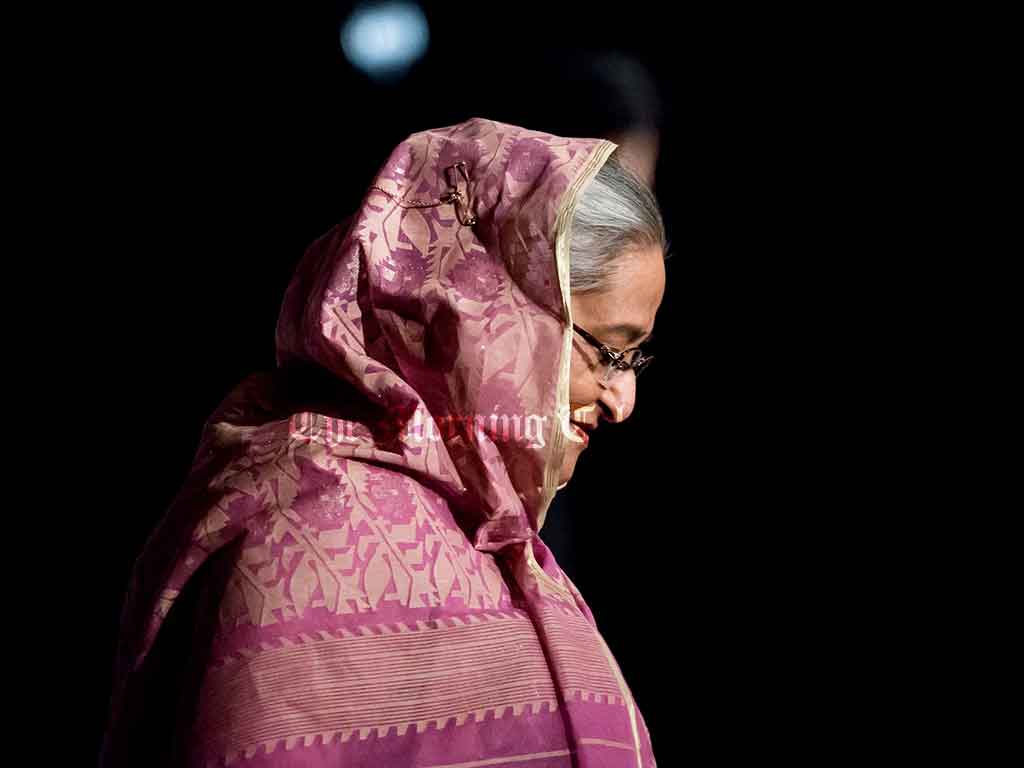
From August 5 to 8, 2024, Bangladesh experienced a seismic shift in power cloaked in silence. Sheikh Hasina—who had served as Prime Minister for over a decade and spearheaded one of South Asia’s most ambitious development agendas was abruptly removed from office following a wave of protests. Flown into exile, her departure marked not just a political exit but the unraveling of a legacy that had transformed a nation.
In her place, Nobel laureate Muhammad Yunus was installed as interim leader, allegedly with backing from foreign intelligence networks including the CIA and Pakistan’s ISI, according to widespread speculation. Despite the high stakes and global implications, international media, academic circles, and political leadership have responded with deafening quiet. The silence is not only curious it is troubling.
Reports suggest the Bangladesh Army, led by General Waker-uz-Zaman, pressured Hasina to resign, thereby dismantling a democratically elected government and initiating a transitional regime. Though the change appeared internal, many observers argue the real forces behind the upheaval were transnational, with Washington’s deep state playing a strategic hand. If true, this would represent one of South Asia’s most significant extra-constitutional regime changes in modern history.
Yet, Hasina’s fall from power cannot overshadow what she built. Her leadership guided Bangladesh through an unprecedented developmental transformation. From infrastructure megaprojects to strategic energy investments, Hasina redefined the country’s trajectory. Still, this monumental progress remains underreported, both at home and abroad. Why?
The reasons are multifaceted. First, geopolitics. Hasina’s balanced foreign policy steering clear of full alignment with any single global power may have alienated major international players. Second, media bias. Global coverage often filters Bangladesh through a lens of human rights concerns, ignoring the sweeping socioeconomic advancements. Finally, the chaotic scenes of the 2024 protests monopolized the news cycle, drowning out the country’s success stories.
At the core of Hasina’s legacy lies an impressive portfolio of infrastructure projects. The Padma Multipurpose Bridge, a 6.15-kilometer marvel funded without foreign aid, opened in June 2022 and has revolutionized trade between Dhaka and the country’s southwest. The Dhaka Metro Rail (MRT-6), the capital’s first metro, and the Dhaka Elevated Expressway have reshaped urban mobility and connectivity.
Further south, the Karnaphuli River Tunnel, South Asia’s first multi-lane underwater passage is poised to accelerate industrial expansion in Chattogram. The Rooppur Nuclear Power Plant, built with Russian cooperation, introduced nuclear energy into Bangladesh’s power grid with a capacity of 2,400 MW. And the Matarbari Deep Sea Port and Thermal Power Complex, expected to be operational by 2026, is primed to become a gateway for global trade.
Meanwhile, the Mirsharai Economic Zone (Bangabandhu Industrial City) has already attracted over US$1 billion in investment and promises to employ more than 775,000 people. Hasina’s vision extended beyond infrastructure: projects like the India–Bangladesh Friendship Pipeline and the Khulna–Mongla Rail Link underscored her commitment to regional integration, much of it in partnership with India’s Narendra Modi.
Defensively, the construction of BNS Pekua the country’s first submarine base has fortified Bangladesh’s naval reach in the Bay of Bengal. These aren’t symbolic accomplishments; they are the scaffolding of an emerging middle-income economy. Hasina’s development roadmap, titled “Smart Bangladesh 2041,” aimed to position the nation among the world’s top 30 economies through digital and environmental reforms.
Under her leadership, GDP soared from US$102 billion in 2009 to over US$416 billion in 2022. Per capita income tripled. The United Nations officially reclassified Bangladesh as a developing country. Export diversification, declining foreign aid reliance, and robust remittance inflows indicated a shift toward economic sovereignty.
But with her ouster, a darker narrative has taken hold. Political adversaries have launched a coordinated smear campaign, weaponizing unverified corruption allegations against Hasina and her family. The Anti-Corruption Commission has opened investigations into eight flagship projects. Simultaneously, the interim government has hired international firms to scrutinize contracts with companies like Adani Power and Chinese energy giants—moves seen by many as strategic attempts to tarnish Hasina’s reputation.
What’s equally disturbing is how the global media has latched onto these accusations while largely ignoring the underlying transformation Hasina orchestrated. The stories of cities unchoked by expressways, of industrial parks teeming with new jobs, of villages lit by newly installed power grids these have all taken a back seat.
Among her supporters, Hasina is revered as a modern Joan of Arc undaunted, visionary, and misunderstood. As the daughter of Bangabandhu Sheikh Mujibur Rahman, she inherited a legacy of resilience and national rebirth. Her supporters remember her not just as a policymaker but as a leader who embodied the aspirations of millions seeking prosperity through dignity and self-determination.
Her path from personal tragedy and imprisonment to national leadership is not just remarkable it is emblematic of the Global South’s complex journey toward self-reliance. Yet her forced removal, without due process or public accountability, robs history of a crucial chapter.
It is alarming that many global power brokers and intellectuals have chosen not to engage with this moment. Bangladesh sits at the crossroads of geopolitical rivalry, bordered by India, China, and the Bay of Bengal. It plays a critical role in the ideological tension between secularism and extremism. Ignoring the development story that unfolded under Hasina is to reduce a profound national transformation to a footnote.
There is an ethical responsibility to acknowledge what has occurred not to deify a leader, but to document a nation’s rebirth. Sheikh Hasina’s removal wasn’t just political drama. It sparked economic instability, refugee movements, and a crisis of legitimacy. Her infrastructure legacy now stands frozen, its future uncertain.
But legacies built in steel and stone do not vanish overnight. The bridges she built still stand. The power plants still run. The ports still open their gates to global commerce. Her vision lives on not as propaganda, but as concrete testimony to a decade of progress.
As the world averts its gaze, history must not. Sheikh Hasina’s leadership reshaped Bangladesh. Her era had its imperfections, but it represented one of the most significant post-colonial transformations in the Global South. Her name deserves remembrance not in veiled footnotes, but with the clarity, weight, and honor due to a leader who dared to build when the world expected her to beg.