A $1.2 billion India–Sri Lanka power grid project remains in limbo as discussions continue between ministries, despite strategic significance and two decades of planning.
The proposed Indo–Sri Lanka power grid interconnection project remains uncertain, with progress slowed by ongoing discussions and incomplete planning documentation.
Although reports surfaced claiming the Ministry of Energy had requested its removal from the Ceylon Electricity Board’s (CEB) long-term generation expansion plan, Energy Ministry Secretary Professor Udayanga Hemapala confirmed that the project has not been scrapped.
“The project remains in our plans. Implementation discussions are proceeding as scheduled,” Professor Hemapala stated, dismissing rumors of its removal.
However, the CEB has delayed formally including the project in its long-term generation plan until these technical and policy-level discussions are finalized.
CEB officials reiterated that the cross-border energy exchange initiative is strategically vital. CEB Media Spokesperson Dhammika Wimalaratne emphasized that the project would improve grid stability through interconnection and enable bilateral electricity trading between India and Sri Lanka.
A senior CEB engineer confirmed that a comprehensive technical report is being finalized for submission to the Indo–Sri Lanka Joint Working Group, which will determine the project’s future course.
Meanwhile, the Public Utilities Commission of Sri Lanka (PUCSL) confirmed that no formal project notification has yet been received. PUCSL Director General Damitha Kumarasinghe noted that the commission is awaiting official documentation before engaging further.
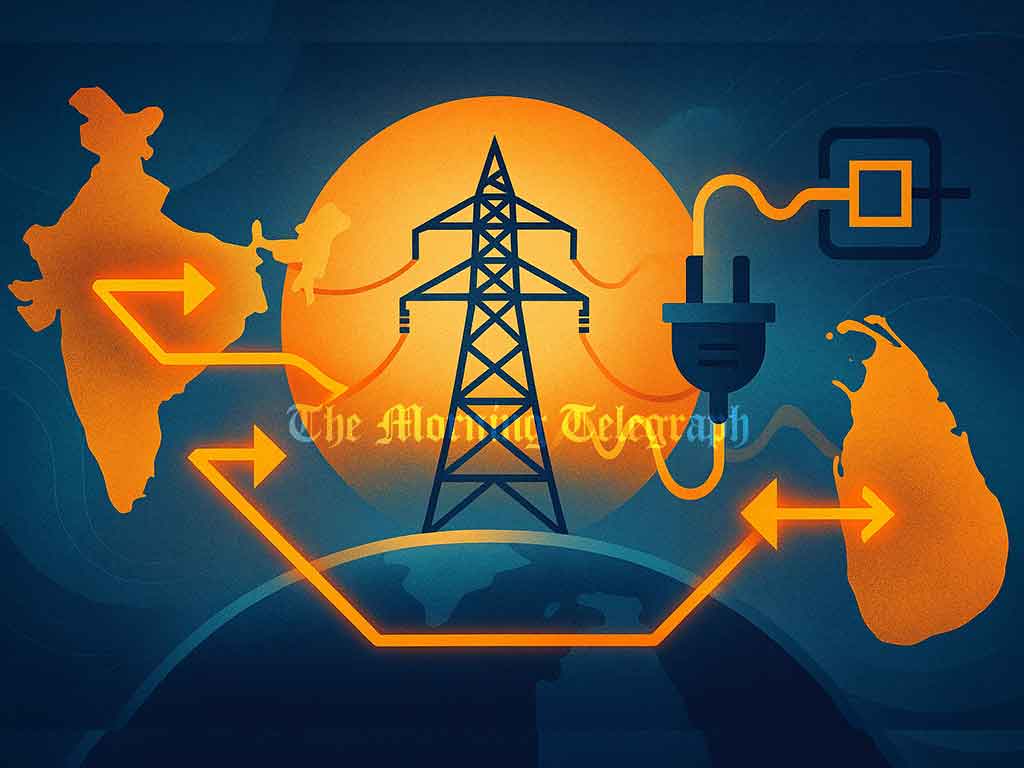
The India–Sri Lanka Grid Interconnection Project stems from a Memorandum of Understanding (MoU) signed during Indian Prime Minister Narendra Modi’s visit to Colombo. The MoU outlines the construction of a Voltage Source Converter (VSC) and a High Voltage Direct Current (HVDC) bipole transmission line connecting Madurai, India to Mannar, Sri Lanka in Phase I, with an initial capacity of 500 megawatts.
The project, valued at approximately $1.225 billion for Phase I alone, has a long history dating back to 2002. It began with a feasibility study supported by the United States Agency for International Development (USAID), followed by technical reviews from India’s Power Grid Corporation and formalized with an MoU in 2010.
Joint feasibility studies have since been conducted by the CEB, Power Grid Corporation of India, and the Asian Development Bank, exploring the technical, economic, and financial aspects of the grid integration.
In 2023, the location of Sri Lanka’s HVDC terminal was revised from Habarana to Mannar to better align with the country’s wind energy infrastructure. This change prompted a new feasibility review, including the consideration of a submarine cable.
The interconnection is designed in two phases, with the capacity expandable to 1,000 megawatts based on future demand. However, no firm decision has been reached on cost sharing or implementation timelines. Stakeholders continue to engage in complex discussions over the next steps.