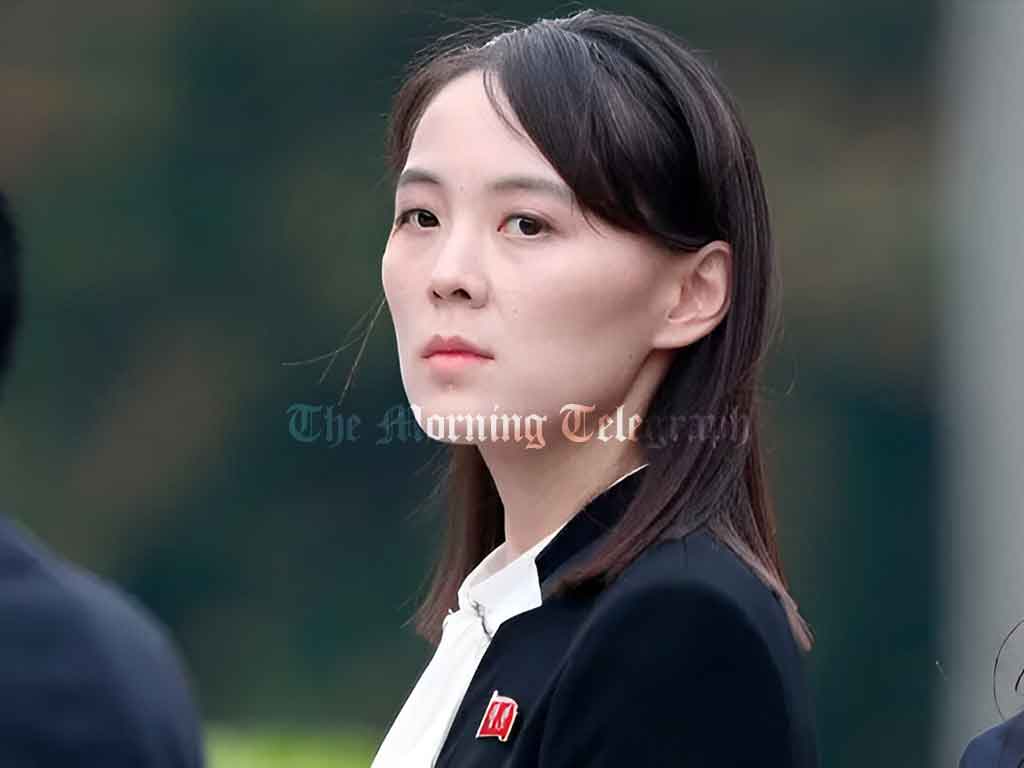
Kim Yo Jong, once a silent shadow behind North Korea’s throne, has now emerged as its fiercest voice, reshaping nuclear diplomacy, tightening ties with Russia, and redefining global threats. Her rise is not just symbolic, it marks a turning point in the regime’s future, pushing Pyongyang further into a new axis of power.
History in Northeast Asia moves slowly but when it turns, it turns with thunder. The rise of Kim Yo Jong, the most powerful woman in Pyongyang, may not only signal a seismic internal shift but also a global one.
Earlier this week, Kim Yo Jong delivered a blunt message: North Korea will no longer return to dialogue with South Korea and will only engage the United States on the condition of recognition as a de facto nuclear state. Her words, issued with surgical clarity, echoed far beyond the Korean Peninsula. On the surface, it sounded like another wave of Pyongyang’s usual rhetoric. But beneath that, a transformation in ideological posture and the very structure of the regime’s internal power architecture was underway.
Educated in Switzerland, Kim Yo Jong is more than the younger sister of Supreme Leader Kim Jong Un. She is no ceremonial consort or symbolic figure. As North Korea’s chief strategist, spokesperson, and guardian of military-diplomatic policy, she now holds a power that no woman in the country’s history has ever publicly wielded. Her rise is unprecedented, not only for its substance but for the way she commands attention shaping the nation’s global posture, especially amid a complex web of alliances and unconventional warfare.
Her early political grooming was evident long ago. Indonesian journalist Teguh Santosa, who has deep ties with Pyongyang, recalled a critical moment in 2012 during the unveiling of Kim Jong Il’s statue. Kim Yo Jong was seen coordinating the event down to its most intricate military details. Even then, she moved freely among the elite, orchestrating ranks and formations, a visible sign of control in a regime known for rigid hierarchy.
Today, her influence is fully visible. Whether issuing warnings of “irreversible rupture” to Seoul or dismissing Washington’s gestures as “only America’s wish,” she commands Pyongyang’s messaging with precision. These statements, crucially, come without provocation timed not as reactions, but as proactive framing of future diplomatic positions, shaped entirely on North Korea’s terms.
This pivot is all the more significant given the timing. North Korea is undergoing its fastest military evolution in decades. According to Ukraine’s HUR intelligence agency, North Korean troops have fought alongside Russian forces in Ukraine. Around 4,000 have reportedly been killed or wounded a steep cost. But in return, they’ve gained combat experience, exposure to drone warfare, missile upgrades, and skills in modern battlefield maneuvering and camouflage.
Once theoretical capabilities have now been battle-tested. Pyongyang’s KN-23 ballistic missile, for instance, is now drawing comparisons to Russia’s Iskander class an alarming trend for defense officials in both Washington and Seoul. More troubling, however, is Russia’s reported sharing of sensitive military technology, including nuclear submarine frameworks and missile-evading decoy systems.
North Korea, long a pariah nation, is now a strategic player in a new global axis with Russia and Iran, quietly observed by China. It is a silent realignment with loud consequences.
Beneath all of this lies a legacy soaked in betrayal and blood. During the Korean War, while hundreds of thousands of Chinese soldiers died on Korean soil, Stalin and the Soviet Union gained the strategic upper hand without sacrificing a single troop. That betrayal still echoes through Asian strategic thought today. One of the war’s most brutal moments occurred at P’aro-ho Lake in 1951. The South Korean army slaughtered an estimated 20,000 Chinese soldiers. Their bodies, dumped into the lake, stained its waters red. The event, renamed “Porok” by Syngman Rhee, was etched as a symbolic victory over what were once deemed “barbarians.”
This brutal memory continues to shape current alliances. North Korea has turned its gaze from Beijing to Moscow, seeking battlefield experience, weapons technology, and recognition not conditional aid or ideological lectures. Russia, in turn, has responded with a clear, transactional relationship that meets Pyongyang’s strategic needs.
Though North Korea’s ideological core sovereignty, security, survival remains unchanged, its foreign engagement has drastically evolved. While the United States clings to the assumption that denuclearization is still negotiable, Pyongyang has moved on. It seeks not dialogue, but acknowledgment. It seeks not reintegration, but validation as a legitimate nuclear power backed by powerful allies and military credibility.
Guiding this strategic transformation is Kim Yo Jong herself a woman discreet yet unyielding, shaped by both Western education and North Korean ideological rigor. She embodies the blend of Juche ideology and realist geopolitics. Her leadership does not signify reform but recalibration. Not liberalization, but focused modernization. She speaks rarely, but when she does, she redefines North Korea’s stance and the world listens.
This is not a simple dynastic change or a gender milestone. It is possibly the most transformative development inside North Korea in 50 years. Kim Yo Jong’s ascent fuses nuclear ambition with historical pain and feminine command, forming a potent axis of influence unlike anything Pyongyang has previously seen.
The bottom line remains: history in this region moves slowly but when it turns, it turns with thunder. Kim Yo Jong’s rise is not just powerful it is the sign that the world is turning with it.