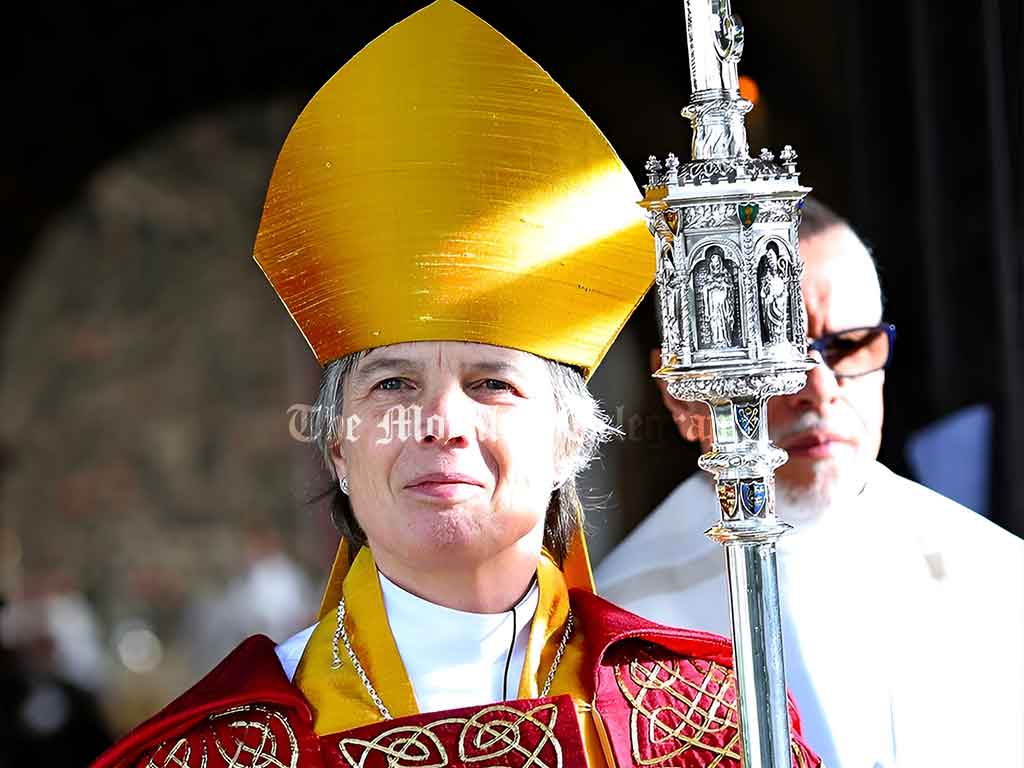
In a seismic shift for the Church in Wales and the global Anglican community, Cherry Vann becomes the first openly gay female archbishop, sparking celebration and controversy. Her appointment challenges centuries-old norms and opens a new chapter in the fight for inclusion and gender equality in religious leadership.
This is the story of the Immortal Diamond, the Cherry on the Knickerbocker Glory of Anglicanism. The Anglican Church in Wales has just elected its new primate, the Bishop of Monmouth, the Right Reverend Cherry Vann, aged 66.
Vann has a kind face, and most decent people would wish her well. What makes this story remarkable is that she has a long-time civil partner, Wendy Diamond. Vann revealed that it took her two decades to tell her parents she was gay. Her journey, marked by silence, courage, and identity, reflects the larger struggles faced by LGBTQ+ individuals in faith communities.
Imagine rewinding the clock just 30 years. The idea that an openly gay woman could become an archbishop would have seemed absurd to both conservatives and liberals. Today, some still see her appointment as a sign of chaos in the Anglican Communion. Yet, it is also a symbol of progress.
As the long and contentious search for a new Archbishop of Canterbury continues, Vann’s elevation forces reflection among those concerned about the church’s future. It’s noteworthy that another frontrunner is also a woman—the Right Reverend Guli Francis-Dehqani, the Iranian-born Bishop of Chelmsford, who, to public knowledge, is straight. The fact that two women are in serious contention shows how far the Anglican Church has come—or how far it’s been pushed.
Not everyone welcomes these shifts. Rose Hudson-Wilkin, the Bishop of Dover and former chaplain to the Speaker of the House of Commons, once declared that Anglicans who oppose female ordination should be forced to accept it. This aggressive stance seeks to abolish a long-standing provision allowing alternative bishops—commonly known as “flying bishops”—to serve parishes that reject women priests.
These alternative bishops ordain male priests and lead confirmations for congregations that still adhere to traditionalist beliefs. These Anglicans consider themselves part of the one holy catholic and apostolic church, just as Orthodox Christians or Roman Catholics do. To them, fidelity to doctrine is more important than conformity to modern trends.
It’s true that Catholic and Orthodox Christians continue to follow patriarchal traditions. While some argue these are misogynistic, they are also deeply rooted in centuries of theology and liturgy. Nonetheless, promoting Christian unity—especially when it comes to spreading the Gospel—may require acknowledging both the beauty and the brokenness in these divisions.
This is the context in which traditionalist Anglicans resist the ordination of women. The synod’s decision to allow flying bishops was a way to keep the Church from fracturing entirely. The global Anglican community has largely embraced women clergy. But in England, the fudge—an Anglican specialty—continues.
Elizabeth I, not Henry VIII, was more instrumental in shaping the Church of England as it is today. Founded on compromise, the church has always been a space for contradictory beliefs to coexist—Catholics, Protestants, and the in-betweens. But when it comes to women priests, fudge no longer works. A priest’s gender is a visible fact, and that makes the divide sharper and harder to reconcile.
If Bishop Hudson-Wilkin’s view prevails, many of the church’s most devout leaders and congregants—those who refuse to accept women priests—might be driven out. Some would return to Rome, others to isolated pockets of worship. Such a purge would be tragic and unnecessary. To be Anglican is to accept contradiction and paradox—to hold faith and doubt, tradition and change, all at once.
Rose Macaulay, a revered Anglican writer, once said no church could ever claim truth the way Roman Catholics do. This ambiguity is what makes Anglicanism uniquely capable of encompassing both sides of the debate over female ordination. Traditionalists cling to the apostolic legacy. Progressives argue that human understanding has evolved—and so must the church. Much of what once passed for morality, they say, was actually hypocrisy.
Jesus never explicitly mentioned homosexuality. He did, however, elevate women who were marginalized by society. Whether it was the Syro-Phoenician woman seeking crumbs from the master’s table, the widow with her last coin, the Samaritan woman at the well, or the unnamed sinner who wept at his feet—he honored those whom others dismissed. These women were not only seen by Christ; they were embraced.
Scholarship remains divided over whether women in early Christianity led congregations or administered sacraments. But it’s not unthinkable that they did. Women likely ran Saint Paul’s city churches in Corinth and Thessalonika. If they presided at the Eucharist then, why not now?
The deeper question is what today’s church says about God’s love. Does it grudgingly tolerate human difference—gayness, sexuality, gender—or does it celebrate the full humanity of all believers? Can it finally recognize that women, who have sustained the church for two millennia, are just as fit to lead it?
This is why Cherry Vann’s appointment stirred such joy. There’s something poetic in the symbolism—Cherry and the Diamond. It sounds like a parable. But beyond the wit lies a powerful truth: Vann’s rise signals what Anglicanism can still offer public life in an age of spiritual disillusionment.
The church may never regain its former size or influence, but it can still provoke, inspire, and reform. As a regular churchgoer, I don’t demand that the next Archbishop of Canterbury be a lesbian. But I would prefer it. If not a lesbian, then someone with the boldness to see what the role could be—not to protect the establishment, but to challenge it, from within and without.