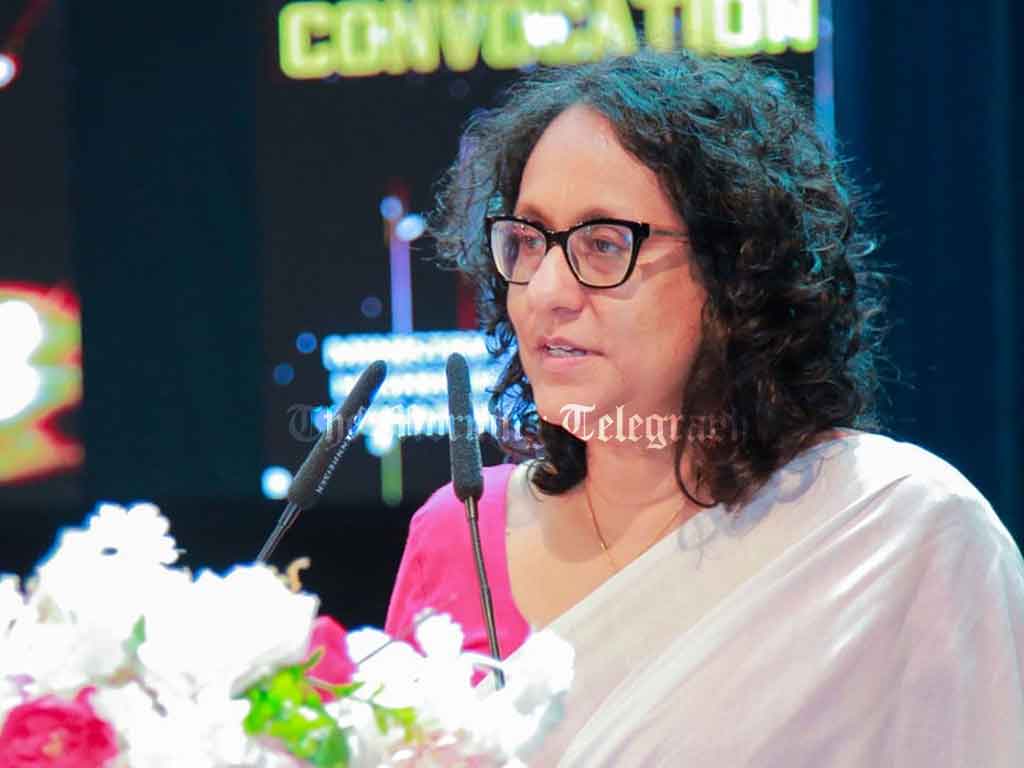
Prime Minister Harini Amarasuriya makes it clear that Sri Lanka’s sweeping education reform is not her personal agenda or President Anura’s, but a shared national responsibility. In a powerful address in the Northern Province, she outlines how the changes aim to transform the system for every child, school, and region step by step, starting 2026.
Sri Lanka’s Prime Minister and Minister of Education, Higher Education and Vocational Education, Dr. Harini Amarasuriya, clarified that the new education reform is not a personal initiative of hers or President Anura Kumara Dissanayake. Instead, she emphasized that it is a collective national duty to reshape the future of the country’s children through an inclusive, fair and visionary transformation of the education system.
Dr. Amarasuriya made these remarks at an awareness program held at the Northern Province General Secretariat Auditorium, where she addressed education officials about the goals and structure of the proposed education reform.
She noted that under the current education system, a child entering school in Year One often leaves without confidence or hope for the future. This system, she said, must be reimagined to nurture happy, hopeful children capable of becoming not only doctors and engineers but also artists, entrepreneurs, and responsible professionals across all fields. Schools must become spaces that promote holistic development, child-friendly teaching, and a sense of purpose.
“This is not a reform for one district or one province. Every province and region is important,” she stated, stressing the need for equal opportunity. “Equality starts by distributing resources fairly. It’s unacceptable to focus all infrastructure and staffing on one region while others remain neglected.”
Dr. Amarasuriya said that special attention would be given to underdeveloped and difficult-to-reach areas. This includes addressing teacher shortages and ensuring all schools are equipped with digital learning tools, modern classrooms, sanitation facilities, playgrounds, laboratories, innovation hubs, and aesthetic education units.
She emphasized that this reform includes a detailed, well-thought-out plan and is being launched with a phased approach, beginning in 2026 with Year 1 and Year 6 students. “We cannot wait ten more years for perfection. We need to start now and adapt along the way.”
The new reform framework prioritizes continuous assessment and a shift to a more child-centered teaching and learning model. The aim is to develop responsible citizens who contribute meaningfully to society.
Dr. Amarasuriya underscored that this reform must be a shared mission. “We are not doing this alone. We are holding a public dialogue, and we welcome input from everyone teachers, unions, professionals, university academics, and parents. All sectors of society must take part.”
She stressed the need for unity, stating that dividing schools into those under the central ministry and those under provincial control would only hinder progress. “All children in Sri Lanka are our children. This must be a united effort for the next five years.”
“We must not look at one component of this plan in isolation. This is a complete, structured reform of the education system. Let’s work together for our children,” the Prime Minister concluded.