From Black July to Chemmani’s skeletons, Sri Lanka’s turbulent July history resurfaces with painful truths. As Tamils still seek justice and India raises concerns, the island’s buried past continues to haunt its fragile peace.
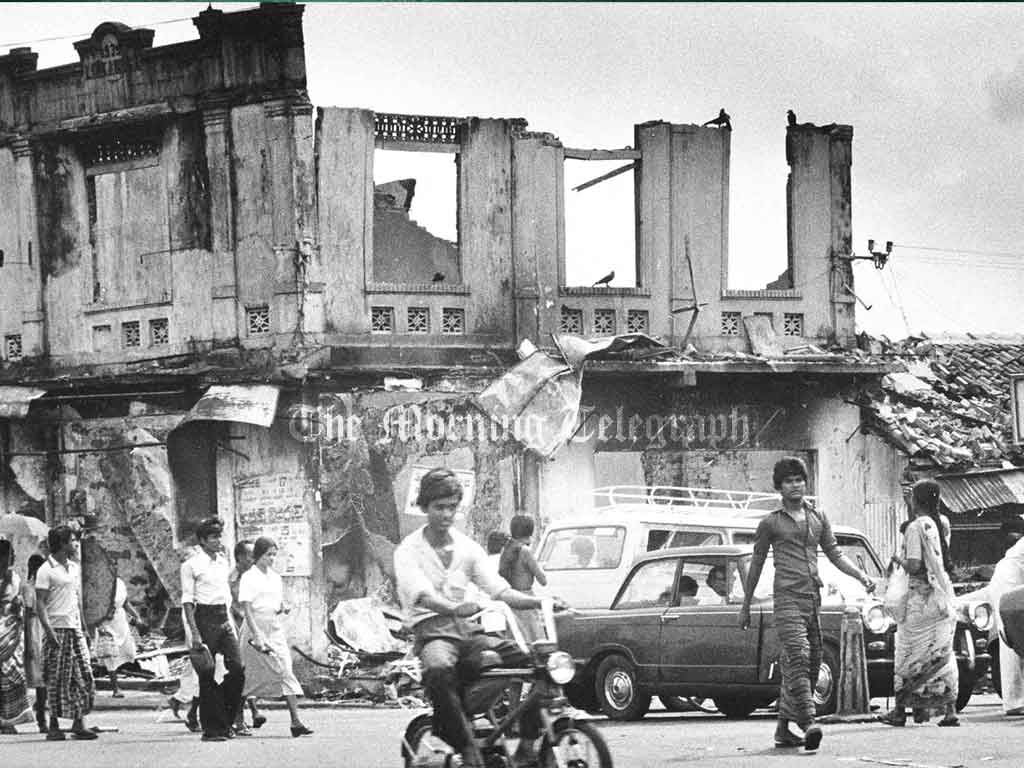
The month of July remains etched in Sri Lanka’s national memory as a time of irreversible historical shifts and unresolved trauma. Two of the most pivotal events that unfolded in this month, the Black July Pogrom of 1983 and the Indo-Sri Lanka Accord (ISLA) signed on July 29, 1987 continue to define the island’s fractured politics, ethnic relations, and its place on the global human rights map.
Black July was more than a pogrom. It marked the beginning of a violent transition from democratic protests by the Tamil minority to an armed insurgency seeking a separate state called Eelam. Orchestrated by Sinhala mobs with political backing, over 150,000 Tamils were displaced, and nearly 200,000 fled the country. Their destination: the Tamil diaspora across Canada, the UK, Australia, and Europe. In time, this diaspora would become a vital force in sustaining the LTTE’s armed struggle, lobbying for Tamil rights, and fueling the call for justice.
The ISLA, signed by President J.R. Jayewardene and Indian Prime Minister Rajiv Gandhi, attempted to quell tensions through limited Tamil autonomy. The creation of provincial councils under the 13th Amendment granted some self-governance in education, health, and housing, but not over land or policing. Tamils saw this as half-hearted devolution, and successive Sri Lankan governments only deepened that distrust through political stalling.
India’s involvement, once driven by moral responsibility toward Tamil refugees in Tamil Nadu, began to wane after Rajiv Gandhi’s assassination by the LTTE in 1991. Tamil influence in Indian politics has since declined, but New Delhi continues to raise concerns about devolution and reconciliation, most recently by Prime Minister Narendra Modi.
Meanwhile, the physical and psychological scars of war endure. Nearly 300,000 people died or went missing during the civil conflict. Among the most chilling reminders is the Chemmani mass grave in Jaffna. Discovered in 1998, it has yielded over 90 skeletons so far. No translator is needed to understand what it symbolizes: impunity.
According to international observers, Sri Lanka has among the highest numbers of unresolved enforced disappearances worldwide, between 60,000 and 100,000 cases. Each unearthed skeleton, every uncovered grave, further highlights Sri Lanka’s dismal record of war crime accountability. The United Nations Human Rights Council (UNHRC) has repeatedly raised the issue, but concrete progress remains elusive.
One man who tried to change this trajectory was civil rights lawyer Neelakandan Tiruchelvam. Murdered by the LTTE on June 29, 1999, he co-authored the GL-Neelan Package with then-minister GL Peiris an ambitious constitutional reform proposal aimed at resolving ethnic tensions. Though the package went further than the 13th Amendment, it was rejected by both Sinhala and Tamil hardliners, and Neelan paid the price with his life.
Tiruchelvam’s parliamentary speech on July 22, 1998 laid the foundation for credible mass grave investigations, including Chemmani. Drawing from the UN Model Protocol, he emphasized that exhumations should be treated as forensic crime scenes, supervised by trained anthropologists, and divided into three clear phases: antemortem data collection, archaeological excavation, and laboratory analysis. His recommendations remain largely ignored.
Another July martyr was Appapillai Amirthalingam, leader of the Tamil United Liberation Front (TULF) and former Opposition Leader. Gunned down by LTTE assassins on July 13, 1989, he had once symbolized peaceful Tamil advocacy. His death closed the door on democratic negotiation and further legitimized armed resistance.
July, then, is not just a monthit is a mirror. It reflects Sri Lanka’s cyclical violence, its political betrayals, and its moral failings. It is a time when buried truths claw their way back to the surface, demanding justice from a nation that has long avoided reckoning with its past.