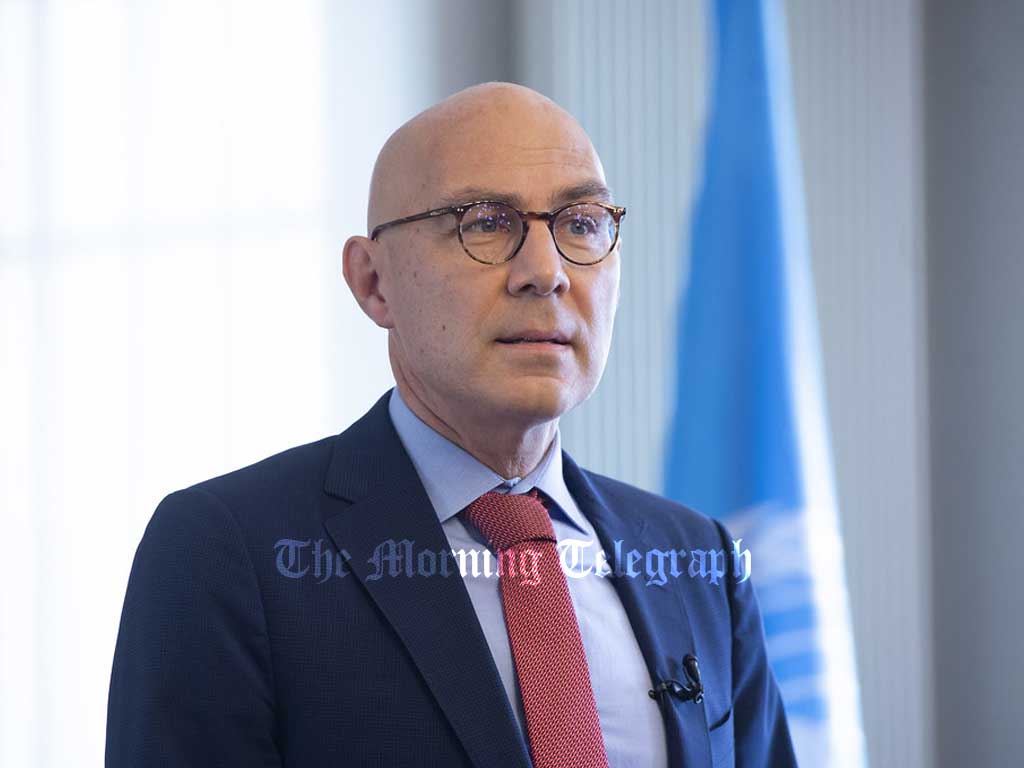
A hard-hitting UN Human Rights Office report calls on Sri Lanka to seize a “historic opportunity” to end decades of impunity, deliver justice for civil war-era atrocities, and implement deep reforms. UN High Commissioner Volker Türk urges the government to create a roadmap for accountability, repeal repressive laws, and protect victims’ rights warning that failure could prolong the nation’s cycle of violence and division.
The United Nations Human Rights Office has issued a powerful call for Sri Lanka’s Government to take decisive steps toward justice, accountability, and reconciliation, warning that the country stands at a turning point in its history.
The new report, released today, urges the administration to confront a legacy of entrenched impunity by implementing transformative reforms and delivering long-overdue justice for grave violations committed during the civil war and other periods of unrest. This includes addressing crimes committed by both State security forces and non-state armed groups such as the Liberation Tigers of Tamil Eelam (LTTE).
“Today, an opportunity presents itself for Sri Lanka to break from the past,” said UN High Commissioner for Human Rights Volker Türk. “The leadership has pledged to deliver justice, restore the rule of law, and end discrimination and divisive politics. It now needs a clear and comprehensive roadmap to turn these promises into reality.”
Türk stressed that this process must begin with formal acknowledgment of the abuses and crimes committed, alongside recognition of their enduring impact on victims and communities. Recounting his visit to Trincomalee, Jaffna, and Kandy, the High Commissioner said the suffering of victims remains “palpable,” with persistent demands for truth and justice.
The report advocates for sweeping structural reforms in Sri Lanka’s security sector, as well as constitutional, legal, and institutional changes in line with the country’s international human rights obligations. It emphasizes that such measures are critical to achieving “national unity” and preventing the recurrence of past violations.
While welcoming the government’s proposal to establish an independent Public Prosecutors office, the report also calls for the creation of a dedicated judicial mechanism with an independent special counsel to prosecute serious human rights violations and war crimes. Other recommendations include releasing military-held land in the north and east, repealing the Prevention of Terrorism Act (PTA), and freeing long-term PTA detainees some imprisoned for decades.
The UN further calls on the international community to support accountability and reconciliation both domestically and globally, urging member states to make use of the UN Human Rights Office’s strengthened capacity for accountability-related work.
Despite some openings for memorialisation and public debate, the report points to ongoing intimidation of civil society actors, especially those advocating for enforced disappearance cases, land rights, and environmental justice. Families of the disappeared face harassment and surveillance, while the PTA continues to be used despite pledges to repeal it.
The report highlights ongoing arbitrary arrests, torture, and deaths in custody, and calls for a moratorium on the PTA’s use. It also recommends revising or repealing laws that restrict freedoms of speech, assembly, and association, including the Online Safety Act, the ICCPR Act, the draft NGO Bill, and the draft Personal Data Protection Act No. 9.
Beyond human rights, the report examines the economic crisis’s toll, particularly on marginalized communities such as the Malaiyahar Tamils in the plantation sector. The UN urges international financial institutions and creditors to give Sri Lanka fiscal breathing room to meet its human rights obligations without undermining social protections through austerity.
Türk reiterated the UN’s commitment to supporting Sri Lanka in advancing human rights, accountability, and reconciliation, warning that failure to act decisively risks perpetuating the nation’s divisions and suffering.