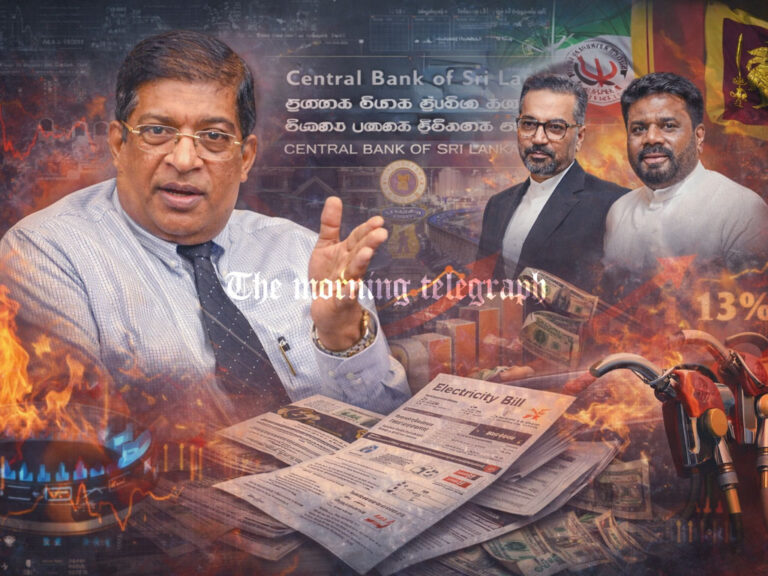
Sri Lanka is facing fresh economic turmoil as the government prints over Rs. 1.2 trillion in just nine months, driving debt up by Rs. 905 billion while foreign reserves plummet. Experts warn the country is on the path to another financial collapse.
The Sri Lanka Human Rights Center has sounded alarm bells, warning that reckless money printing, declining foreign reserves, and soaring domestic debt threaten to derail the country’s economic recovery and development goals.
From October 2024 to June 2025, the Central Bank of Sri Lanka printed Rs. 1,225.9 billion in broad money supply (M2b). Executive Director Rajith Keerthi Tennakoon warned that this unchecked monetary expansion, in violation of International Monetary Fund (IMF) conditions, risks dragging Sri Lanka back into a severe financial crisis.

Money Printing Surge
The breakdown of monthly money printing since the new government took power is staggering. In December 2024 alone, Rs. 234.8 billion was printed, followed by Rs. 233.9 billion in March 2025, the highest in the first six months. Even in June 2025, Rs. 210.3 billion was printed, expanding the money supply by 10.4 percent. These figures echo the dangerous excesses of the Gotabaya Rajapaksa regime, when unlimited money printing in 2022 triggered an unprecedented collapse.
Debt Burden Rising
The nation’s debt crisis has deepened. At the time of the September 2024 presidential election, Sri Lanka’s domestic debt stood at Rs. 17,595.05 billion. By April 2025, it had risen to Rs. 18,629.86 billion, an increase of Rs. 1,034.81 billion. Total domestic and foreign debt has now climbed from Rs. 28,574.65 billion to Rs. 29,480.39 billion.
While foreign debt shows a decline, this is largely because the state is increasingly relying on domestic borrowing through bonds. Yet investor confidence is clearly shaken. The Rs. 65 billion bond issue floated by the Central Bank on August 12 failed completely, with not a single bid placed for the 2032 bond offering 8 percent interest, a stark warning sign for the government’s borrowing strategy.
Foreign Reserves Decline
Reserves are also collapsing. Central Bank data shows reserves fell from $6,531 million in March 2025 to $6,080 million in June, before stabilizing slightly at $6,114 million in July. But when currency swaps are stripped out, Sri Lanka’s net foreign reserves fell from $2,799 million in March to just $2,210 million in June, a dangerous drop of $589 million within three months.
Compared to December 2024, when net reserves stood at $2,574 million, the decline by June 2025 was $364 million. These figures highlight a rapid erosion of the country’s financial buffer, leaving the economy dangerously exposed.
Looming Crisis
Observers fear a repeat of the 2021–2022 collapse, when warnings about excessive money printing, debt mismanagement, and falling reserves were ignored, leading to one of the worst financial crises in Sri Lanka’s history.
The Human Rights Center stressed that the Central Bank, Treasury, Ministry of Finance, and Parliament must act immediately to prevent a repeat of past mistakes. With Rs. 1.2 trillion printed in less than a year, debt rising by nearly Rs. 1 trillion, and reserves shrinking fast, Sri Lanka’s fragile economic stability is once again at risk.