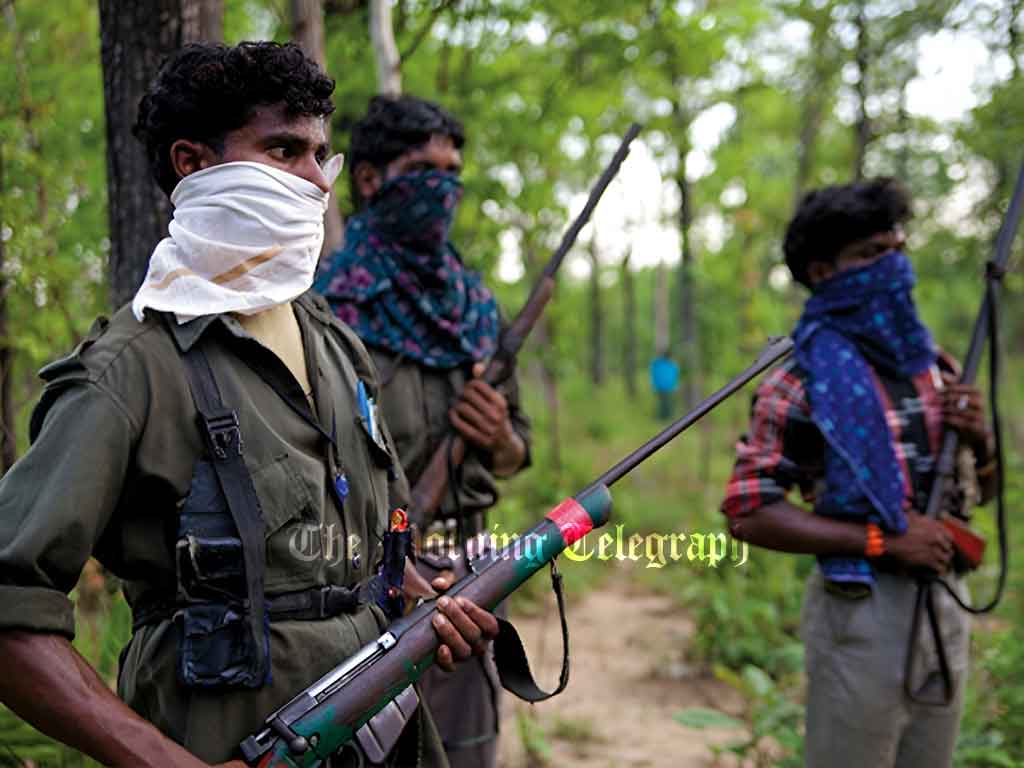
A fierce dawn gun battle in Jharkhand’s Saranda Forest ended with the death of a high-ranking Maoist commander, marking a significant blow to the CPI-Maoist’s hold in one of India’s most volatile insurgency zones.
In the early hours of August 13, 2025, the quiet of the Saranda Forest in West Singhbhum District was shattered by gunfire. Security Forces, acting on precise intelligence, engaged a heavily armed Maoist unit in the rugged hills of Souta under Goilkera Police Station. When the smoke cleared, one of the insurgency’s hardened fighters lay dead—Arun alias Varun alias Nilesh Madkam, a CPI-Maoist area commander hailing from Ka Enta village in Sukma District, Chhattisgarh.
Arun, wanted in multiple cases and carrying a bounty of INR 200,000, was a key figure within the Maoist hierarchy. Police reports suggest that he was part of a larger group of senior leaders including Misir Besra, Anmael, Maechhu, Anal, Asim Mandal, Ajay Mehta, Sagan Angaria, and Ashwin, who were regrouping in the Saranda-Kalhan belt to stage attacks ahead of Independence Day. Alongside them were several notorious squad leaders such as Ravi Sardar, Jaikant, Sandeep, Shiva, Risib, Uptan, Sanat, Amit Munda, and Bhuneshwar alias Saluka Kayam Somwari.

At dawn, a combined team of Chaibasa District Police and CoBRA 209 closed in. The Maoists opened fire at around 6:00 AM, sparking a heavy exchange that lasted several hours. Outgunned, the insurgents retreated deeper into the forest, leaving behind the body of Arun and a trove of weapons. Security Forces recovered four looted Self-Loading Rifles (SLRs), 527 live cartridges, nine SLR magazines, one Light Machine Gun (LMG) magazine, detonators, backpacks, Maoist uniforms, pamphlets, and other supplies, an indication of the scale of the insurgents’ operations.
This was not the first time Saranda had witnessed bloodshed this year. On April 12, 2025, Maoists triggered an Improvised Explosive Device (IED) in Radhapada Forest under Jaraikela Police Station, killing a Jharkhand Jaguar Constable and injuring a CoBRA Head Constable. A month earlier, on March 22, CRPF Sub-Inspector Sunil Kumar Mandal lost his life in a similar blast at Chhotanagra. With thousands of IEDs buried across Saranda’s dense undergrowth, every step for Security Forces remains perilous.
Figures from the South Asia Terrorism Portal (SATP) highlight the grim cost. As of August 17, 2025, West Singhbhum had recorded eight fatalities this year, including one civilian, two Security Force personnel, and five Maoists. In 2024, the toll stood at 17, while 19 were killed in 2023. Since March 2000, the district has witnessed 241 deaths linked to Maoist violence, with 82 civilians, 91 Security Force personnel, and 64 Maoists among the victims.
Arrests and surrenders have been rare. Not a single Maoist has surrendered in 2025 so far, and none have been arrested. From 2000 to 2025, security operations led to 340 arrests and only 22 surrenders. With the fall of Buddha Pahad, once a Maoist fortress, the insurgents have shifted their bases deeper into Saranda and the surrounding forested hills, making West Singhbhum a new epicenter of resistance.
Yet the campaign against them continues. On July 1, 2025, Police, CRPF, and Jharkhand Jaguar forces seized 18,000 detonators from Husipi village under Tonto Police Station. By mid-August, at least 24 recoveries of arms and explosives were documented in the district alone.
Jharkhand Chief Minister Hemant Soren announced in April 2025 that the state was in the “final phase” of its war against the Maoists. But senior officials remain cautious. Director General of Police Anurag Gupta, while reviewing security in Chaibasa on August 14, insisted that 95 percent of the Maoist menace had been neutralized, but acknowledged Saranda as a stubborn pocket of insurgency.
At least nine senior Maoist leaders remain at large, including Saluka Kayam alias Bhubaneshwar, Suleman Hansda, Sagen Angaria, Karan alias Dangur Tiu, and Sona Ram alias Sudesh Honhaga, each carrying bounties totaling INR 2.8 million. Their survival underscores the difficulty of eliminating Maoist influence in terrain that spans 5,351 square kilometers, more than half of it forest-covered.
The statistics are sobering. Since 2000, West Singhbhum has recorded 448 Maoist-linked incidents, including over 63 IED blasts. Despite advances, the insurgents continue to inflict casualties and sow fear. Experts argue that the answer lies not only in aggressive counterinsurgency but also in developmental outreach, roads, schools, healthcare, and livelihoods—to dismantle the socio-economic roots of rebellion.
For now, however, the Saranda Forest remains both a battleground and a symbol. Arun’s death is a tactical victory, but the larger war to reclaim Jharkhand’s heartland from decades of insurgency is far from over.