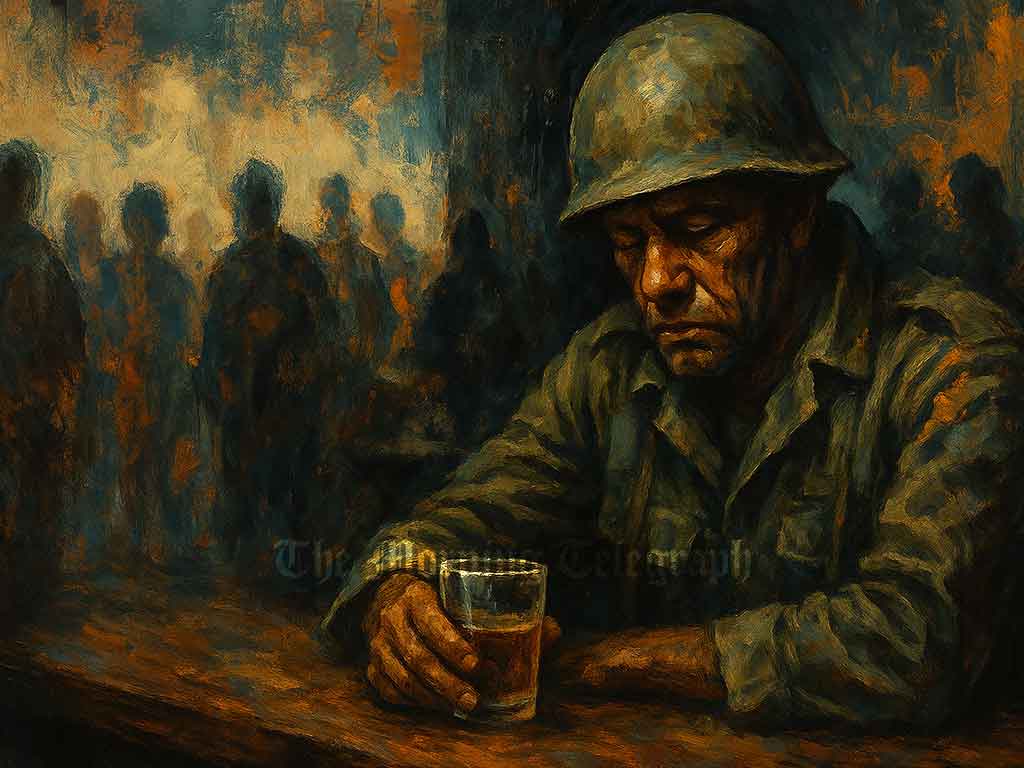
A searing reflection on the sacrifices of Sri Lanka’s veterans, whose courage ended decades of war yet left them invisible in a society that celebrates victory but neglects its warriors.
Sweet and fitting it is to die for one’s country, they said. Yet we live, carrying wounds that are unseen, enduring a society that cannot reconcile the paradox of survival with neglect. Veterans know that the pain they carry is neither poetic nor symbolic; it is raw, unrelenting, and often dismissed. They fought wars not for applause but because duty demanded it. It was their calling, one that exacted the highest toll upon body, mind, and spirit.
To witness comrades fall beside you, to carry the wounded across merciless terrain while the enemy’s gaze remained fixed, is no abstract notion of courage. It is the reality of those who endure not only the chaos of combat but also the haunting spectres of guilt, loss, and survival. Men in uniform, their faces etched with anguish, confronted destruction in oceans, jungles, and mountains alike. Thirty years of vigilance finally eradicated the enemy in May 2009. But victory did not translate into recognition. The commercialised euphoria of peace, the political manoeuvres of elites, and the selective applause of the world rendered their sacrifices invisible.

The global community, quick to preach human rights, remained silent when children were conscripted into war and when women became tools of terror. Innocents suffered while distant capitals toasted to their comforts. History is filled with such ironies. After the First World War, soldiers who returned from the trenches found neglect instead of gratitude. Kurdish fighters in Syria were celebrated only when it was politically convenient, then left abandoned.
Today, the Sri Lankan veteran is a forgotten figure. Society remembers them only by the medals they wear. Loyalty, honour, and sacrifice are relegated to sentimentality, reshaped by the tides of politics. Conversations among veterans reveal bitterness. One laments that Sri Lankans are ungrateful. Another claims they were born in the wrong land. A third mutters that their service achieved nothing. These are not exaggerations but echoes of decades of service answered with indifference. The first casualty of war is truth, but the second is recognition, and the third is dignity.
Justice, too, becomes a contested ground. Veterans recognise that if wrongdoing occurs outside the conflict, proper judicial procedure must follow. Arrest and investigation must define the nation’s response, not suspicion or vendetta. Yet narrative often substitutes for fact, and vendetta becomes convenient. It is easier for societies to bury inconvenient truths than to uphold justice.
John F. Kennedy once said that gratitude must not only be spoken but lived. It is precisely this living gratitude that Sri Lankan veterans have been denied. In contrast, the GI Bill in post-war America transformed soldiers’ lives with housing, education, and employment. It recognised that soldiers are not merely instruments of war but citizens who must be reintegrated into society. The island known as the Pearl of the Indian Ocean could do well to remember such lessons.
Poetry, too, speaks to this burden. Wilfred Owen, from the mud of the Western Front, rejected the old lie: Dulce et decorum est pro patria mori. Sweet and fitting it is to die for one’s country, they said. Yet the soldier lives, wounded, enduring a society that fails to honour his survival.
Operations etched into memory remain uncelebrated. Amphibious assaults, jungle patrols, counter-insurgency campaigns like Operation Jayasikuru demanded moral fortitude and endurance. Each night raid, each close-quarter encounter where hesitation meant death, demanded sacrifice. Yet these stories vanish from public memory, replaced with sanitised narratives designed not to offend or challenge.
The world’s history shows the same dissonance. The Gurkhas fought for Britain with unmatched bravery but received fair recognition only after long struggles. The Kurdish peshmerga were celebrated when convenient, abandoned when they were no longer useful. Societies valorise soldiers in rhetoric but forget them in practice.
Even literature acknowledges this paradox. Ernest Hemingway’s A Farewell to Arms depicted soldiers whose personal suffering was eclipsed by the machinery of war. Likewise, Sri Lankan veterans find their sacrifices buried in rhetoric, their scars ignored. And still, they persist. They endure loneliness, invisibility, and societal amnesia.
Anger follows reflection. Veterans are asked to forgive, to move past bitterness. But how does one forgive a society that denies their existence? How does one reconcile the sacrifices of fallen comrades with the trivialisation of their memory? Forgiveness becomes a private solace, not a public reality.
The world celebrates victories selectively. Elites enjoy freedoms while soldiers are vilified or forgotten. Michel Foucault’s idea of power, exercised through narrative and authority, is evident here. Soldiers, once the guardians of sovereignty, are reduced to relics when their stories become inconvenient.
Veterans live with memory as both shield and burden. Memories of fallen friends, of moral choices imposed by circumstance, of the loneliness that comes when a nation forgets. Behind the bar, a veteran sits not in leisure but in confrontation with a society that has turned away. The pain they carry is existential, not just physical. It is the erosion of recognition, the rewriting of history, the amnesia of a nation that demanded everything of them.
The truth is simple. Veterans served because it was required. They sacrificed because it was demanded. And now they are invisible. As Owen wrote, they curse the old lie of dying for one’s country while surviving in neglect. Yet they endure with dignity, because without it, survival becomes unbearable.
The lament of being a veteran in an ungrateful nation is not mere complaint. It is a moral indictment and a historical critique. It is urgent and inescapable. Until a nation lives by the words of Kennedy, until it honours the living as much as it celebrates ideals, veterans will remain trapped between sacrifice and oblivion, witnesses to a society unwilling to pay its true debt.