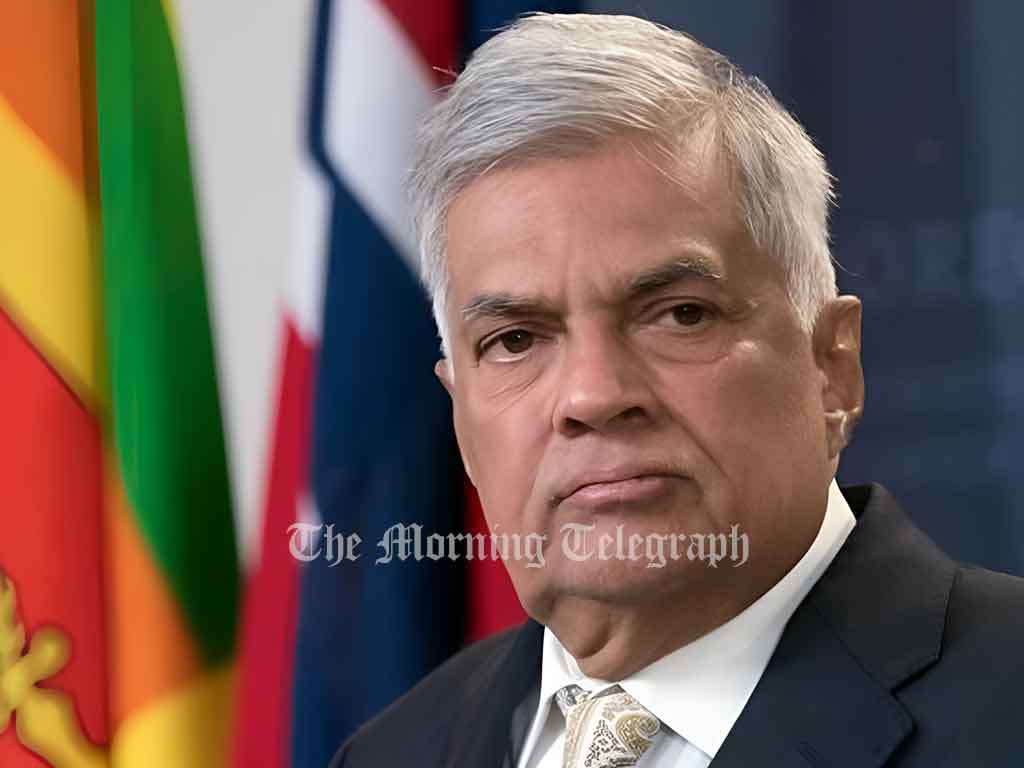
The arrest of former President Ranil Wickremesinghe has ignited a political firestorm, exposing what critics call the pathological immaturity of the current government, more reliant on spectacle, propaganda, and vendetta than meaningful reform.
If justice were applied without bias, could the Secretary of Law and Order remain in office after being apprehended for drunk driving while his case drags unresolved? If fairness were truly upheld, could the Energy Minister continue in power while corruption allegations swirl around him? The list of unresolved scandals in this administration stretches beyond measure. Against this backdrop, the sudden arrest of Wickremesinghe appears at first to be routine enforcement of law. Yet on closer examination, it reveals the reckless immaturity of the JVP/NPP regime now commanding the country.
This is a government that substitutes meaningful reform with contrived crises, targeted arrests, and endless propaganda designed to reinforce its hold. Its pursuit of senior leaders such as Wickremesinghe signals a wider strategy: distract the people, weaken opponents, and control the national narrative. With decades of experience and deep insight into Sri Lanka’s political cadence, Wickremesinghe recognises this cycle well. Having endured the brutal insurgency of the JVP and its waves of terror in earlier decades, he now faces a new performance of political theatre, modernised with digital sophistication and shielded by state-backed impunity.

His contributions cannot be ignored. As one of Sri Lanka’s most seasoned statesmen, Wickremesinghe has weathered both existential and institutional crises, confronted the terror unleashed by the JVP in the late 1980s, and worked to stabilise a polity fragmented by division. Yet today his long career is reduced to a prop in the theatre of a government unwilling to generate substantive reforms. The immaturity of the current regime surfaces not in serious policymaking, but in propaganda drives, symbolic arrests, and legalistic showmanship. Political theatre has overtaken the practical work of governance.
History offers telling parallels. The Roman Emperor Tiberius thrived by inventing conspiracies to terrify elites and entrench his authority. Byzantine rulers engineered trials and purges to eliminate rivals, while maintaining the appearance of justice. The JVP/NPP regime appears to be cut from the same cloth, employing social media actors, pliant institutions, and intimidation to silence critics while real issues, economic decline, corruption, collapsing infrastructure — remain untouched. What results is a government addicted to spectacle, while the people and institutions of Sri Lanka bear the cost.
Seen in this light, Ranil’s arrest is not a mere legal action but a calculated political maneuver: an effort to neutralise a veteran critic, deter other challengers, and craft a diversion from government failings. When YouTubers can sway the criminal justice process, when armed groups operate without consequence, when killings are whispered about unchecked, and when the state drowns the public sphere with hollow propaganda, governance mutates into theatre. The country is trapped between staged performance and lived reality, its legitimacy steadily eroded by the gap between what rulers enact and what they claim.
In this context, Wickremesinghe emerges as a rare continuity: a witness to Sri Lanka’s cycles of insurgency, terror, and vendetta politics. He has been accused, he has survived, and he has contributed to the architecture of governance. By contrast, the present administration reveals its immaturity in its dependence on spectacle, punishment, and narrative manipulation to disguise its fragility. Instead of advancing reforms, strengthening institutions, or addressing deep inequities, it exploits fear and propaganda to suppress dissent and control perception.
The irony is striking. A country burdened with economic collapse and social upheaval finds itself ruled by a government whose primary energy is expended on vendetta, theatrics, and hollow legality. History warns of the futility of such tactics. From the purges of Rome’s elite to the sham trials of Byzantium, rulers who weaponised law secured only fleeting obedience, while planting the seeds of instability. By corroding trust in institutions, weaponising the state for political ends, and targeting leaders like Wickremesinghe, the JVP/NPP administration risks not only domestic alienation but international condemnation. The very methods deployed to cement power may ultimately destroy the foundations of its legitimacy.
Thus the arrest of Ranil Wickremesinghe is more than a personal drama; it is a mirror of the pathology consuming Sri Lanka’s politics. A government addicted to symbolism and reliant on propaganda reveals its immaturity by preferring spectacle to reform, vendetta to vision, and performance to policy. The lessons are ancient but relevant: fabricated crises can weaken opponents and distract the public for a time, but without structural competence and principled leadership, they guarantee eventual instability and decline.