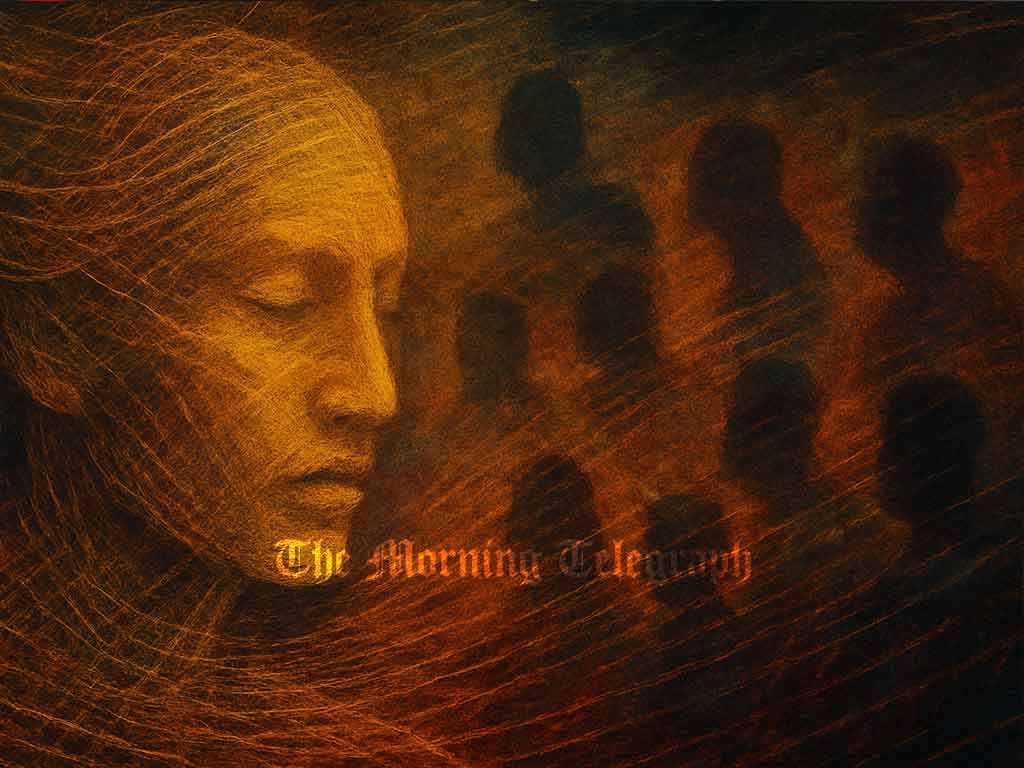
Joy and sorrow, kindness and arrogance, all are threads, but none are the fabric itself.
By Roshan Jayasinghe
This article is Part II of the three-part reflective series, The Pre-Recognition of Our Suffering. In Part I, I explored the dual currents of energy that shape the outer flow of life. In this second piece, the focus turns inward — to the weave of our human conditions, and how thought carries them across past, present, and future.
There are moments when a song holds a mirror to our lives.
Teddy Swims & P!nk’s “Tomorrow” feels like one of them.
It reaches into the weight of what has been carried,
the ache of what is here now,
and the fragile hope of what might come next.
It sings of suffering,
of love that endures,
of pain that softens into possibility.
And listening, I feel how deeply music reminds us
of what it means to be human.
Because when I look at life,
I notice that every condition,
sorrow and joy, kindness and arrogance,
pain, euphoria, anger, forgiveness,
hope and despair, fear and courage,
love and loss,
is held by the same thread.
Thought weaves past, present, and future,
and lays them over our feelings
like a tapestry we mistake for life itself.
We suffer,
we rejoice,
we hope,
we fear.
But beneath it all,
life is simply here,
waiting to be seen as it is.

The Past: Shadows That Linger
The past is never gone;
it arrives each day in memory.
Sadness comes as the echo of loss,
joy as the glow of a childhood laugh.
Arrogance clings to remembered victories,
while regret whispers of mistakes replayed.
Love, too, is often carried as memory:
a hand once held,
a voice now silent.
The past itself does not hurt us.
What hurts is our insistence on carrying it forward,
on turning echoes into weights.
A song on the radio.
A familiar street corner.
In a breath, memory returns,
and with it, the emotion of a time long gone.
The past is not here.
But thought makes it present again.
The Present: A Moment Covered in Commentary
Life, in this very moment, is simple.
A sound.
A breath.
The light on a table.
Yet rarely do we let it stay simple.
We measure it, judge it,
wrap it in commentary.
This should not be happening.
This is not enough.
This must last forever.
Even kindness, when it arises,
becomes a story: I am good for being kind.
Even arrogance takes the same form:
This proves my worth.
The present itself asks nothing of us.
But thought adds layer upon layer,
until we live more in the story
than in the moment itself.
It is as though life is a clear window,
and thought fogs the glass
with its breath of judgment.
The Future: The Horizon of Imagination
The future is not here,
and yet it shapes us constantly.
Hope stretches us forward:
A better day will come.
Fear pulls us back:
Something terrible awaits.
Excitement trembles in anticipation,
anxiety in dread.
Even love is caught in projection:
Will it stay?
Will it fade?
I remember walking alone one evening,
my mind racing ahead,
worrying about conversations not yet had,
events not yet real.
And in that rush toward what was not yet,
I missed the beauty of what was:
the sky flushed with dusk,
the cool air against my face.
So much of our suffering
is not about what is happening now,
but about what we imagine may come.
We suffer twice,
once in thought,
and again, perhaps, in reality.
The Tapestry of Conditions
When I step back,
I see that all of these,
suffering and joy, kindness and arrogance,
pain, euphoria, fear, courage,
hope and despair,
are threads in the same weave.
Each arises.
Each passes.
The colors differ,
but the loom is always the same:
memory, commentary, imagination.
Without these,
joy would be pure and fleeting.
Sadness would come honestly and go.
Pain would be felt but not multiplied.
Love would not cling in fear of loss.
It is not the condition itself that binds us,
but the story thought tells around it.
Recognition
And yet, there is a shift,
small, quiet, but profound.
When we notice the weaving itself.
When sadness comes,
and we see not only sadness,
but also thought’s thread carrying it forward.
When joy arrives,
and we feel it deeply,
yet recognize how quickly thought rushes in:
Hold onto this, don’t let it go.
Recognition is not escape.
It does not cancel humanity.
It does not strip us of love or sorrow.
It simply opens a space,
a breath between thought and self,
where we are no longer fully entangled.
In that space, conditions still arise,
but they pass more freely.
Sadness softens.
Joy becomes lighter.
Love flows without fear.
Recognition is the gentle loosening
of the thread.
Closing: Toward Silence
So I return to the song.
Its voices carry longing,
but also resilience.
And I realize life offers us the same,
not certainty,
but the invitation to see.
If Part I revealed the dual currents of energy,
and this part the weave of our human conditions,
then the next reflection turns deeper still, to the silence that holds both current and thread.
About the Author
Roshan Jayasinghe writes about consciousness, nature, and the unfolding of human experience. His reflections invite readers to pause, question, and return to the quiet clarity within. He contributes regularly to Morning Telegraph.