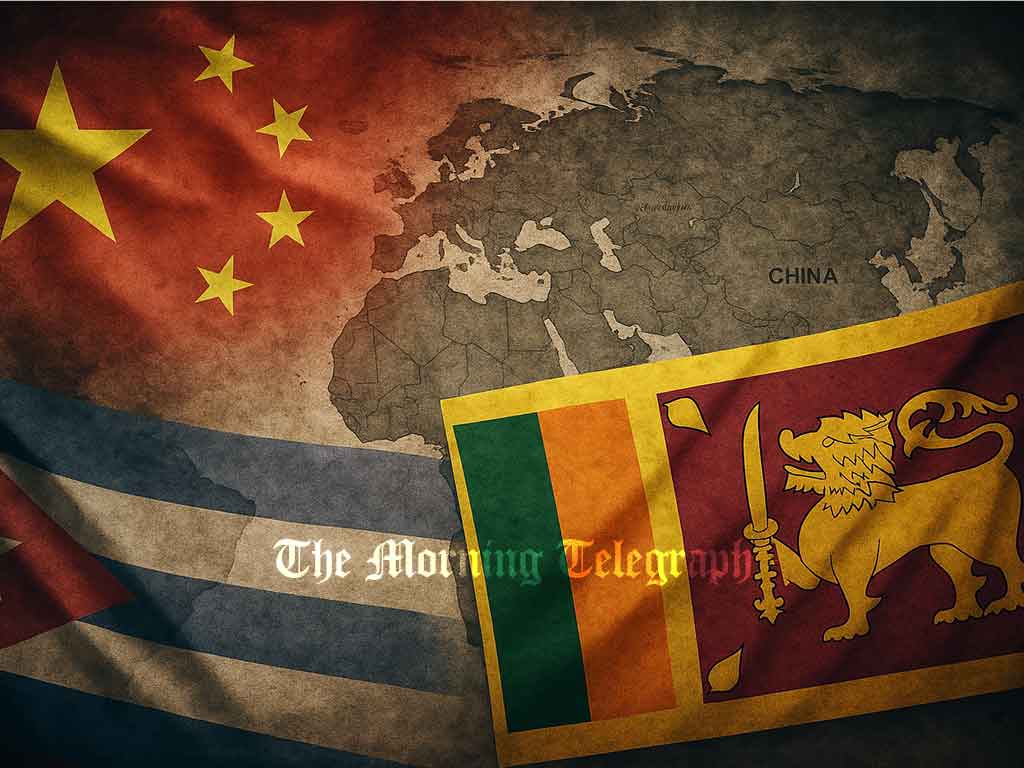
Sri Lanka’s decision not to attend the Shanghai Cooperation Organization (SCO) Summit in China has triggered debate, with the Ministry of Foreign Affairs citing lack of an invitation and the Cabinet Spokesperson pointing to the President’s busy schedule. Analysts argue the absence exposes cracks in foreign policy at a critical global moment.
At a time when global attention was fixed on China, Sri Lanka’s absence from the Shanghai Cooperation Organization (SCO) Summit became a major talking point among citizens and political observers. With no Sri Lankan representative present, questions quickly surfaced as to why the country stayed away from such a high-profile gathering.
On social media, Sri Lankans shared a range of opinions. One Facebook user described the government’s choice not to attend as a “good decision,” arguing that participation could have triggered potential risks such as higher tariffs under former U.S. President Donald Trump’s policies. Others claimed that Sri Lanka did not have an appropriate representative to send, pointing to a lack of preparedness.

A Divided Debate on Foreign Policy
Media expert and lawyer Dr. Viranjana Herath also defended the decision in a Facebook post, writing that in today’s turbulent global climate, Sri Lanka should follow a time-tested path of neutrality rather than align with one power bloc.
Senior diplomat Dr. Dayan Jayatilleke offered a very different assessment, describing the absence as reckless. He likened Sri Lanka’s foreign policy to a ship lost at sea during a political storm, warning that the government was failing to navigate the global stage with a clear direction. “The government does not seem to operate with an understanding of world politics,” he cautioned. “If India and Pakistan, sworn enemies in South Asia, participated, why could Sri Lanka not send at least one representative?”
Ministry of Foreign Affairs: “We Were Not Invited”
The Ministry of Foreign Affairs presented its official explanation during a BBC Sinhala inquiry. Thushara Rodrigue, the Ministry’s Director General and Media Spokesperson, stated that Sri Lanka had not been invited. “We cannot attend without an invitation. China maintains strong ties with us. The President recently visited Beijing, and the Prime Minister is scheduled to visit next month. That is why China did not see the need to extend an invitation this time,” he said.
Rodrigue emphasized that China renews its strategic partnerships on a rotational basis, suggesting that Sri Lanka was not excluded but simply overlooked in favor of other invitees.
Cabinet Spokesperson Offers a Different Answer
Cabinet Spokesperson Minister Nalinda Jayatissa, however, gave a conflicting response. Speaking to journalists, he suggested that the President may have opted out due to an already full international travel schedule. When pressed about the Ministry’s explanation, he admitted he was unaware of it.
This discrepancy between the Ministry and the Cabinet Spokesperson has fueled speculation over whether Sri Lanka deliberately stayed away or was diplomatically sidelined.
Foreign Minister’s Response to Xi Jinping
Amid the controversy, Foreign Minister Vijitha Herath issued a statement endorsing Chinese President Xi Jinping’s proposals at the SCO Plus meeting in Tianjin. “I positively noted the global development, security, and civilizational initiatives, as well as the global governance initiative, based on principles of sovereign equality, multilateralism, rule of law, people-centered development, and action-oriented cooperation,” he stated, signaling Sri Lanka’s continued support for China’s global vision.
What is the Shanghai Cooperation Organization?
The SCO originated in 1996 as the Shanghai Five, with China, Russia, Kazakhstan, Kyrgyzstan, and Tajikistan. It was officially established in 2001 after Uzbekistan joined. Over time, the group expanded, admitting India and Pakistan in 2017, Iran in 2023, and Belarus in 2024, bringing membership to ten.
It also includes two observer states, Mongolia and Afghanistan (currently inactive) and 14 dialogue partners such as Sri Lanka, Turkey, Nepal, Egypt, Saudi Arabia, and the UAE. Covering 80 percent of the Eurasian landmass and 40 percent of the global population, it is the largest regional organization in the world.
The 25th SCO Summit opened in China on September 1, drawing over 20 world leaders, including Modi, Putin, and Xi. While Sri Lanka’s absence did not affect the summit’s outcomes, it has sparked a heated domestic debate about whether the country is missing vital opportunities to engage with major global powers.