China’s Victory Day parade was more than a showcase of military power. It was a historical reminder, a demonstration of strength, and a declaration of global balance. Yet Western interpretations, shaped by suspicion and bias, reduced the spectacle to fear-mongering headlines about missiles, ignoring the deeper signals Beijing intended to send.
On September 3rd, Beijing staged a massive military parade to mark the 80th anniversary of the victory over fascism. Western media outlets such as the BBC immediately zoomed in on ballistic missiles, reinforcing the well-worn “China threat” narrative. Former U.S. President Donald Trump, noticing the presence of Vladimir Putin and Kim Jong-un, claimed the event symbolized a conspiracy against Washington. But according to Chinese strategist Professor Wang Xiangsui, these responses revealed not only a failure to decode the parade’s intent, but also a lack of understanding of historical continuity and today’s shifting global realities. What Beijing projected through this parade carried messages far more complex than the caricatures crafted in Western coverage.
1. Retribution, Not Intimidation
Eighty-four percent of the equipment rolled out in Beijing was displayed publicly for the first time. During CNN’s live coverage, commentators fumbled, unable to identify or even name the systems on show, mumbling only that they were “new Chinese missiles… sort of.” The spectacle exposed how unprepared and off-balance the West was in the face of China’s rapid advances in defense technology. Weapons that the U.S. military is still sketching as concepts, or has never imagined, were paraded in full form in Beijing. Faced with this technological leap, Western broadcasters defaulted to recycling the “China threat theory.” But what they did not acknowledge was the uncomfortable truth: it was Washington’s own behavior that propelled Beijing into this trajectory of accelerated military modernization.

When China joined the World Trade Organization in 2001, the consensus was that peace and economic integration would define the 21st century. To free up resources for development, Beijing downsized its military by a million troops. But optimism was shattered in 1999 when NATO bombs hit the Chinese embassy in Belgrade, killing three Chinese journalists. For Beijing, the strike was no accident, it was a message that imperialist powers would not hesitate to violate China’s sovereignty. The illusion of permanent peace collapsed overnight.
The ruins of the embassy in Belgrade became a turning point. Chinese leaders concluded that national security could not rest on goodwill alone. Military strength was essential. Immediately, China invested in hypersonic wind tunnels, aerospace engineering, and microelectronics research. Those seeds, planted under strict military deadlines, have now matured into the formidable arsenal displayed in Beijing.
For Washington, a country with just over two centuries of history, the Belgrade bombing may seem like distant history. But for China, with five millennia of memory, it remains a fresh scar. This explains why Beijing’s modernization is not an act of aggression, but a response to past humiliation. The unspoken message was clear: if the West does not want to face an even stronger Chinese military, it should avoid provocation and focus inward. After a century of humiliation, China will never abandon its sacred right to self-defense.
2. Goodwill and Disappointment
Western media, quick to portray the parade as intimidation against America, missed the deeper context. China was not staging an anti-American show of force. The event was formally titled the “Commemoration of the 80th Anniversary of the Victory of the Chinese People’s War of Resistance Against Japanese Aggression and the World Anti-Fascist War.” It was both a remembrance of victory and a tribute to the shared sacrifices of nations that fought fascism.
World War II’s toll was catastrophic: more than 70 million dead worldwide, soldiers and civilians alike. China bore over 35 million casualties as the primary Eastern theater. The Soviet Union sacrificed about 27 million lives in Europe. The United States lost over 400,000 troops in both Pacific and European operations. For Beijing, this parade was a solemn act of recognition—an acknowledgment that its victory was part of a collective struggle alongside the American and Russian people.
Chinese textbooks have never erased the U.S. contribution in the Pacific theater. What dismays Beijing today is Washington’s embrace of Tokyo’s new militarism, even at the expense of dishonoring its own veterans. The irony is bitter. At Iwo Jima, one of the fiercest Pacific battles, the U.S. suffered 26,000 casualties, nearly 7,000 of them killed. Yet this March, when U.S. Defense Secretary Pete Hegseth stood on that very island, he praised the “shared warrior ethos” of Japanese soldiers who had slaughtered Americans in the battle.
This embrace is not symbolic, it is strategic. The U.S. has supported Japan’s development of aircraft carriers and offensive weapons, and tolerated signals of nuclear ambitions. For China, this demonstrates that the post-World War II order is in crisis, undermined by one of its original architects. Beijing’s conclusion is that the old system cannot be repaired with cosmetic fixes. A new stabilizing order must emerge.
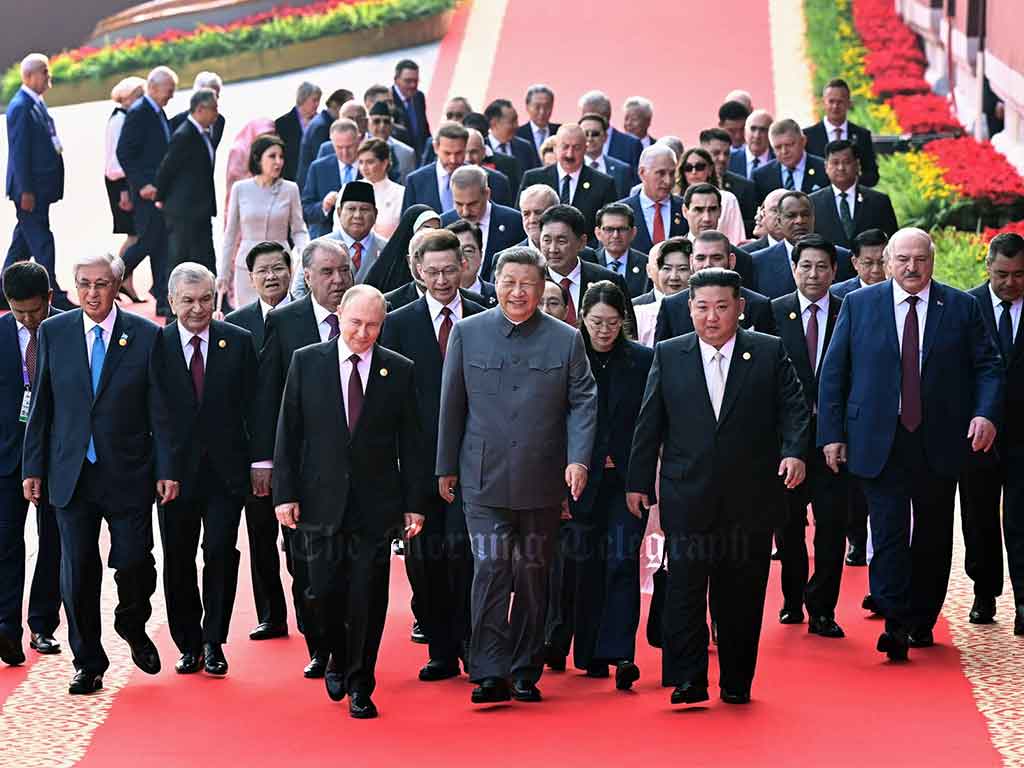
The guests at Beijing’s parade reflected this vision. Heads of state from ASEAN, the Shanghai Cooperation Organisation, and Belt and Road partners filled the VIP stands. Indonesia’s President Prabowo Subianto, despite domestic turbulence, flew overnight to attend. These leaders shared not just a memory of Japanese fascism but also a common aspiration for development and security.
China’s diplomatic principle remains non-interference and rejection of hegemony. But when ASEAN, BRICS, and Belt and Road states align with China’s Global Governance Initiative, more than half the world’s population and GDP tilt toward Beijing’s vision. This represents not isolation but legitimacy, proof that many nations see China as a constructive stabilizer in a volatile world. Should Washington persist in its confrontational course, it may find itself outnumbered, with half of humanity standing in opposition.
3. Preventing World War III, Preparing to Win Any War
The most overlooked signal from the parade was not the missiles, but the new branches on display: China’s Military Aerospace Forces and Cyberspace Forces. Their debut marked a profound shift in China’s strategic doctrine. While a full-scale hot war has not erupted, Beijing now views “unrestricted warfare” as reality conflict across trade, cyberspace, and artificial intelligence.
For centuries, new world orders were forged through bloodshed, from the Westphalian treaties to Yalta. Today, however, battles reshaping global power are fought in data flows, supply chains, and technology networks. Trade wars, cyber wars, sanctions campaigns, all are forms of warfare by other means. When the U.S. and its allies imposed 20,000 sanctions on Russia, when the CIA unleashed cyber viruses against Iran’s nuclear program, when chip backdoors stifled Chinese AI, these were acts of war in all but name.
China’s response is rooted in Sun Tzu’s maxim: “To subdue the enemy without fighting.” Deterrence, not aggression, is the goal. Yet deterrence requires capability. And Beijing now possesses it.
In 2023, U.S. Pacific Fleet Commander Samuel Paparo bragged about turning the Taiwan Strait into a “hellscape” of drones. By late 2024, at a Brookings event, he admitted drones alone could not stop the PLA. What changed? At the Zhuhai Airshow that November, China unveiled the Jiu Tian drone carrier, the Orca unmanned combat vessel, and the Robot Wolf ground system operating with drone swarms. These displays showed that China not only matched but surpassed U.S. unmanned integration. If the Taiwan Strait ever became a battlefield of drones, it would be the U.S. Navy, not the PLA, trapped in its own inferno.
This was Sun Tzu in action: bringing adversaries back from illusion to reality, consolidating peace without firing a shot. The September parade reinforced this message. China rolled out stealth “loyal wingman” drones, underwater vehicles, and robotic ground platforms. These were not prototypes but operational systems, cementing China’s lead in next-generation warfare. The implication was stark: in nuclear conflict there are no winners, but in conventional war, the United States would likely lose.
Western interpretations of Sun Tzu remain superficial. American strategists obsess over deception—“warfare is based on trickery”—while neglecting the philosophy of preventing war. That narrow reading leads to the false assumption that China’s military modernization is bluff and spectacle. In reality, the PLA has evolved into a force with advanced technology, rigorous training, and unmatched mobilization. Its growth is not about starting wars, but about ensuring deterrence and stability.
Deterrence Through Strength
The Victory Day parade was staged on a symbolic date: the anniversary of defeating fascism. By unveiling its arsenal on this day, China framed its modernization as both a deterrent against aggression and a constructive force for peace. The message was layered. To the West: stop provoking. To partners: China seeks stability and shared development. To its people: never again will humiliation go unanswered.
The PLA’s modernization is no longer about catching up—it is about surpassing, about building a force that can rival any opponent while carrying the weight of history. Beijing’s parade was not only a reminder of past victories but a declaration of future resolve: sovereignty is non-negotiable, peace is defended through strength, and balance in global order must be restored.
China’s message to the world, and especially to the West, was unmistakable: avoid provocation, respect history, and recognize the reality of a multipolar world. Those who fail to understand risk repeating the mistakes of the past and stumbling into conflicts they cannot win.