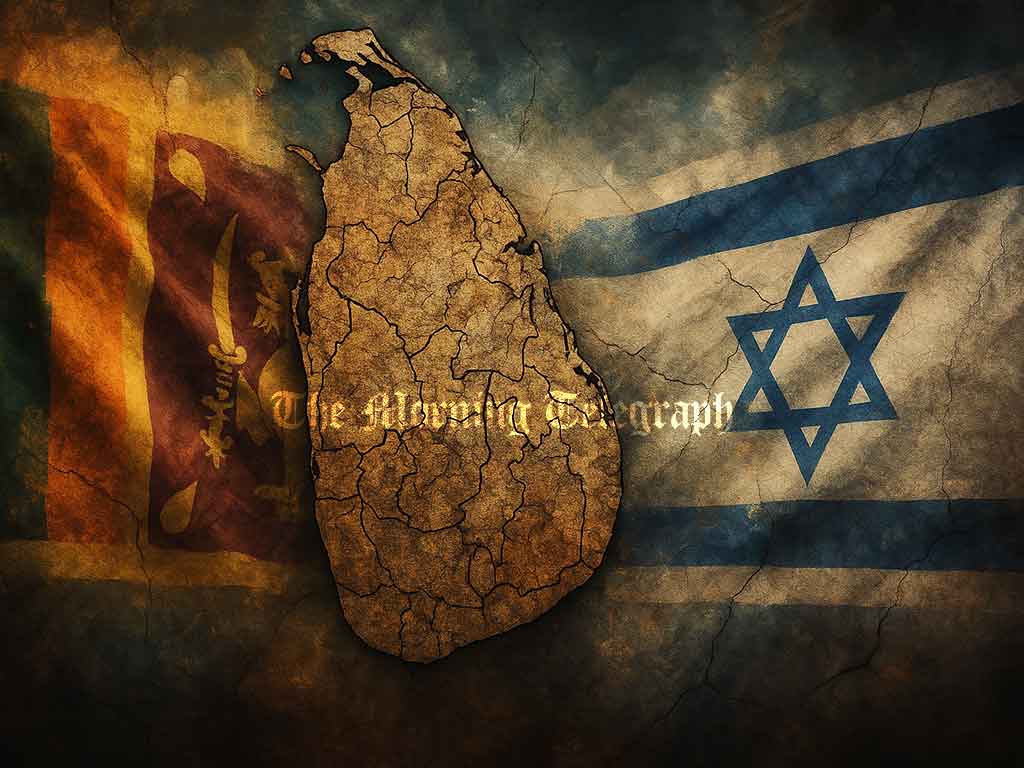
The uproar over Sri Lankan journalists visiting Israel reveals less about ethics and more about orchestrated outrage, exposing how selective morality and partisan agendas twist journalism into a weapon of manipulation.
A storm has erupted over a recent visit by Sri Lankan journalists to Israel. What began as a fringe “scandal,” spread by a journalist dismissed from the BBC Sinhala service for questionable affiliations, has spiraled into full-blown hysteria. Opportunistic social media posts, selective reporting, and orchestrated outrage have fueled the fire. The Sri Lankan ambassador in Israel, whose online posts amplified the issue, was cited in reports that triggered a cascade of vitriol against Israel. This is a classic case of manufactured consent: amplify outrage, censor inconvenient truths, and narrow the space of acceptable opinion. As Chomsky and Herman observed, the way to keep people obedient is to limit what they are allowed to think. Colombo’s frenzy illustrates that principle in action, where perception is shaped while genuine inquiry is suppressed.
The irony becomes sharper when recalling the words of the father of the journalist who stoked this scandal. After the Easter Sunday bombings of 2019, he excused the terrorists responsible for slaughtering civilians. He claimed that “containers of swords imported to Sri Lanka” were not weapons for killing, but tools for trimming mosque grass. At a time when the nation mourned hundreds of innocent dead, this framing attempted to normalise terror within arbitrary lines. Yet the same public that tolerated such moral evasion now rages against journalists for visiting Israel. This is not about journalism; it is about selective outrage dressed up as principle, and it sets a dangerous precedent for societies that claim to value truth and accountability.

The intensity of the animus toward Israel raises another question: who fuels these campaigns, and why must certain media portray Israel as the permanent villain? Across the Middle East, nations from Iran to Saudi Arabia routinely host foreign journalists to tell their version of events. Israel does the same, yet suddenly it is branded propaganda, brainwashing, or influence-buying. This double standard exposes the deeper reality: it is not about truth-seeking but about preserving a one-sided narrative that serves ideological and financial interests. The protests in Colombo were no spontaneous eruptions; they were staged performances of outrage, crafted not to illuminate but to inflame.
Journalism should serve investigation, not partisan agendas or virtue signaling. To argue that Israel cannot “tell its side of the story” is absurd. Every embassy hosts foreign journalists. Israel’s narrative—of survival amid terrorism, of relentless attacks by Hamas, of democratic debate within its own society—deserves the same scrutiny. Yet conspiracy rhetoric insists on caricatures: Israel as eternal oppressor, Palestine as perpetual victim. This simplification erases nuance and silences uncomfortable truths.
Sri Lanka, scarred by decades of civil war and by the 2019 Easter bombings, should understand the weight of consequence. Israel faced the Hamas attacks of October 7 with responses some label violent, yet can any nation claim innocence when confronted with such orchestrated savagery? To demonise Israel while excusing similar acts elsewhere is not ethics—it is selective memory, a historical amnesia of the most dangerous kind. As Churchill reminded, “History will be kind to me for I intend to write it.” For journalists, the responsibility is to resist rewriting history for ideological gain. To deny Israel’s narrative is not neutrality but censorship under the mask of morality.
Behind the uproar lies a machinery of ideological distortion. Conspiracy theories, selective narratives, and partisan agendas are deployed to smother inconvenient truths. Ironically, the same voices now furious about Israel visits once excused Islamic terrorism in Sri Lanka itself. They resist the other side of the story because it threatens the neat binaries they promote: good versus evil, victim versus oppressor, Palestinian versus Israeli. Such binaries are easy but false. The public deserves more than this curated outrage.
The implications are stark. If journalists are intimidated from visiting Israel, the public is robbed of the chance to grasp reality in its full complexity. Observing Israel does not mean endorsing its policies—it means witnessing, reporting, and analyzing. Yet this basic function of journalism is treated as betrayal. Meanwhile, outlets that downplayed or rationalised terror now rage at fact-finding trips. The hypocrisy is staggering.
This debate is not about defending Israel but about defending Sri Lanka’s right to honest journalism. The nation must resist being manipulated by one-sided narratives or conspiratorial distortions. Only through multiple perspectives can citizens navigate the shifting geopolitics of our era. Visits to Israel should not be scandalous—they should provoke thought. They should challenge assumptions, surface inconvenient truths, and reclaim the role of journalism as a searchlight rather than a mouthpiece.
Sri Lanka’s journalists must remain free to witness both sides without fear of vilification. The hysteria against Israel reflects a deeper insecurity within certain political and social factions: they cannot tolerate contradiction, cannot tolerate nuance, cannot accept moral equivalence. Yet for a nation that has endured terrorism, propaganda, and manipulation, the call for courageous, independent reporting has never been louder. Journalism must not only report facts but witness them—even when uncomfortable or inconvenient.
So the question remains: is visiting Israel a sin? If journalism exists to illuminate reality instead of reinforcing ideology, the answer is no. It is not only allowed—it is necessary. Sri Lanka, shaped by conflict and manipulation, cannot afford to embrace curated outrage. To see reality in all its complexity is not optional; it is duty. Manufactured outrage, moral posturing, and selective condemnation must be rejected. Only then can Sri Lanka’s journalists—and the public—reclaim the right to truth.
Visiting Israel is not a sin. The true failure lies in refusing to understand why it matters, in ignoring broader truths, and in surrendering to orchestrated outrage instead of facing reality.