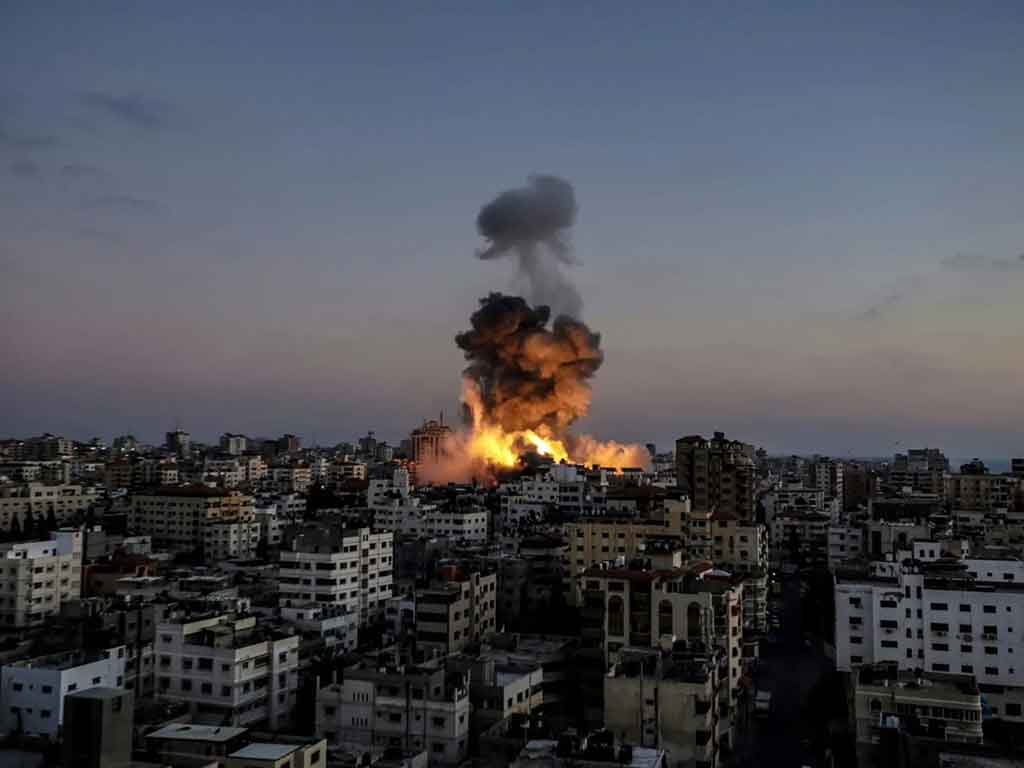
With Gaza City under heavy bombardment and famine looming, Israel says the war could end instantly if Hamas surrenders and frees hostages, but Hamas refuses without a full Israeli withdrawal.
Israel once again urged Hamas to surrender on Sunday as its military intensified strikes on Gaza’s largest urban centre, where hundreds of thousands of Palestinians are trapped in dire conditions.
Foreign Minister Gideon Saar declared in Jerusalem that the conflict could end immediately if Hamas agreed to release the remaining hostages and lay down arms. “We will be more than happy to reach this objective with political means,” he stated.
Hamas, however, rejected the demand. Senior official Basem Naim told Reuters that while the group would release all hostages if Israel ended the war and withdrew from Gaza, it would never disarm, reiterating a long-held position.

Israel’s assault on Gaza City, launched last month, has brought its forces within just a few kilometres of the city centre. Overnight airstrikes killed 14 people, including civilians sheltering in a school. The Israeli military insisted the target was a Hamas militant and claimed civilians were warned beforehand.
“We want a ceasefire, end this war before Gaza City is turned into ruins like Rafah,” pleaded Emad, a Gaza City resident, who asked that his surname not be published. “How many lives are going to be wasted? Enough is enough.”
The weekend bombardment demolished two high-rise buildings housing displaced Palestinians. Israel alleged the buildings were being used by Hamas, though no evidence was presented. Hamas denied the claims.
Prime Minister Benjamin Netanyahu had previously ordered troops to seize Gaza City, where international monitors warn of looming famine. Tens of thousands of Palestinians have already died in the conflict, triggered by Hamas’s October 7, 2023 attack that killed 1,200 Israelis and saw 251 abducted. Of those hostages, 48 remain in Gaza, with around 20 believed to be alive.
Israel maintains that the war will only end if Hamas disarms, releases the hostages, and agrees to step aside from Gaza’s governance. Hamas counters that hostages will only be freed in exchange for an Israeli withdrawal and a permanent ceasefire.
Danish Foreign Minister Lars Lokke Rasmussen, visiting Jerusalem, urged Israel to “change course” over the humanitarian catastrophe. He pressed for injured Gazans to be allowed medical care in the occupied West Bank and East Jerusalem, but Saar rejected the idea, asking why Denmark could not treat them directly.
Meanwhile, U.S. President Donald Trump said Washington was engaged in “very deep” negotiations with Hamas. Hamas’s Naim cautiously welcomed the comments but offered no confirmation of active talks.
On the ground, civilians face impossible choices. Many Palestinians have fled Gaza City for the south, joining hundreds of thousands already crammed into makeshift tent camps, while others refuse to leave after multiple displacements. The military has continued to warn civilians to move south despite the severe overcrowding.
Hamas has offered temporary hostage releases in exchange for short ceasefires, similar to negotiations that collapsed in July. Pressure is mounting on Israel domestically as well. Tens of thousands protested in Tel Aviv on Saturday night, joining families of hostages demanding an end to the war and the release of captives.
“We want to call for change and for peace. To bring them home because the government won’t do it,” said Nimrod Cohen Bar-Eli, 29, at the rally.
For now, Israel continues to pound Gaza City, Hamas refuses to disarm, and the humanitarian crisis worsens—leaving the war without a clear end in sight.