Nepal is reeling from its deadliest protests in decades as violence, arson, and clashes with security forces leave dozens dead and over a thousand injured. Gen Z protesters say their peaceful movement against corruption and social media bans has been hijacked by opportunists, while the resignation of the prime minister deepens political uncertainty.
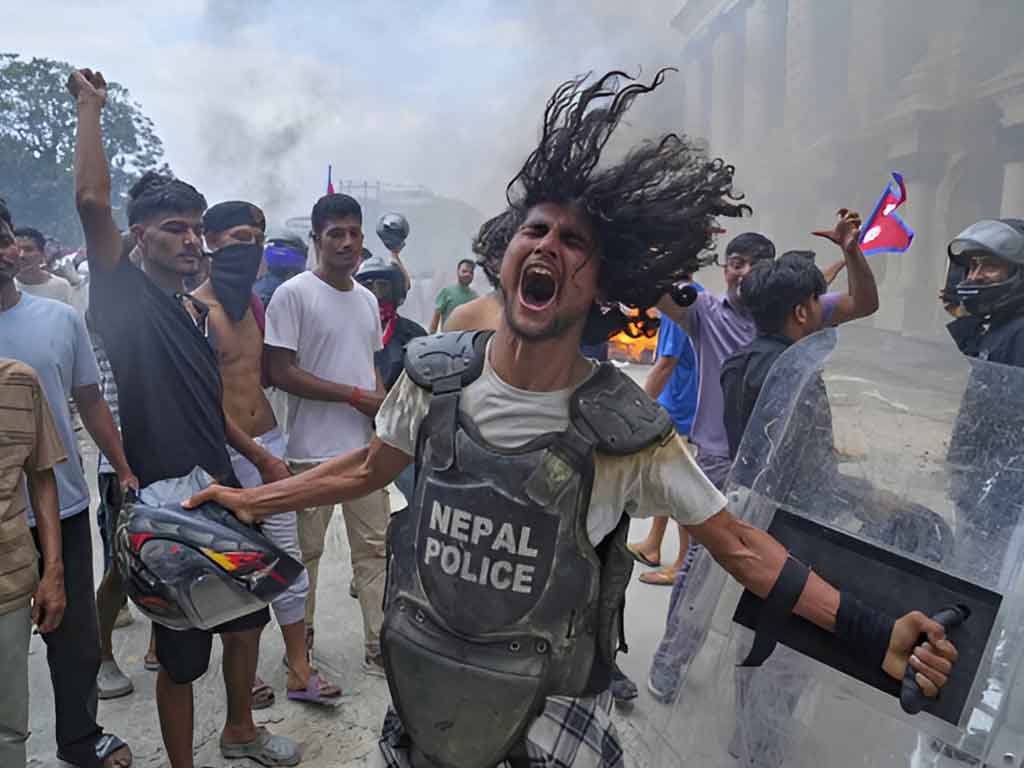
Nepal is facing its worst unrest in decades, with violent protests sweeping across the capital Kathmandu and beyond. Troops have been deployed to patrol the streets as demonstrators clash with security forces, leaving thirty people dead and more than one thousand injured.

The protests began after the government’s decision to ban 26 social media platforms, including WhatsApp, Instagram and Facebook. Although the ban was lifted on Monday night, the anger had already spiraled into a wider movement against corruption and political privilege. The “nepo kid” campaign on social media, which exposed the lavish lifestyles of politicians’ children, had fueled public frustration long before the ban.
Nineteen protesters were killed in clashes with police on Monday, and the deaths triggered even more unrest on Tuesday. At least three more protesters and two police officers were reported dead the following day. Demonstrators set fire to the headquarters of the Nepali Congress Party in Kathmandu and torched the home of its leader, former Prime Minister Sher Bahadur Deuba. Hundreds stormed the parliament building, breaking windows and setting parts of it ablaze. The Sinha Durbar, a complex housing government offices, was also raided, and officials confirmed that all court proceedings there were suspended indefinitely after severe damage.
In one of the most serious incidents, former Prime Minister Jalnath Khanal’s wife, Ravi Lakshmi Chitrakar, suffered life-threatening burns when their house was set on fire by protesters. She remains in intensive care. Thousands of prisoners escaped from jails across the country during the chaos, with security forces killing five escapees under the age of 18 from a juvenile detention center in Banke on Tuesday evening.
The army has taken control of Kathmandu’s streets, setting up checkpoints, inspecting vehicle registrations and urging citizens through loudspeakers to remain indoors. A nationwide curfew has been imposed until Thursday morning, and the military has warned of severe punishment for vandalism or violence. Authorities confirmed 27 arrests linked to looting and arson, and recovered 31 illegal firearms.
Kathmandu’s airport reopened on Wednesday, with the city calmer as most people obeyed the curfew. However, scenes of devastation remained, with young residents volunteering to clean the streets and damaged public property.
The Gen Z activists who first organized the anti-corruption protests insisted they had no role in the violence. In a statement, they said, “The movement was non-violent and based on the principles of peaceful civil disobedience.” They accused “opportunists” of hijacking their cause for looting and arson.
Army spokesman Rajaram Basnet also admitted that criminal elements were exploiting the protests. “The army is in the process of controlling elements who were taking advantage of the situation to commit looting, arson and other incidents,” he said.
The Gen Z protesters said they would take responsibility for helping manage the crisis, protect citizens and safeguard public property. They confirmed that no protests were planned for Wednesday, urging the army and police to enforce the curfew fairly and prevent further destruction.
The prime minister’s resignation has created a power vacuum, leaving Nepal’s future uncertain. With leadership in limbo, the crisis risks deepening unless a credible successor emerges to address both corruption and the public’s mounting frustration.