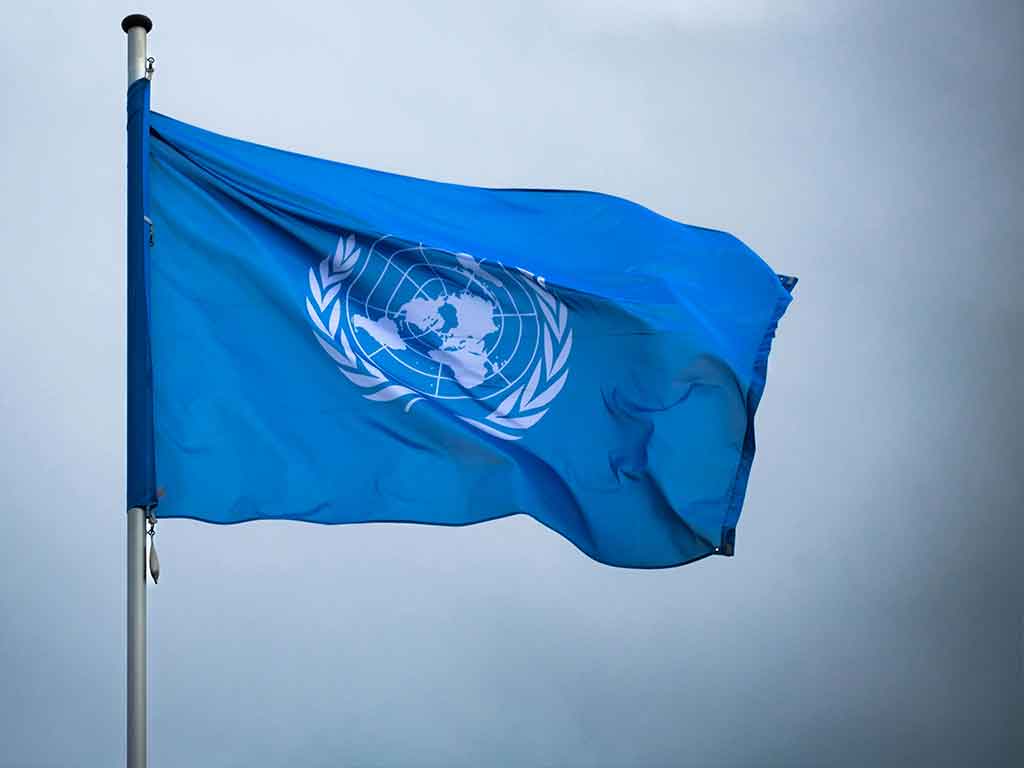
At 80 years old, the United Nations faces its greatest test yet. Once hailed as humanity’s best hope for peace, the institution now struggles under the weight of its own contradictions, veto-wielding powers, underfunding, and an inability to prevent atrocities such as the genocide in Gaza. Its survival is less a triumph and more a reflection of inertia, as questions mount over whether it can ever be reformed to meet the demands of the present.
A Legacy Born of War
The United Nations was created in 1945, in the shadow of World War II, as a framework to prevent another global conflict and provide a forum for collective decision-making. The United Nations Charter, ratified by representatives of fifty nations, has been described as the single treaty that, despite its flaws, binds nations together. Yet even at its inception, it was incomplete.
As the document itself admitted, the charter merely set terms for the “behaviour of nations.” It did not create a new order and left the responsibility of compliance to individual member states. Without enforcement power, the UN was only as strong as the community of nations behind it.
The cracks emerged early. The need for a Universal Declaration of Human Rights in 1948 reflected the insufficiency of the Charter, and even that declaration was contested, splitting political and civil rights from social and economic rights. These rifts in vision have only widened, keeping the UN from effectively addressing crises across decades.
At eighty, the UN is called a miracle for still existing, especially when compared to the League of Nations, which collapsed after just 18 years. But for many critics, its longevity is not proof of success, but of inertia, survival without effectiveness.
Power Without Power
The UN has always been trapped between idealism and geopolitics. The institution cannot be expected, as one observer noted, “to fly in like an angel and whisper into the ears of the belligerents and stop them.” Instead, it can only “blow the whistle, an umpire for a game whose rules are routinely broken by the more powerful states.”
The Security Council remains the most visible face of this contradiction. Made up of fifteen countries, with five permanent members, the United States, Russia, China, France, and the United Kingdom, the Council operates with the veto power that has paralyzed countless resolutions.
Since 1972, the United States alone has vetoed more than forty-five resolutions concerning the Israeli occupation of Palestine. During the ongoing Gaza genocide, the U.S. repeatedly quashed even the mildest ceasefire resolutions. Secretary General António Guterres lamented, “Gaza is a killing field, and civilians are in an endless death loop,” and later declared that the famine there was “not a mystery, it is a man-made disaster, a moral indictment, and a failure of humanity itself.”
Despite such statements, the UN has been unable to translate outrage into action. Resolutions passed by the General Assembly, such as the five calling for a ceasefire between 2023 and 2025, hold symbolic weight but no binding authority. The gap between rhetoric and enforcement has never been starker.
Agencies of Hope, Starved of Resources
Beyond the Security Council, the UN system comprises a vast network of agencies. The International Labour Organization (ILO), UNICEF, UNESCO, and WHO have carried out vital humanitarian work, from advocating for children’s rights to coordinating health campaigns. These agencies, alongside refugee relief, telecommunications, and development programs, form the operational lifeblood of the UN.
Yet their ambitions have always been outstripped by funding. In 2022, the UN’s entire expenditure stood at $67.5 billion, while global arms trade spending topped $2 trillion. The contrast is damning: the world spends thirty times more on war than on peace.
Chronic underfunding is compounded by ideological battles. Wealthy states frequently disagree over priorities, leaving agencies unable to act decisively. As neoliberal austerity gutted state capacities worldwide, the UN became the world’s humanitarian stopgap, but without the resources to fill the gap meaningfully.
Reform or Ruin
Calls for reform have punctuated UN history. From Boutros Boutros-Ghali’s An Agenda for Peace in 1992 to Kofi Annan’s Renewing the United Nations in 1997 and António Guterres’s Our Common Agenda in 2021, successive leaders have tried to push for transformation.
The UN80 Task Force, established in 2025, is the latest attempt, focusing on “internal efficiency, mandate review, and programme alignment.” But as Under-Secretary-General Guy Ryder admitted, “we’ve tried this exercise before.” The reforms address bureaucratic weaknesses while sidestepping the political problems that paralyze the UN.
Critics argue that a bolder agenda is required:
- Move the Secretariat to the Global South. With nearly all UN agencies headquartered in the U.S. or Europe, Washington wields disproportionate control. Visa denials have even prevented Palestinian officials from attending the UN General Assembly. Relocating to Nairobi or Geneva would loosen this stranglehold.
- Restructure funding. Currently, the U.S. contributes 22% of the UN budget and China 20%. With seven U.S. allies providing another 28%, Western influence is entrenched. The Global South, even with China, covers nearly half the budget but lacks proportional influence. A redistribution of financial power is overdue.
- Humanitarian funding within states. Nations must spend more on healthcare and education rather than debt servicing. Africa, for example, spends more on debt repayment than on social services, leaving the UN to fill the void. This dependency is unsustainable.
- Cut the global arms trade. With international arms sales nearing $150 billion annually, war remains profitable for the Global North. In 2023, the top 100 arms manufacturers made $632 billion, mostly from U.S. military contracts. Meanwhile, UN peacekeeping operations limp along with just $5.6 billion.
- Strengthen regional structures. African, Arab, and Latin American blocs must be empowered within the UN framework. If permanent UNSC membership is denied, regional structures must assume greater authority, diluting the veto power of the P5.
The Gaza Test
Nowhere are the UN’s limitations more glaring than in Gaza. Despite near-unanimous global recognition of the humanitarian disaster, the Security Council remains deadlocked. The General Assembly has passed ceasefire resolutions, but without enforcement power, the carnage continues.
Solidarity movements outside the UN, such as the Freedom Flotilla, have stepped in to fill the moral vacuum. Ayoub Habraoui, a Moroccan activist aboard one of the boats, wrote:
“What is happening in Gaza is not a conventional war, it is a slow-motion genocide unfolding before the eyes of the world. I am joining because deliberate starvation is being used as a weapon to break the will of a defenceless people, denied medicine, food, and water, while children die in their mothers’ arms. I am joining because humanity is indivisible. Whoever accepts a siege today will accept injustice anywhere tomorrow.”
His words highlight the chasm between grassroots defiance and institutional paralysis. “Silence is complicity in the crime, and indifference is a betrayal of the very values we claim to uphold,” he added. For many, this flotilla is a reminder that conscience can sail even when diplomacy sinks.
The Future at a Crossroads
The UN at eighty is caught in a paradox: too weak to stop wars, yet too important to discard. It records suffering, coordinates relief, and provides a global forum, but it fails to prevent atrocities or challenge entrenched power structures.
Its survival thus far is a testament not to effectiveness, but to necessity, a flawed institution better than no institution at all. But necessity alone will not sustain it for another eighty years. Reform is no longer optional, it is existential.
The world has changed since 1945. Power has shifted towards the Global South, inequality has deepened, and the threats of climate change, pandemics, and mass displacement dwarf those foreseen by the UN’s founders. Without structural transformation, moving beyond rhetoric to real redistribution of power and resources, the UN risks fading into irrelevance, a relic of postwar idealism unable to meet 21st-century demands.
The United Nations stands at a critical juncture. For decades, it has been both a symbol of hope and an emblem of frustration. Its failures in Rwanda, Syria, and now Gaza underscore its impotence in the face of powerful member states. Yet its agencies, from UNICEF to WHO, continue to provide lifelines for millions.
Whether the UN can be reborn as a genuine force for peace and justice depends on choices made now. Will it continue as a stage for empty rhetoric and vetoes, or can it transform into an institution that truly reflects the world it claims to serve?
As the flotilla to Gaza sails, the answer seems less about what the UN is and more about what humanity demands it to become.