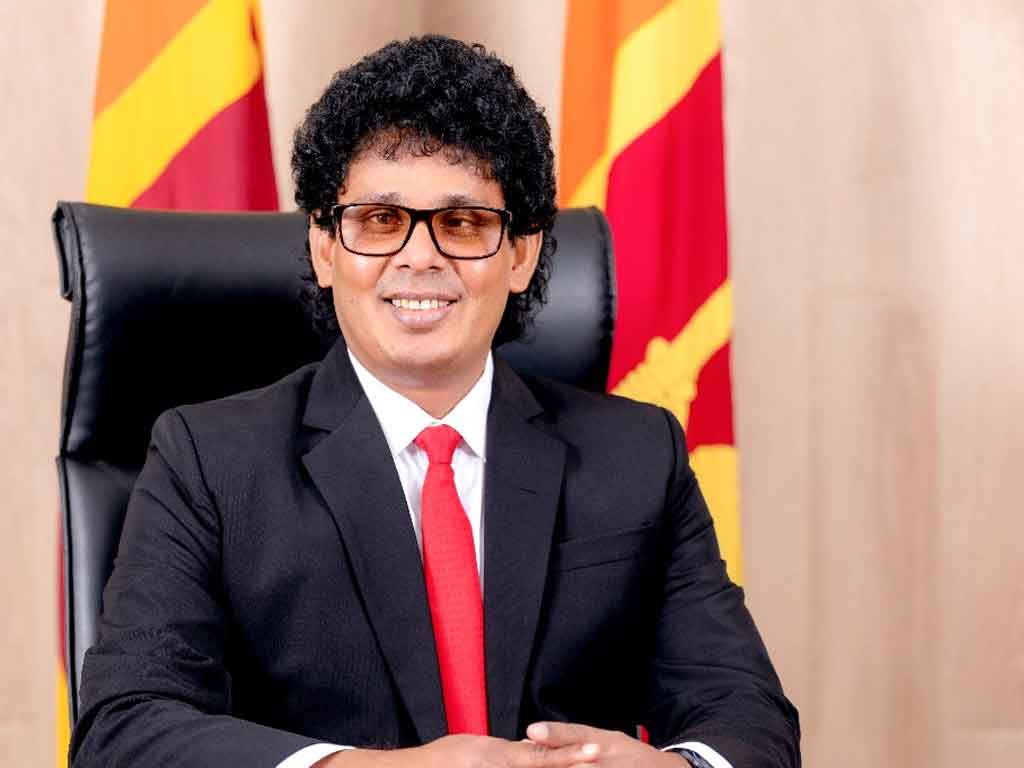
From teaching under coconut trees to dabbling in crypto, Minister Wasantha Samarasinghe insists his 27-crore fortune is no scandal. But as Cabinet Spokesperson Nalinda Jayatissa reminds the nation, the real problem is not wealth itself but how convincingly it can be explained.
Trade Minister Wasantha Samarasinghe has stepped into the political spotlight not for his policies but for the value of his personal fortune. Declaring assets worth 275 million rupees, or roughly 27 crores, Samarasinghe has made an unusually detailed defense of his wealth, insisting that every cent is accounted for and derived from generations of inheritance, hard work, and multiple business ventures. At the same time, Cabinet Spokesperson and Minister Nalinda Jayatissa has intervened in the debate, making the broader point that wealth in politics is not a crime unless it cannot be explained. Together, their remarks have reignited a national conversation about money, transparency, and credibility in Sri Lankan politics.
Speaking on Siyatha Rupavahini, Samarasinghe openly described how his fortune was built. He began by anchoring his story in his hometown. “Thambuttegama is our village. Everyone in Thambuttegama knows us, our family also knows us,” he explained. From his perspective, his roots, his education at the University of Kelaniya, and his long history of political activity prove that his prosperity is not the result of shortcuts or corruption but of decades of persistence.

The minister recounted how he began teaching classes in 1997. His humble beginnings started with benches built under coconut trees on inherited land in Thambuttegama. From those simple facilities, the classes grew into one of the town’s largest education centers. Today, the site has been transformed into a three-storey commercial building covering 7500 square feet. It is fitted with solar panels, though he admitted that one system remains unconnected and unpaid for. The property, according to Samarasinghe, is now worth 225 million rupees and is rented out for educational purposes ranging from Ordinary Level to Advanced Level and vocational training programs.
“This is not something that came in one day by chance. It came little by little,” he said, highlighting how property values in Thambuttegama have skyrocketed, with one perch now worth around 30 lakhs. The land, he stressed, was inherited but improved over decades. “About 4 years ago, I was asked for 100 million for the land where the Thambuttegama class is located. But I did not give it, we are continuing this work.”
Samarasinghe also discussed his ventures beyond education. He borrowed money from the Regional Development Bank (RDB) to build a four-storey commercial property in the town center. This building, too, adds to his declared assets and generates rental income. “This is not a journey that I came to alone. It came little by little,” he repeated, emphasizing incremental progress rather than sudden unexplained wealth.
Alongside real estate, the minister has a history of side ventures. “I have been in business since I was a child. When I was in high school, we usually did business on trains. I am a man who lives in Mahapola. I also do farming. We have shops in the town. I know every job in those shops, from the kitchen to the front,” he explained. His diverse activities included farming, small business management, and even the stock market.
During the Covid-19 pandemic, Samarasinghe ventured into cryptocurrency trading with the help of his son. “Cryptocurrency, I was at home during this Covid period. One thing that caught my attention at that time was crypto. My son is a bit tech-savvy, he created that account. He still owns that account. That is why I am a man who has dabbled in various fields,” he said.
For Samarasinghe, the point of this detailed disclosure is simple: he insists his wealth has not been derived from public money. “I did not do this by taking any public money, a single cent belonging to the people. I can say this with great responsibility according to my conscience. I have given my assets and liabilities declaration. There is nothing to hide.”
He went further, even describing his wife’s gold jewelry, acquired at the time of their marriage in 2006. “From my wife’s grave, we have our two wedding rings, the chain, all of this. I bought a pound in 2006 for 6500 rupees. Now a pound is 300,000 rupees. Their value is increasing. They are worth a lot now, even if you calculate them today,” he said, stressing that these too were openly declared in his filings.
While Samarasinghe defended his wealth, Minister Nalinda Jayatissa provided a broader context. Responding to a journalist, the Cabinet Spokesperson noted that there is nothing inherently wrong with politicians owning property. “Having property is not a barrier to entering politics,” he explained. “The problem arises with having property or assets that cannot be explained how they were acquired.”
Jayatissa emphasized that his party has already published the declared assets of its MPs and Ministers, which he said should serve as an example to the country. His comments framed the debate around transparency rather than wealth itself. In his view, wealth earned through inheritance, business, or professional work is acceptable, but wealth that lacks clarity invites suspicion and undermines public trust.
The combined narratives of Samarasinghe and Jayatissa highlight the broader debate in Sri Lanka about political wealth. On one hand, Samarasinghe presents his story as one of upward mobility, grounded in education, land development, and entrepreneurial ventures, making the case that wealth can be legitimate. On the other, Jayatissa warns that legitimacy is not about fortune alone but about evidence and accountability.
For the public, the question remains whether such detailed disclosures will build trust or simply add to skepticism in a climate where corruption scandals, unexplained fortunes, and missing accountability have too often dominated politics. The keywords are clear: political wealth, transparency, accountability, inheritance, business ventures, farming, real estate, and cryptocurrency. Whether these words reassure or inflame depends on how the electorate interprets them.
What cannot be denied is that this debate adds another layer to the ongoing struggle over credibility in Sri Lanka’s political class. As wealth grows and politics continues to be under the microscope, the real challenge is not only to declare assets but to convince the people that those assets tell a story of hard work rather than hidden privilege.