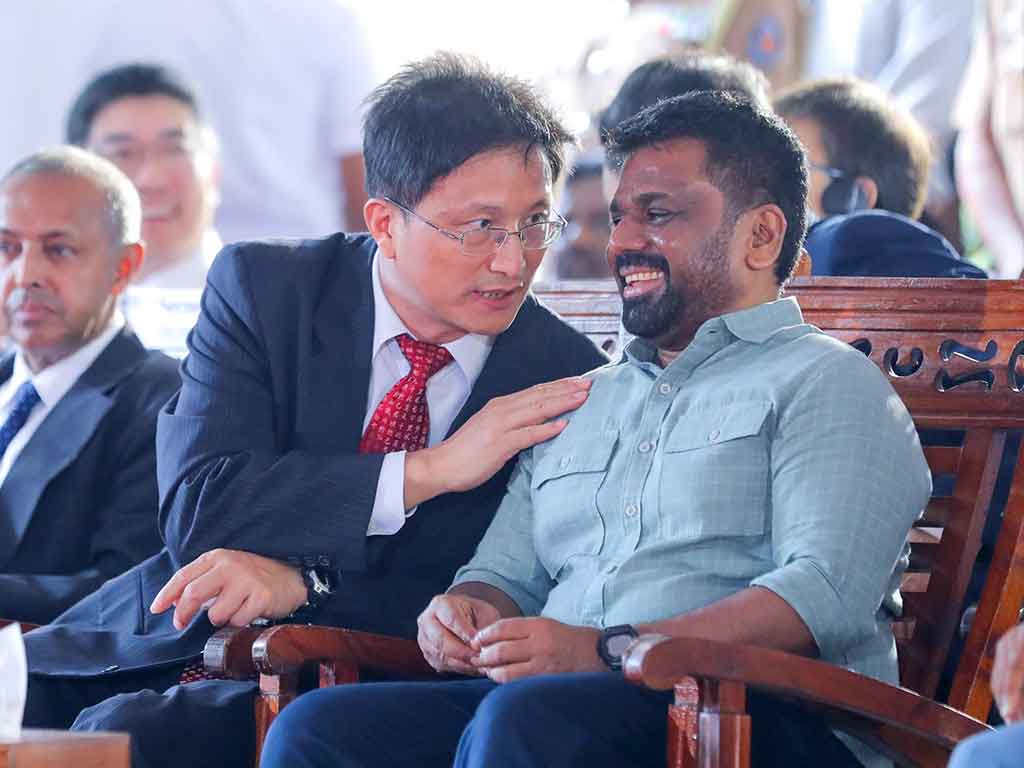
President Anura Kumara Dissanayake vows that Sri Lanka will never again face an economic collapse like 2022–2023, promising sweeping reforms, foreign investment, and a crackdown on corruption. But as history has shown, promises in Colombo are easier made than kept.
Sri Lanka’s government is once again offering assurances that the dark days of 2022–2023 will never return. Addressing the nation at the resumption ceremony for the Kadawatha–Mirigama section of the Central Expressway Project, President Anura Kumara Dissanayake vowed that decisive measures are in place to prevent another devastating economic collapse.
The President emphasized that the previous crisis, which brought with it widespread social and financial hardship, was not a matter of chance but the result of multiple, interconnected failures. His central message was clear: a new approach is underway to ensure resilience, growth, and stability.

“The country will be built in a way that such a crisis will never occur in Sri Lanka again,” the President declared. He underscored that genuine stability is not achieved merely through highways or infrastructure projects but through stronger, systemic reforms across governance, finance, and society.
Much of his optimism was tied to discussions held with Chinese President Xi Jinping during his recent state visit. “I requested support to restart projects initiated with Chinese loans. President Xi agreed, and the Chinese Exim Bank has expressed willingness to provide a concessional loan for this expressway section at an interest rate of 2.5–3.5%,” he said. For a nation still grappling with external debt, concessional financing and revived projects are being framed as vital lifelines.
But the President’s address did not dwell solely on economics. He used the platform to target what he described as an “underground state” fueled by organized crime and corruption. “Organized crime groups have created a great disaster in society. We will definitely end this underground state,” he stated firmly, thanking police authorities for their continued work to restore public trust and enforce the law.
Reform was the dominant theme throughout. On public service, Dissanayake insisted that outdated practices and individuals resistant to new political norms would no longer be tolerated. Every rupee of public money, he stressed, must be treated as a corporate asset rather than squandered. To reinforce this, the 2026 budget includes Rs. 11,000 crore dedicated to salary increases for public servants, with pay set to rise to Rs. 33,000 crore in 2027. In parallel, all government services are expected to transition to full digitalization by next year.
The President painted an ambitious economic outlook, projecting 5% growth by the end of the year and foreign reserves climbing to $7 billion. He pointed to the attraction of $1 billion in direct foreign investment and signaled confidence in the completion of stalled projects across multiple sectors. “A collapsed state is building stable economies, not stagnant economies. This year marks a significant turning point in Sri Lanka’s economy, social life, politics, and rule of law,” he declared.
International recognition was also cited as validation. Dissanayake referenced the World Bank, which recently described Sri Lanka as the fastest country to recover among collapsed economies. “These are important factors. That is why we are moving forward on this journey very steadily,” he remarked, dismissing domestic political noise as distractions from the larger task at hand.
Education and citizen empowerment were given equal weight in his address. “A developed nation requires developed citizens who can fearlessly express ideas and take collective action. We are creating an education reform to produce such citizens,” he explained, positioning education reform as a cornerstone of long-term national progress.
Infrastructure remained another focal point. While projects like the Central Expressway symbolize visible progress, the President warned that delays are unacceptable, labeling them as direct economic losses. “It is the responsibility of officials to complete the Central Expressway on time, and the government will provide all necessary support for this,” he concluded, making it clear that efficiency is now a political mandate.
Yet, while the promises are grand, the underlying skepticism is impossible to ignore. Sri Lanka has heard similar declarations before, particularly after past economic or political collapses. Each new administration has vowed sweeping reforms, foreign investment, and the eradication of corruption, but few have delivered results that match the rhetoric.
Still, the current leadership insists this time is different. With foreign partners like China and the World Bank showing signs of cooperation and the government pledging a combination of digitalization, education reform, and infrastructure revival, the roadmap appears ambitious. Whether those promises can outlast the entrenched culture of inefficiency, corruption, and political infighting remains the question that will define Sri Lanka’s next decade.