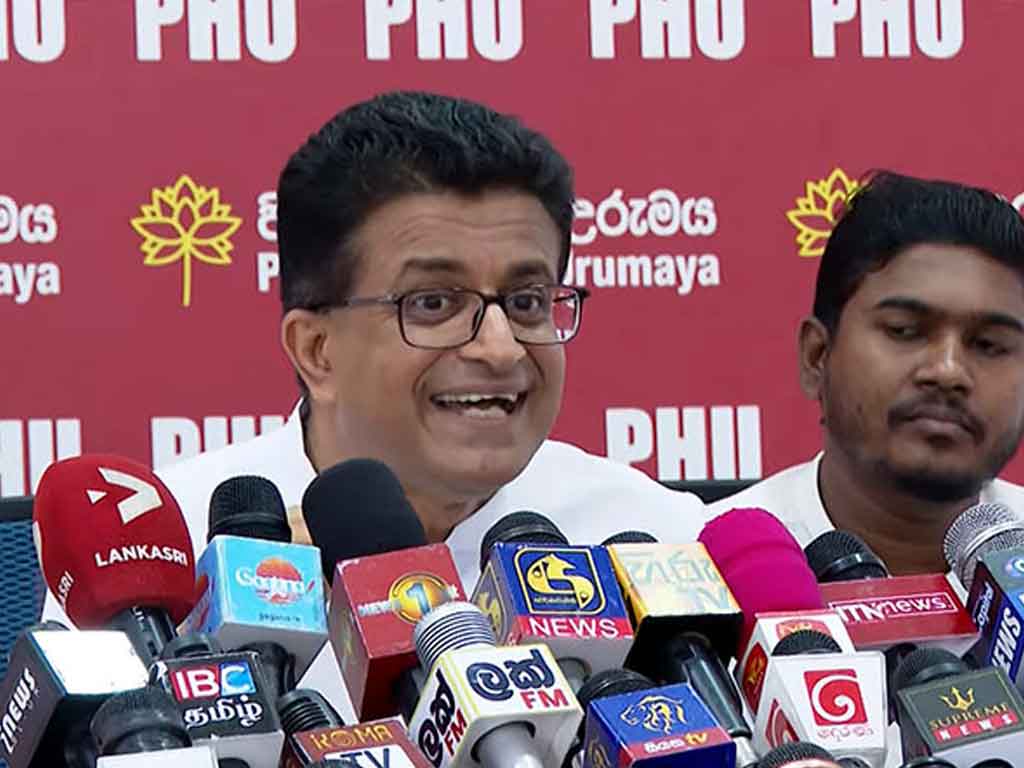
Udaya Gammanpila blasts the Malima government for repeatedly fabricating cases to silence him, claiming six failed arrest attempts prove only one thing, that he has no skeletons for them to drag out, so they just keep inventing new ones.
At a Pivithuru Hela Urumaya media conference, party leader and lawyer Udaya Gammanpila launched a scathing attack on the Malima government, accusing it of abusing legal instruments to suppress dissent and silence opposition voices. According to Gammanpila, the government has tried to arrest him six times in less than a year, yet has failed to prove even a single genuine allegation.
He began by explaining how the Criminal Investigation Department (CID) had informed the Fort Magistrate that an investigation against him was being initiated under the ICCPR Act while he was abroad for a research project. Gammanpila argued that the ICCPR Act is notorious worldwide for being misused by governments to stifle critics. “That is why the United Nations even issued guidelines stating that arrests can only be made under this act if five conditions are met. It is called the Rabat Test,” he said. He noted that although the ICCPR Act has been in force in Sri Lanka for 18 years, no government has previously abused it in this manner against political opponents. He has already filed a case in court challenging the investigation.

Gammanpila then detailed what he described as six separate attempts by the government to have him arrested. The first was in October 2024 when he published two reports on the Easter Sunday attacks that, he claimed, the President had deliberately concealed. At that point, Minister Vijitha Herath and President’s Counsel Upul Kumarapperuma declared that he should be arrested under the Official Secrets Act.
The second attempt came after he publicized details from a meeting with Pillayan, which ministers alleged was “obstructing the investigation.” Then, Ministers Bimal Ratnayake, Harshana Nanayakkara, and Sunil Watagala announced a third arrest threat, this time for exposing the fraudulent release of 323 shipping containers.
The fourth threat came from Minister Nalinda Jayatissa, who claimed he should be arrested for publishing two of the seven secret agreements signed with India. The fifth centered on Gammanpila’s questioning of the President’s private visit to Germany at public expense. That incident prompted the National Bhikku Front to complain to the CID and demand his arrest, while Malimawa municipal councillors staged protests outside police headquarters. Deputy Minister Mahinda Jayasinghe even went so far as to declare publicly that he would ensure Gammanpila’s arrest. The CID sought a warrant, but the court refused, finding no basis.
The sixth, Gammanpila said, was the latest misuse of the ICCPR Act to intimidate him. “They are trying to arrest me by raising baseless allegations because the government has understood that I cannot be charged with theft, robbery, or adultery,” he argued. Over the past 26 years, he claims, successive governments have searched through files of every institution he has managed, questioned officials, and tried to uncover wrongdoing, but have found nothing. Instead, the current regime has handed the task of fabricating cases to former CID director Shani Abeysekara. “Thank you very much, Honorable President, for taking the time to start this baseless investigation and issue a character certificate stating that I have not committed any corruption despite being so busy,” Gammanpila said with sarcasm.
He tied these repeated arrest attempts to what he described as the rapid collapse of the Malima government’s popularity. “There has never been a government in the history of the world whose vote base has decreased by 34% within six months of coming to power,” he said, citing small poll results. To deal with this collapse, he claimed, the government has launched three projects.
The first project is the systematic intimidation of opposition activists. “Today, the Malima leaders are telling their activists, ‘Don’t be afraid. We will let all the opposition activists in and go to the next election. We will not leave a single person who poses a threat to us,’” he said. It was under this strategy, he added, that former President Ranil Wickremesinghe was arrested on what he called fabricated charges, and under which he too is now targeted.
The second project, according to Gammanpila, is the wholesale capture of the state apparatus. He accused the government of filling even departmental head positions, traditionally held by career officials, with individuals tied to the ruling “compass” faction. He described it as an effort to extend partisan control into village-level institutions like dayaka councils and funeral benefit societies.
The third project, he alleged, is large-scale fraud. He pointed to scandals such as the 323 container release, rice price manipulation, the Sahasdanavi deal, sugar duty fraud, and coal procurement corruption. In his words, “When they say that the pubs will close at midnight tonight, today’s government bosses steal like drunkards.”
Gammanpila concluded by asserting that these three projects — intimidation of opponents, capture of the state, and systemic fraud — can only succeed if dissenting voices like his are silenced. That is why, he argued, the government continues to fabricate new cases against him. Yet he insisted he will not be intimidated, framing himself as proof that a relentless government campaign has failed to uncover even a trace of personal corruption.