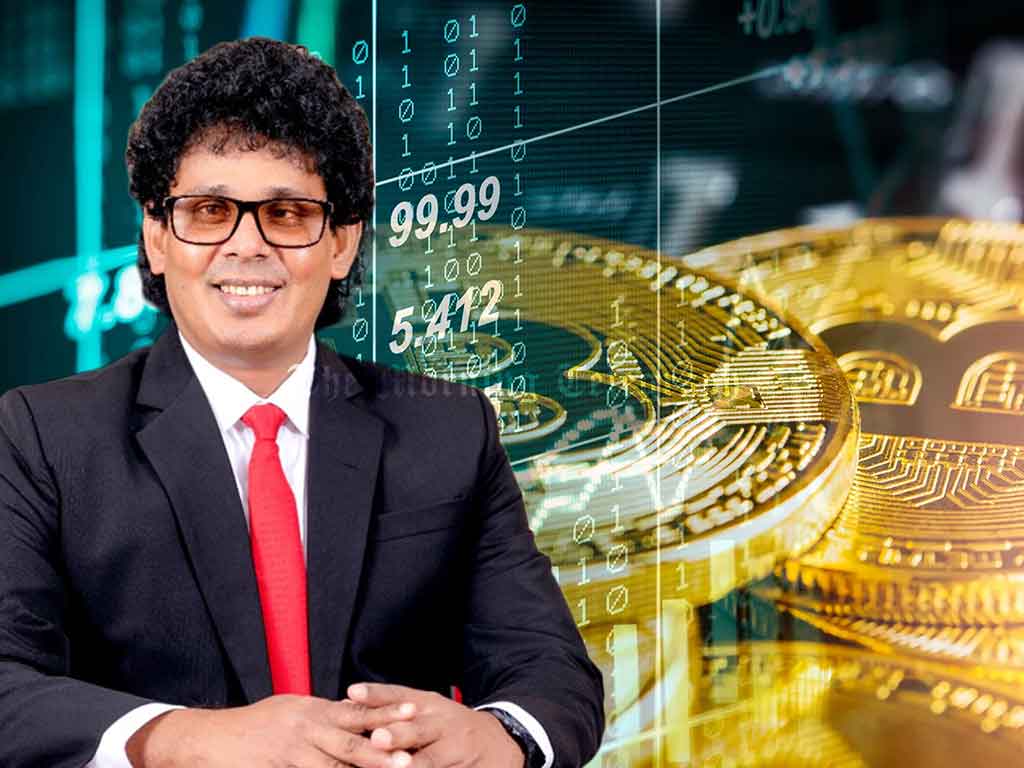
Wasantha Samarasinghe stands accused of making millions through prohibited digital currency deals, raising questions of money laundering, asset legitimacy, and whether the government’s promises of relief have only enriched its ministers.
The storm surrounding Minister of Commerce, Food Security and Cooperatives, Wasantha Samarasinghe, has intensified after allegations surfaced that part of his declared assets worth 27 crores was built through investments in digital currencies. Opposition figures now demand clarity on whether these earnings were legitimate investments or part of a money laundering operation hidden behind the glamorous facade of cryptocurrency.
The controversy erupted when New People’s Front Avissawella Chief Organizer, Seethawaka Pradeshiya Sabha Member Nalaka Bandara, together with Avissawella Youth Affairs Secretary Darshana Harshanath and Borella Electorate Organizer Kushan Madanayake, submitted a formal letter to the Secretary to the Ministry of Finance. The letter requested a clear statement on the legality of digital currencies in Sri Lanka, warning that if ministers themselves are engaged in such practices, the public too may follow, risking their money in unregulated and potentially illegal financial schemes.

Nalaka Bandara, speaking at the event, stated, “The Minister has publicly declared his assets at 27 crores, claiming digital currency as one of his sources of wealth. We are asking the Finance Ministry to explain whether such digital transactions are even legal in Sri Lanka. If this is not an accepted form of currency, then the country must investigate how a minister could have accumulated millions through it.”
The questions grow sharper when placed in context. A single Bitcoin currently costs upwards of 3 crores. Therefore, any substantial investment would have required vast amounts of capital. Opposition figures now want Minister Samarasinghe to disclose not just vague references to “digital currency” but specify which cryptocurrencies he invested in, how much money was transferred, and whether such dealings were legally compliant.
The allegations cut deeper because they come against the backdrop of a government that has consistently claimed to be “for the people.” Bandara criticized the hypocrisy, stating that the Malima government relies on public funds to cover everything from fuel and food to clothing for its members, yet some of those same ministers are sitting on millions while the people struggle. “This government promised a rich country. Instead, the country has become poorer, while ministers have become richer,” Bandara charged.
Public anger is growing not only at the scale of wealth allegedly accumulated but also at the suspicion that digital currency may have been used as a channel to launder illicit money. Cryptocurrency, often criticized globally for its role in hiding untraceable transactions, is seen by many in Sri Lanka as a tool for black money operations. The opposition’s letter to the Finance Secretary explicitly demanded an answer: is digital currency legal tender in Sri Lanka, and if not, why is a government minister openly claiming it as a source of wealth?
The controversy also touches a raw nerve politically. The Malima government came to power on promises of transparency, relief, and economic justice. Yet today, those promises are eroding as more stories of massive personal wealth among ministers surface. Instead of relief for the poor, citizens now see ministers declaring assets in crores while inflation and job shortages push ordinary families to the brink.
The political implications are explosive. Samarasinghe, once a champion of workers’ rights, is now painted as a millionaire who lectures the public on sacrifice while building his personal fortune. The accusation that he might have used prohibited or semi-legal financial channels only worsens the perception that the government is shielding its own while the people pay the price.
The demand for accountability is clear. Bandara and his colleagues insist that Samarasinghe must reveal the exact cryptocurrency units he invested in, the sources of the money he used, and whether proper regulatory frameworks were followed. They argue that silence or vague answers will only confirm suspicions of money laundering and corruption.
Meanwhile, public sentiment continues to sour. Across social media, questions are being raised not only about Samarasinghe’s assets but also about the broader credibility of the government. Citizens wonder how a country that cannot stabilize the price of rice, sugar, and fuel can tolerate ministers flaunting investments in high-risk digital currencies.
The Finance Ministry now faces pressure to respond decisively. A clear explanation is needed: is digital currency legal in Sri Lanka? If not, how could a minister legally justify wealth earned from it? Failure to address this could further inflame public distrust, potentially driving people to protest in the streets against a government already accused of enriching itself while the masses suffer.
The controversy surrounding Wasantha Samarasinghe is no longer just about one minister’s assets. It has become a litmus test for the government’s credibility. Will it investigate and hold its own accountable, or will it allow accusations of prohibited business and money laundering to deepen the perception that it has abandoned the people for power and profit?