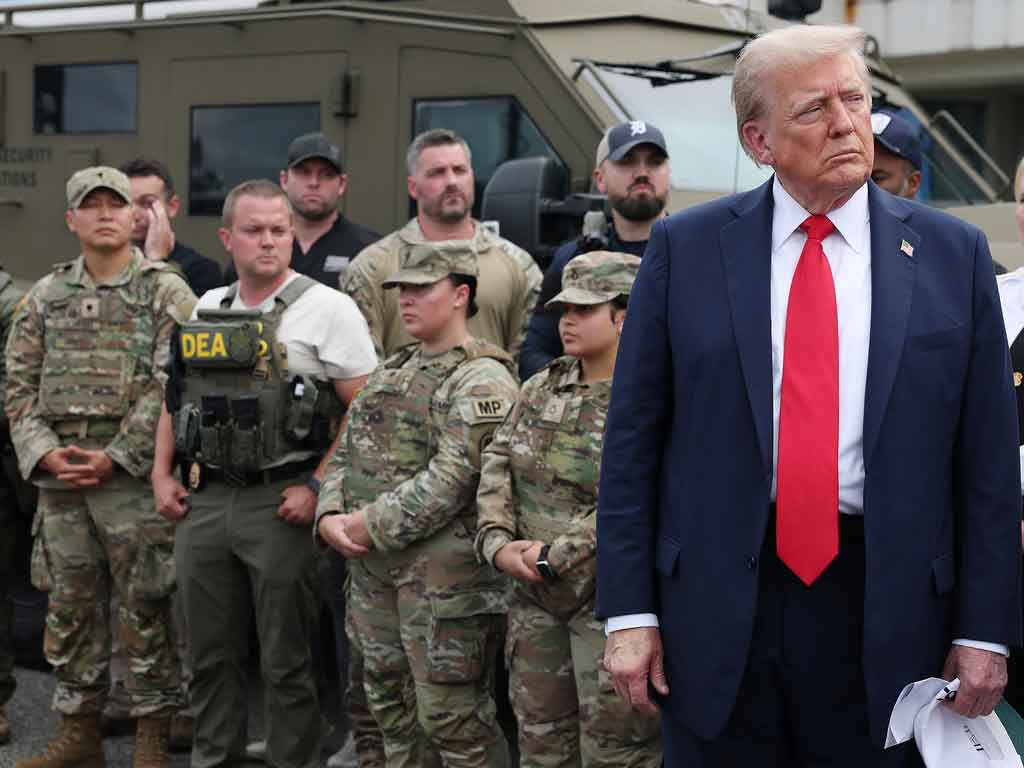
President Donald Trump announced Monday that his administration will deploy the National Guard and a new “Memphis Safe Task Force” to Tennessee’s largest city, in what he framed as a sweeping effort to combat violent crime.
Speaking from the Oval Office alongside Tennessee Governor Bill Lee, Trump signed a presidential memorandum authorizing federal agencies including the FBI, ATF, DEA, ICE, and Homeland Security, to work with state and local law enforcement. He said the move would replicate federal crackdowns in Washington, D.C., and Los Angeles.
“It’s very important because of the crime that’s going on, not only in Memphis, in many cities,” Trump said. He added that Chicago would be the next target, despite vocal opposition from Democratic leaders there.

Memphis Mayor Paul Young said he was “not happy” about the deployment but was preparing to adapt. He noted that details such as troop numbers and duties had not yet been finalized, though the National Guard could help with traffic control, surveillance, or neighborhood patrols.
The order allows Tennessee Highway Patrol troopers, and potentially officers from neighboring Arkansas and Mississippi, to join the task force. Planning is already underway, and some forces could arrive as soon as this week.
White House officials defended the move by citing Memphis’ high violent crime rates in 2024, though local police recently reported a sharp drop in crime this year, with overall crime at a 25-year low.
Reactions have been divided. Tennessee Republicans welcomed the plan, while local Democrats condemned it as a “militarized occupation.” Shelby County Mayor Lee Harris and state Rep. Justin Pearson argued that federal resources should go toward poverty reduction and community programs, not troops.
The deployment recalls past Guard interventions in Memphis, including after the assassination of Martin Luther King Jr. in 1968. Mayor Young said the city does not want to “invoke those same images” again.
Trump has increasingly used federal muscle to confront urban crime, asserting authority in Democratic-led cities such as Washington, D.C., and Los Angeles. Critics call the strategy an overreach, while Trump insists it is necessary to “save America’s cities.”