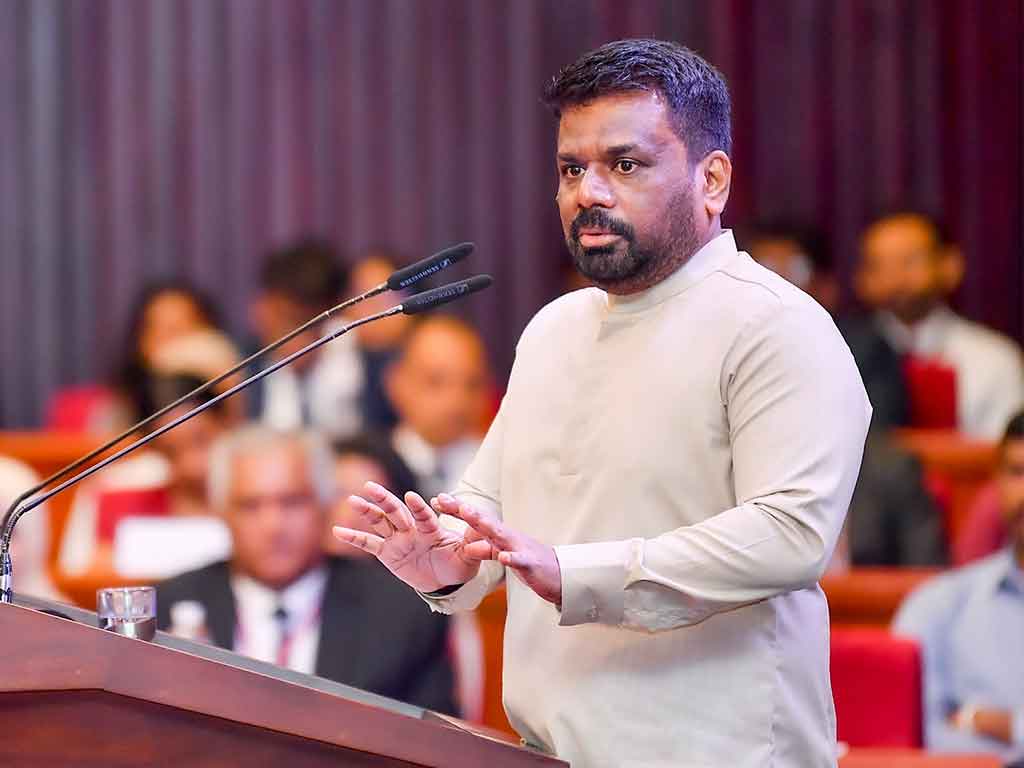
President Anura Kumara Dissanayake says Sri Lanka’s survival depends on embracing digitalization and cybersecurity, calling the launch of the national strategy a defining moment for the nation’s economy, security, and future.
President Anura Kumara Dissanayake declared that in order to move the country forward economically, efficiency and transparency must be ensured across all sectors. Speaking at the launch of the National Cyber Security Strategy (2025–2029) and the inauguration of the National Cyber Security Operations Center at the Bandaranaike Memorial International Conference Hall in Colombo, the President positioned the initiative as a turning point in Sri Lanka’s economic and social trajectory.
The President described himself modestly as a small man in this field, yet underscored the monumental importance of what was being introduced. He emphasized that the government’s digitalization program will not only modernize the country but also act as a safeguard for national security, the economy, and the daily lives of citizens.

The Sri Lanka Computer Emergency Response Team, working in collaboration with the Ministry of Digital Economy and with technical assistance from the World Bank, introduced the National Cyber Security Strategy 2025–2029. The aim is to establish a safe, reliable, and inclusive digital ecosystem for all citizens.
This comprehensive strategy is designed to create a strong legal and administrative framework for cybersecurity. It focuses on developing a skilled workforce, increasing public awareness, enhancing preparedness in government institutions, strengthening Sri Lanka CERT, protecting institutions that manage critical digital infrastructure, and promoting broad collaboration to secure cyberspace.
The newly launched National Cyber Security Operations Center will monitor 37 institutions that manage essential digital infrastructure, such as the Department of Immigration and Emigration, the Department of Motor Traffic, and the Department of Inland Revenue. The center will operate 24 hours a day, identifying cyberattacks and vulnerabilities, and providing real-time alerts to appropriate authorities.
By doing so, it will enhance the resilience of Sri Lanka’s digital systems, offer early warning mechanisms, and support both public and private institutions in managing security risks. The benefits include rapid response to threats, operational continuity, cost reduction, and improved public trust in digital services.
The National Cyber Security Strategy 2025–2029 was formally presented to the President and Minister of Digital Economy, Eranga Weeraratne, by the Deputy Minister of Digital Economy Affairs. Addressing the gathering, President Dissanayake stressed that any nation capable of rapidly absorbing the advances of technology and science moves toward development at a much faster pace. Those that fail, he warned, inevitably fall behind.
He emphasized that this system is not merely a technical upgrade but an integral element of national development, designed to safeguard Sri Lanka’s economy and security while elevating the living standards of citizens.
The President underlined the historic nature of the event, noting that Sri Lanka was not simply inaugurating a building or an office. Rather, the country was beginning a decisive journey into a digital future where robustness and reliability were vital.
Politically and economically, he argued, the central issue of the modern world is the ability of states to rapidly integrate the achievements of science and technology. He described Sri Lanka’s challenge as one of closing a widening gap with advanced nations.
Reflecting on history, the President explained that many ideas conceptualized during the 16th and 17th centuries only became reality in the 20th century, such as breakthroughs in healthcare, the democratization of governance, and new forms of human interaction. Since the late 20th century, he said, digitalization has become the dominant force shaping global progress.
Sri Lanka now has two options: embrace digitalization and advance alongside developed nations, or fail to adopt new technology and drift further from global progress.
The President lamented that Sri Lanka’s public service, once celebrated in the 1970s, had since deteriorated. He insisted that digitalization must be used to transform a failing state apparatus into one that is efficient and citizen-centered. Creating new systems that deliver timely and transparent services is, he said, the only way to rebuild trust in government institutions.
Transparency, he stressed, is vital. State machinery has been plagued by corruption in procurement, recruitment, grants, and policymaking. Digitalization, by making these processes transparent, is essential to rebuilding confidence.
The President also highlighted the role of digitalization in creating economic opportunities. By opening access to new markets, innovation, and efficiency, digital tools empower businesses to expand. Recent success stories, he noted, demonstrate that digitalization can create entirely new markets in both the public and private sectors.
He added that the digital economy also improves social life by making everyday tasks more efficient and accessible. Instead of being confined by outdated systems, citizens can benefit from faster, easier, and more reliable services.
Addressing public concerns that people may become machines in a digital future, the President rejected such fears. Human beings, he said, are inherently emotional and socially connected. Digitalization, rather than replacing humanity, will enhance and protect human interactions.
He emphasized that cyber systems are not static walls but dynamic defenses capable of adapting to constant threats. By continuously evolving, Sri Lanka’s cyber security network can protect national security, strengthen the economy, and safeguard the way of life for its citizens.
The President concluded by thanking scholars and professionals who had worked tirelessly on the program, noting that their contributions were critical to Sri Lanka’s digital transformation. He expressed confidence that this system would evolve further, generating new knowledge and tools while ensuring Sri Lanka’s relevance in the rapidly changing global economy.
This is a very important moment in our digital economic journey, he said. By embracing technology and ensuring security, transparency, and efficiency, we can finally move forward as a nation.