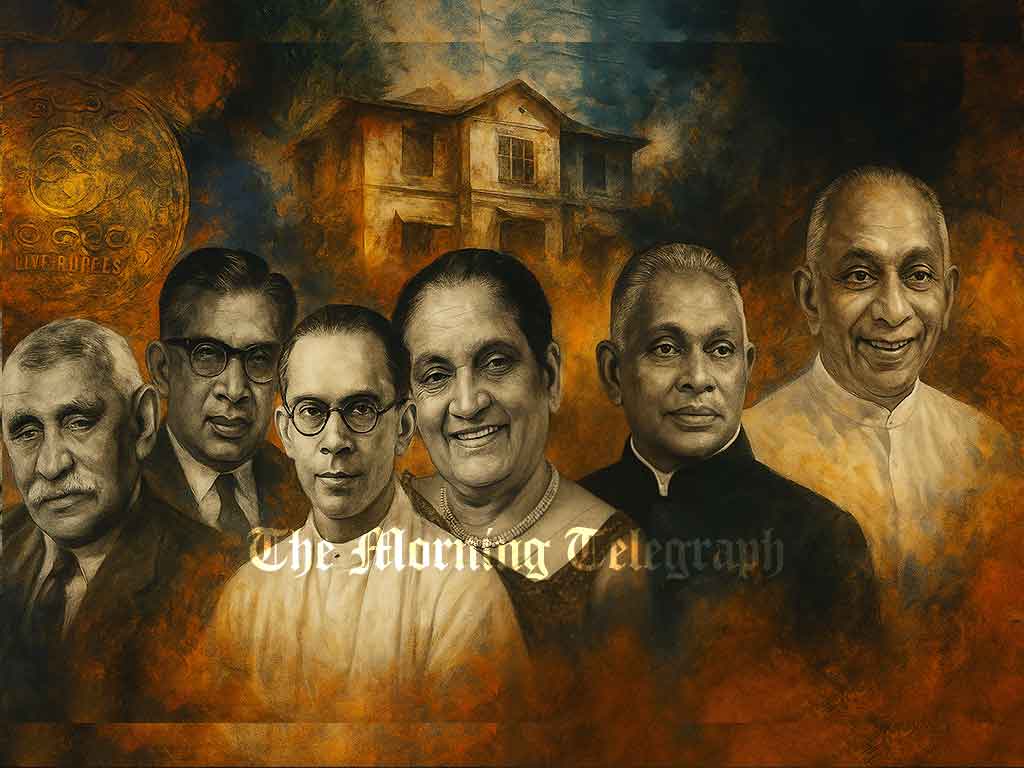
From mortgaging mansions to selling vast estates, Sri Lanka’s elite leaders sacrificed their wealth, land, and family inheritance in pursuit of politics and power, a story that reveals how deeply personal fortunes were tied to the nation’s turbulent history.
The history of Sri Lanka’s political elite is filled with stories of sacrifice, debt, and the loss of ancestral wealth. They mortgaged their homes, sold their estates, and gave away their family fortunes, all in the name of politics and power. Far from living in unshakable privilege, leaders such as the Bandaranaikes, Senanayakes, Kotelawalas, and Jayewardenes often risked everything to pursue political dominance.
In 1956, Sirimavo Bandaranaike recalled a conversation with her husband, S.W.R.D. Bandaranaike, in which he revealed his fears that Sir John Kotelawala might dissolve Parliament to secure another mandate. Bandaranaike admitted they were unprepared to face another election. They lacked the money, the resources, and the wealthy backers that could instantly fund a campaign. “With what weapons will I fight? How will I win? Where will I get the funds?” he asked his wife.

The Bandaranaike family had land but no immediate cash flow. Elections were costly, and his allies were poor. Sirimavo remembered his sudden declaration: “We have to mortgage this house.” Shocked, she resisted, reminding him that debt was a curse her parents had always warned against. She asked what would become of their children and whether he wanted them to inherit debt rather than property. Yet Bandaranaike insisted, pledging to repay the loan over 25 years. Eventually, their Rosmead house in Colombo was mortgaged to the Bank of Ceylon for two hundred thousand rupees.
This story, recorded in Sirimavo by Maureen Seneviratne in 1975, illustrates the financial risks leaders took. When Bandaranaike was assassinated in 1959, mortgage payments were halted. After Sirimavo’s defeat in the 1965 general election, the family lost their Rosmead residence. The bank foreclosed, forcing her children — Sunethra, Chandrika, and Anura — to travel from Horagolla Walawwa for school in Colombo.
Dudley Senanayake later offered Sirimavo residence at Temple Trees, but she declined and returned to Horagolla. Even as she struggled with debts, she spearheaded the Land Reform Act of 1970–77, transferring thousands of acres of her land to the state. The Balangoda Ratwatta Walawwa, once a symbol of family prestige, was eventually reduced to a fraction of its original size.
The Senanayakes themselves had similar stories of financial sacrifice. D.S. Senanayake, the nation’s first Prime Minister, and his son Dudley lost much of their family wealth. Plantation companies were sold, and Woodlands Walawwa in Borella was gradually dismantled. At the time of his death, Dudley Senanayake had just Rs. 234 in his bank account, a stark reminder of how political life drained private fortunes.
Sir John Kotelawala, who succeeded Dudley as Prime Minister, took another route. In 1953, Army Commander G.E.D. Perera highlighted the absence of a defence university in Sri Lanka. Kotelawala immediately responded by donating Kandawala Walawwa and its estate for the creation of one. The deed was signed in July 1979, and after his death, the institution was renamed the Kotelawala Defence Academy. His decision to part with his ancestral home reflects the same blend of political ambition and sacrifice that marked the era.
J.R. Jayewardene, who became Prime Minister and later President, also disposed of family property. Long before his premiership, his family mansion, Vaijanta, had been sold to the Chinese Embassy. When the embassy relocated, the property was returned to Jayewardene. Instead of keeping it, he donated it to the government to house artefacts, books, and documents from his presidency, creating the J.R. Jayewardene Centre. He also gave away the Birmar house, which passed through government institutions before being absorbed into the Jayewardene Centre. Neither Vaijanta nor Birmar passed to his son, Ravi Jayewardene. His family’s wealth was consciously given to the public, and to this day, no objections have been raised by his descendants.
These stories show that Sri Lanka’s so-called elites were not immune to financial loss. Their wealth was not simply inherited and preserved but often risked, mortgaged, or donated to sustain political careers. The Bandaranaikes gave up estates, the Senanayakes lost companies, Kotelawala donated his ancestral Walawwa, and Jayewardene surrendered mansions to the state. By the time these leaders left the stage, their personal fortunes were often depleted.
JVP theorists today argue that the dominance of these elites — spanning 76 years — was a curse on Sri Lanka. They claim that their rule entrenched privilege and perpetuated inequality. Yet, looking back, it is evident that the pursuit of politics often cost these elites their very wealth. Far from holding on tightly to privilege, they mortgaged and sold it away.
The narrative has shifted with the JVP/NPP era, where leaders present themselves as “non-elite” politicians fighting for the common people. But as asset declarations of these new leaders circulate on social media, comparisons arise. The earlier elites, for all their privilege, eventually donated or lost much of their property to the public sphere. Whether today’s so-called non-elite leaders will follow such precedent is a question history will eventually answer.
This history serves as a reminder of the complicated relationship between politics and wealth in Sri Lanka. Political families did not simply enrich themselves; they mortgaged their futures to fund campaigns, donated ancestral lands for public institutions, and often died with little personal wealth left. At a time when corruption and hidden assets dominate headlines, the sacrifices of leaders like Bandaranaike, Senanayake, Kotelawala, and Jayewardene remind the public of another dimension of leadership — one defined by giving away, not hoarding.