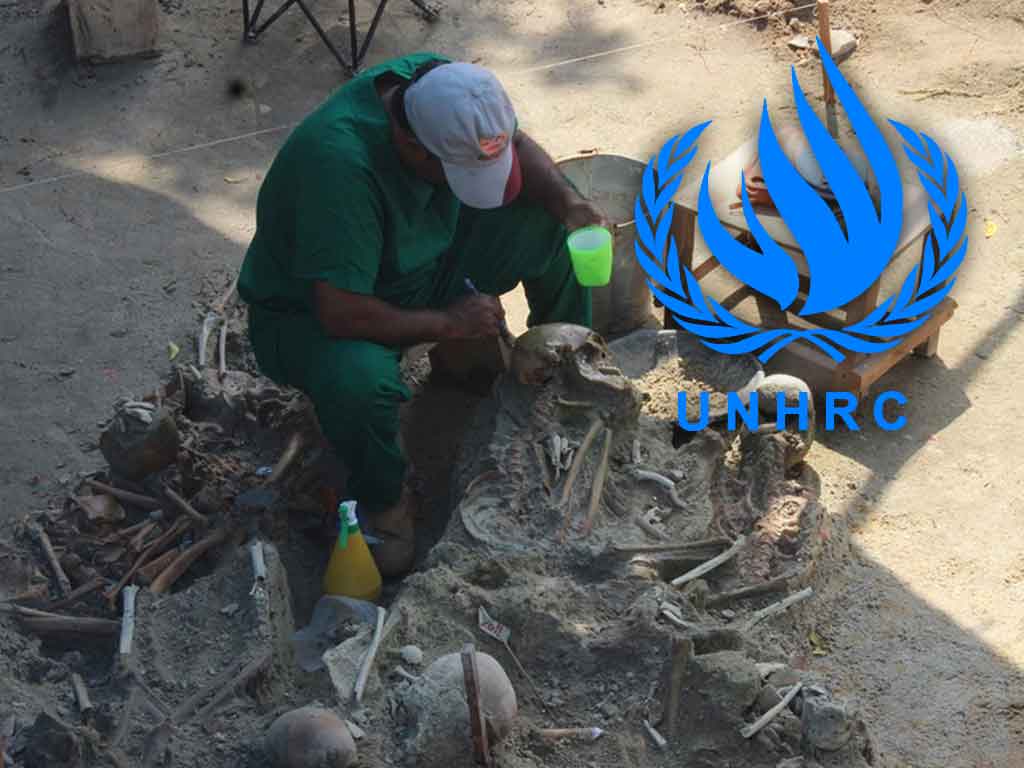
Colombo signals readiness to accept UN forensic and technical help to investigate mass graves and human rights violations, as pressure mounts ahead of a crucial Geneva resolution.
Sri Lanka has indicated that it is ready to seek technical assistance from the Office of the United Nations High Commissioner for Human Rights (OHCHR) to help investigate past crimes, including the use of forensic experts to identify victims buried in mass graves.
Foreign Minister Vijitha Herath confirmed that the government is open to such cooperation, although he stressed that assistance will only be sought based on judicial orders relating to mass graves. He said that the move would help expedite long-delayed investigations into human rights violations that have drawn international scrutiny for years.

A vote on a new resolution on Sri Lanka at the United Nations Human Rights Council (UNHRC) has not yet been scheduled. However, all amendments to the draft resolution must be submitted before September 25. Minister Herath said that no major changes are expected in the draft and confirmed that Sri Lanka will remain under the observation of OHCHR for the next two years.
The draft resolution to extend the OHCHR’s mandate in Sri Lanka was formally submitted last week by the United Kingdom, Canada, Malawi, Montenegro and North Macedonia. The resolution underscores the importance of accountability and cites the discovery of multiple mass graves across the island, urging Sri Lanka to continue cooperating with the Office on Missing Persons.
The document also calls on Colombo to seek international assistance to ensure adequate financial, human and technical resources for exhumations, identifications and burials conducted according to international standards. It further highlights the need to strengthen the country’s ability to investigate and prosecute serious cases of human rights violations, including the devastating Easter Sunday bombings of 2019 that killed more than 250 people.
Minister Herath revealed that Sri Lanka had held discussions with UK and Canadian representatives in Geneva and had requested more time to establish a credible domestic accountability mechanism. He noted that while Sri Lanka remains opposed to external investigation mechanisms such as the OHCHR’s Sri Lanka Accountability Project, the government is open to receiving technical support that would enhance local capacity.
The Sri Lanka Accountability Project, created under the OHCHR mandate, is an evidence-gathering initiative designed to preserve information about human rights violations and serious breaches of international humanitarian law. Its goal is to support accountability processes in the future, either in Sri Lanka or through actions taken by member states with competent jurisdiction. With the extension of OHCHR’s mandate, the Accountability Project will also continue for another two years.
Minister Herath reiterated that the government’s opposition to international investigations remains unchanged. However, he emphasized that technical support, particularly in forensic analysis and victim identification, could strengthen domestic processes while respecting Sri Lanka’s sovereignty.
As part of ongoing reforms, Herath also confirmed that the Prevention of Terrorism Act (PTA) will be repealed this year. The new Anti-Terrorism Law, intended to replace the controversial legislation, is now in its final drafting stages.
For Sri Lanka, the decision to seek UN technical assistance reflects a delicate balancing act between international pressure and domestic control. While global attention remains firmly fixed on unresolved mass graves and accountability for human rights abuses, the government hopes that accepting targeted support from Geneva will demonstrate progress without compromising its insistence on sovereign-led justice.