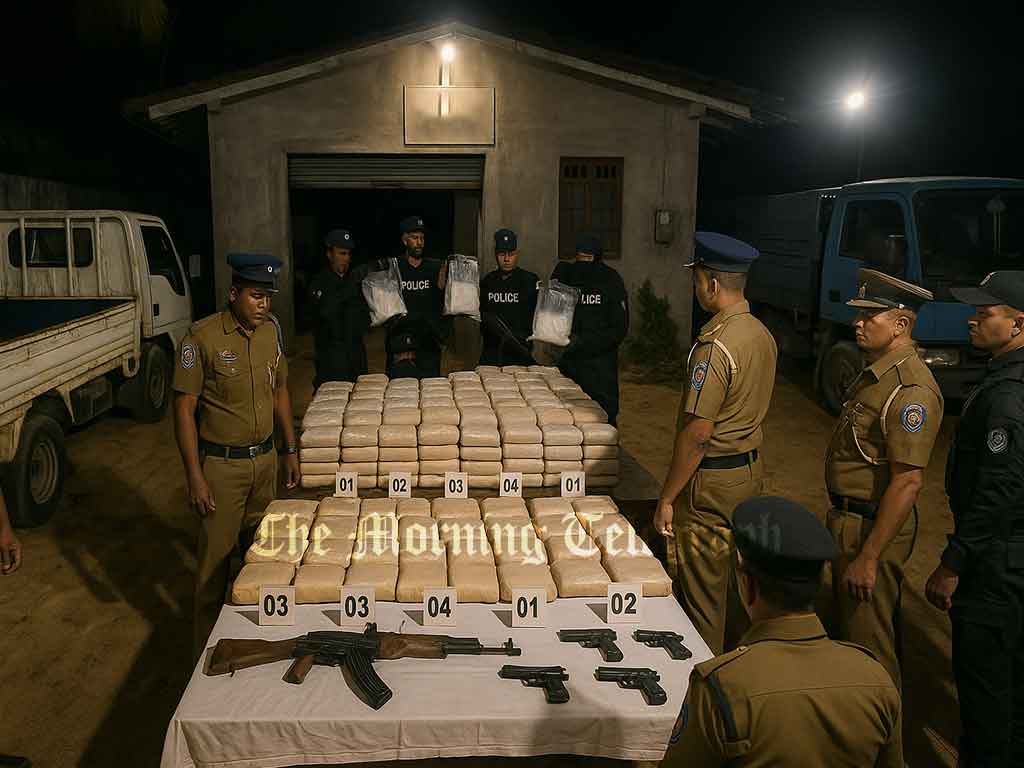
- Note that the above image was AI generated
What began as a covert landing on a quiet southern beach became Sri Lanka’s largest land-based drug seizure, exposing an international narcotics pipeline, a Rs. 100-billion underworld network, and a chilling trail of death. This is the granular, ground-truth account of how the Seenimodara drug haul collapsed an empire in the making — and what it reveals about the island’s fight against organized crime.
What began as a covert landing on a quiet southern beach became Sri Lanka’s largest land-based drug seizure, exposing an international narcotics pipeline, a Rs. 100 billion underworld network, and a chilling trail of death. It is also a granular, ground-truth account of how the Seenimodara haul collapsed an empire in the making, and what that collapse reveals about the island’s long struggle against organized crime. The southern rim has always been a corridor of commerce and contraband, a place where legal trawlers share the horizon with boats that carry goods that never appear on a manifest. In this liminal space, the Seenimodara case does more than set a record. It peels away the layers of a mature illegal market that links Afghan heroin producers, regional brokers, offshore financiers, and Sri Lankan fixers. At the center stands Unakuruwe Shantha, a crime organizer who cultivated invisibility rather than infamy, and who built influence without the theatrics that once turned names like Nawala Nihal, Wele Suda, and Makandure Madush into headlines.
The case reads like a thriller, yet the details are painfully real. Officers pulled 705 kilograms of methamphetamine and heroin from two cleverly modified lorries. They found a cache of rifles and pistols that foreign traffickers had tucked into the load as a grim industry sweetener. They counted three bodies on the margins of the job, two young handlers who overdosed and a middle aged facilitator who died during the frantic aftermath. Extrapolated losses ran well above Rs. 100 billion for the network that bankrolled the consignment. For law enforcement, it was a tactical victory. For the country, it was a mirror held up to the hard face of a market that monetizes fear, debt, and addiction, and that survives by making itself look ordinary from the street.

Before intelligence circles began to whisper his name, Unakuruwe Shantha drove a bus out of Unakuruwa in Tangalle. He worked the same routes as Makandure Madush, who later embraced the notoriety of a modern day crime boss. Shantha preferred to disappear in plain sight. He moved from petty robbery to armed assault, from extortion to rape and theft, including a notorious attack on a foreign tourist at a hotel in Hungama Rekawa. Those early years fixed the method that would later define him. He recruited from familiar turf, compartmentalized tasks so that no one person knew enough to give away the whole, and kept the public face away from the operational core. When the Chairman of the Southern Development Authority, Danny Hitthetiyage, was assassinated over a land dispute, operational groundwork was reportedly laid by Shantha while the trigger work was executed by Madush’s men. It was a division of labor that would repeat itself across other operations. As police pressure mounted, both men left the country, yet distance did not end their business. Encrypted phones, cutouts, and cash couriers kept the network alive. After Madush was murdered, a vacuum opened. Shantha filled it by cultivating ties with operators like Kanjipani Imran, Loku Patty, Harak Kata, and Midigama Ruwan, ensuring that if one partner fell there was always another to take his place.
Even a digitized criminal enterprise depends on old fashioned loyalty. For Shantha, loyalty had a name, his childhood friend, Unakuruwe Thusitha. They grew up in the same village and knew the same lanes, the same families, the same shadows that criminals hide in. When Shantha called from abroad in 2024, the message was simple. A large shipment was coming, worth billions, and it had to be handled perfectly. Get it right and the rewards would be strong, fail and the consequences would be personal. A shipment of that size meant layered receivers, staggered transports, safe houses with false walls, clean phones, and unregistered vehicles. It also meant recruiting a small crew that could lift without leaking information. Thusitha turned to his son, his nephew, and two hotel workers, Lakshan and Kalhara. Both of the hotel workers were known in the neighborhood, and both were deeply dependent on methamphetamine. Their inclusion, convenient in the short term, proved fateful in the end. Networks can be broken by pressure from outside, yet they are more often broken by weakness inside.
Shantha was not acting alone. The Seenimodara consignment bore the fingerprints of Kalu Sagara, an underworld assassin convicted in absentia of a notorious massacre in Angunukolapelessa in 1998. Six members of a single family were killed during that attack. Over time, Sagara built a reputation for hired killings, armed robbery, protection rackets, and drug logistics. He understood both the ruthlessness required to protect a large shipment and the patience required to coordinate one. With Interpol red notices shadowing both men, the operation relied on a maritime relay that began far from Sri Lankan waters and moved slowly toward a pinpoint landing on the southern coast.
On the night of September 21, the sea became a highway. Afghan heroin moved down the chain through Iranian and Pakistani intermediaries, then onto a mother ship. Offshore, the shipment split into two trawlers to reduce risk during the coastal approach. As part of the trade’s distorted etiquette, the consignment came with a bonus, a T 56 rifle and five modern pistols, status symbols to some buyers, insurance to others, and a wordless nudge toward future orders. Onshore, Thusitha coordinated with his son and nephew, as well as the two hotel workers. A DIMO Batta lorry waited with the engine running. Hours passed, phones buzzed, and beer bottles emptied as the crew waited for the trawlers to appear. When the boats finally reached shallow water, urgency replaced boredom. Parcels moved from hand to hand. Feet churned through foam. Orders cut through the surf. Then one of the trawlers lurched and sank. Boxes bobbed to the surface. Ice dissolved in seawater. Lakshan and Kalhara dove repeatedly, hauling soggy packages to shore. It looked like enough, perhaps more than enough. The team drove the load to the Seenimodara safe house, a property that had been quietly purchased using fake addresses and layered ownership, then ringed with a new wall and a half finished roller gate. It was an ordinary house disguised as a fortress that had no reason to exist in that location, except that it did.
Inside the safe house, exhaustion met temptation. The stockpile dazzled the two young men whose dependency had long outpaced their judgment. They used the drug that was stacked beside them. The quantities were large enough to be lethal. At the same time, Thusitha felt an intense pain behind the breastbone, a burning he described to his son as a fire in the body. He was rushed to Tangalle Hospital, stabilized, insisted on returning home, then deteriorated again and was rushed back. He died in the early hours, and his final words were a plea to finish the job, because he feared what Shantha would do if the operation failed. Back at the safe house, Lakshan and Kalhara lay dead. Panic displaced careful planning. From abroad, Shantha called repeatedly. He cared about one thing, get the lorry out before the police arrived. The message to Thusitha’s son was not coded. Whatever happens to your father, move the vehicle now, or face the consequences.
Fear sometimes produces obedience, yet it can also produce flight. Thusitha’s son and his cousin bolted, flagged down a three wheeler, and poured out their story to the driver, not knowing he was connected to Shantha’s network. The driver tried to take them back to the safe house. They fought him, leapt from the moving vehicle, and ran into the dark. At seven in the morning on the twenty second, they walked into the Tangalle Police Station and reported two bodies in the Seenimodara house, as well as their father’s death at the hospital. The story was chaotic, yet precise enough for a seasoned officer to recognize what mattered. Chief Inspector Kapila Senapathi de Silva moved quickly, alerting Senior Deputy Inspector General Kithsiri Jayalath and Senior Superintendent of Police Nipuna Dehigama. Within hours, a tight ring of police secured the area.
At the safe house, officers found ten boxes of methamphetamine already dissolved in water inside the DIMO Batta lorry. That single detail offered two insights. The unloading had happened recently, and part of the product had been compromised by seawater during the rescue. It also suggested that more of the load was hidden in other vehicles. A second lorry was traced to a garage two kilometers away. On the manifest, the front was stacked with melons. Experienced officers have learned to read packaging the way accountants read a ledger. They pulled the fruit, drilled into the false compartment, and found ice, heroin, and a bundle of weapons, a T 56 and four pistols. Back at the Seenimodara house, they found the same kind of engineered cavity in the lorry on site, and they pulled another mountain of narcotics from the metal belly. By midday, the tally was in, 705 kilograms, the largest land based seizure in Sri Lankan history. Street value estimates placed the cache at well over a billion rupees. Upstream valuations, which consider wholesale pricing and forward contracts, suggested losses above Rs. 100 billion for the network that financed the shipment.
Post mortem examinations at Tangalle Hospital established the immediate causes of death. Lakshan and Kalhara died of acute methamphetamine toxicity. Thusitha died of complications consistent with severe intake combined with physiological stress. These were not faceless casualties. They were a reminder that the illegal market uses people as tools and discards them as soon as they break. Meanwhile, the investigation tightened. Inspector General of Police Priyantha Weerasuriya arrived to coordinate, inspected the cache, and authorized parallel arrest operations. The owner of one lorry, a Ratmalana resident and a senior lieutenant in Shantha’s network with four prior drug arrests, went into custody. Thusitha’s son and his cousin were detained as material suspects and potential witnesses. Their statements, messy yet specific, anchored a timeline that investigators could begin to corroborate with cell site metadata, automatic number plate recognition hits, CCTV fragments, and call detail records.
Why does this bust matter, beyond the headline and the record setting number that makes for easy copy. Large seizures alter street pricing, availability, and the cash flow of gangs. When a shipment is stopped at sea, upstream financiers and producers eat the loss. When a shipment touches land and is seized afterward, the buyers bear the loss. That distinction matters. It recalibrates debt obligations, accelerates enforcement violence, and reshuffles alliances. When Rs. 100 billion vanishes in one night, collectors feel the squeeze, mid tier distributors scramble for working capital, and enforcers are told to recover cash that no longer exists. Historically, this is when fractures appear. Informants surface, inside wars erupt, and rival networks exploit the chaos. From a public health perspective, the Seenimodara seizure likely prevented a wave of hospitalizations, overdoses, and family level catastrophes across the island. From a policy perspective, it is a demonstration that rapid multi agency coordination, fed by local intelligence and executed with discipline, can transform an anonymous tip into a systemic disruption.
Arresting the architects will not be simple. Red notices are not magic. Shantha is believed to be in Belarus, while Sagara is also abroad, moving among jurisdictions where extradition is difficult or slow. Difficulty is not impossibility. It means investigators must combine financial surveillance with mutual legal assistance, shutting down the cash taps and freezing assets. Every network has a seam, a bank account created at the wrong time, a front company with a sloppy filing, a phone purchased with a traceable card, a courier who resents his handlers, a family member who wants out. Patience, fused with data and quiet pressure, breaks more networks than public raids ever do.
The Seenimodara property is also a lesson in criminal urbanism, the art of hiding an international enterprise behind brick and plaster. The method is predictable once you know what to look for. Buy through proxies, build high walls that are out of proportion to the house, install a roller gate that looks comically expensive for the neighborhood, cut false cavities into lorries that will beat a quick search but fail under methodical disassembly, insist that the mess is renovation to keep neighbors away, and never draw attention with luxury cars that do not fit the façade. The ordinariness is the camouflage. It works until the inside team panics, talks, or dies.
A shipment like this has a cast. Financiers bankroll purchase orders and hedge risk with side agreements. Facilitators coordinate the shipping handoff at sea and the offloading on the beach. Local crews do the hauling, the repacking, and the hiding. Enforcers collect debts and punish silence, or the wrong kind of speech. Retail distributors face the highest arrest risk for the lowest margin. At the bottom, users slide between roles, sometimes runners, sometimes lookouts, sometimes victims. Seenimodara compressed all of those roles into a single night and its immediate aftermath. Thusitha carried the risk that rests on people who are known by name in a neighborhood. Lakshan and Kalhara, propelled by dependence, crossed the line from participant to casualty in minutes. Suresh and Kalana, terrified by the threat inside the network, chose to run and confess. That single choice transformed a looming distribution wave into a historic seizure.
What comes next must be more than celebration. Sri Lanka needs to deepen maritime domain awareness, through a mix of radar, visual reporting, and pattern analysis that identifies trawlers moving unlike trawlers. It needs to strengthen financial intelligence so that hawala lanes, cash intensive fronts, and crypto off ramps are mapped and monitored. It needs to integrate data between Customs, the Ports Authority, Immigration, telecom companies, banks, and police, with strict rules to protect privacy. It needs to protect community informants, because the fastest tips still come from the neighbors who notice that a simple house suddenly has walls that do not match its story. It needs to expand demand reduction, because every kilogram that is seized matters more when treatment, prevention, and rehabilitation reduce the street’s ability to absorb shocks. And it needs to push international cooperation, because the men who orchestrate shipments do not respect borders and the law must be willing to chase them across the same map.
The national news cycle moves quickly. Raids crest and fade. Yet the Seenimodara case deserves to be part of the civic memory for what it proves. Organized crime is not invincible. Drug networks have seams. A small group of officers who make fast, disciplined decisions can transform millions of doses into exhibits and case files. The names will change, the methods will adjust, and the same dark coastline will remain a tempting runway. If Sri Lanka keeps building the muscle memory that this case required, the next trawler that noses toward a quiet beach will be met by a coastline that is awake.
For the families of the dead, none of this is theory. It is the aftermath of choices made under pressure and within poverty, choices channeled by men who keep their hands clean by keeping their distance. For the public, the lesson is simple. Vigilance is not paranoia when the stakes are life, law, and the future of neighborhoods that want to raise children without the shadow of meth and heroin. For the state, the mandate is simpler still. Sustain the pressure, keep the focus on the financiers and the facilitators, and do not mistake a record for a finish line.
The empire that Unakuruwe Shantha stitched together, from a small village in the south to safe apartments abroad, did not collapse in one night. Yet on that night in Seenimodara, under floodlights and morning haze, as boxes were opened and false walls were cracked, the network lost something that criminal empires fear more than prison. It lost momentum. Once momentum breaks, loyalty fractures, cash dries up, alliances wobble, and arrests follow. That is how stories like this end, not with a single blow, but with persistent strikes until the structure cannot stand. If Sri Lanka wants the Seenimodara haul to be more than a headline, it must keep striking, patiently, lawfully, and without spectacle, until the market that profits from fear and addiction has no place left to hide.