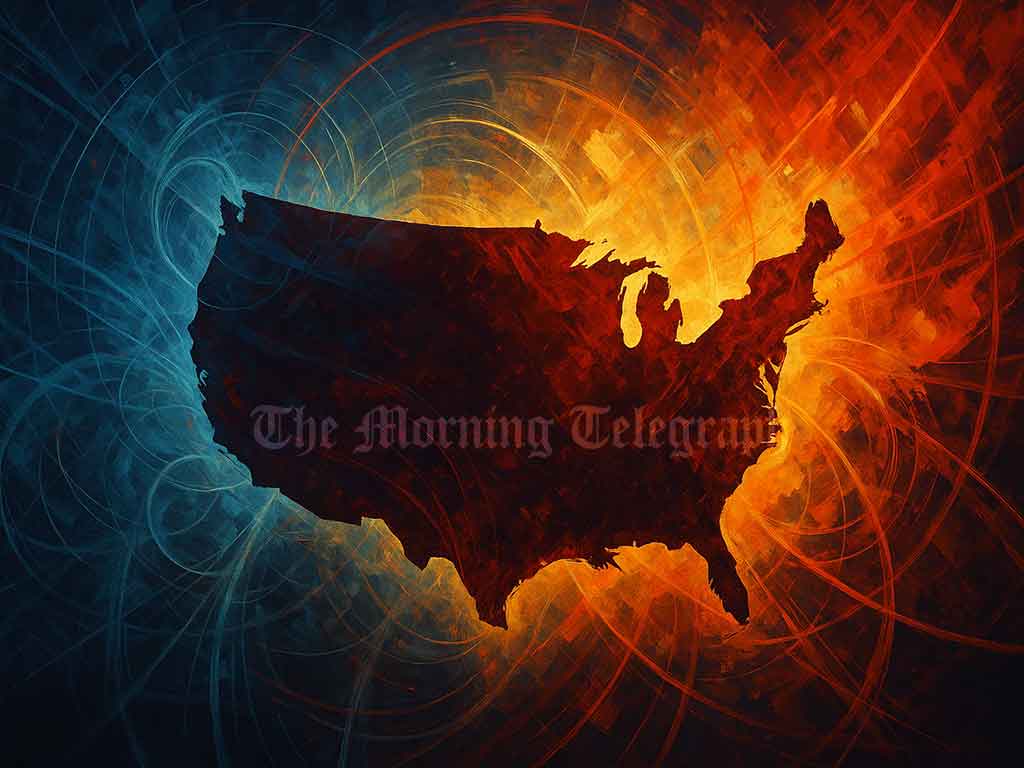
The U.S. government shutdown is more than a budget standoff—it is a fight over the soul of democracy, where power eclipses policy, liberalism falters, and the allure of authoritarian “strong gods” threatens to reshape the nation’s political future.
The American government shutdown currently unfolding has been framed as a dispute about healthcare, but the truth lies much deeper. On the surface, Democrats have chosen healthcare as the rallying cry, betting that voters will view them as champions of affordable care in the face of Republican indifference to a major cost-of-living issue. Republicans, however, appear unfazed by this framing. They see the shutdown not as a matter of healthcare at all, but as a strategic opportunity. In reality, this standoff is not about policy; it is about power. Behind every speech, press release, and talking point, the real conflict is about who gets to control the levers of government in an increasingly polarized nation.

Both sides, Democrats and Republicans, believe that shutting down the government serves their interests. For Donald Trump and the Republican Party, the shutdown is an opportunity to slash the size of what they consider a bloated government, dismiss federal employees they see as resistant, cut back liberal programs, and expand executive power at a time when Congress is struggling to assert itself. Democrats, meanwhile, see the shutdown as a desperate but necessary act of resistance. They view Trump as a president who disregards law and the Constitution, finding ways to bypass or undermine legislation. For them, a shutdown is the last remaining tool to show that Congress still matters, even if it risks dysfunction. It becomes an extreme act of defiance against what they perceive to be an extreme administration.
This means that the shutdown itself has become less about policy and more about raw power. In a political battlefield where power determines survival, compromise becomes synonymous with weakness. Neither side believes they can afford to be seen caving in. The Democrats face a particularly dangerous dilemma. To fight Trump on the ground of power is to step directly onto his preferred battlefield. Trump thrives on brinkmanship, pushing situations to the breaking point until his opponents falter first. He thrives on confrontation and thrives on dragging conflicts out, confident that his opponents will blink before he does. The question then arises: are Democrats willing to allow the shutdown to stretch for weeks or months, even if it leads to the breakdown of government services? Activists will demand such defiance, but others within the party recognize the importance of maintaining functional governance. The longer the shutdown lasts, the greater the pressure to cave in. Yet caving in, in the eyes of Democrats, would amount to losing once again.
There is a deeper danger in this political dynamic. If politics is reduced to nothing more than a struggle for power, the center-left risks abandoning its foundational liberal conviction that law, procedures, and compromise should serve as limits on power. Accepting politics solely as a power contest leaves no room for the restraint and institutional checks that have long sustained democratic governance.
Across Europe and the United States, liberalism is struggling against the tide of populism. In Slovakia, Robert Fico has returned to power. In the Czech Republic, populist leader Andrej Babiš appears poised for reelection. Poland has seen the return of Donald Tusk and his liberal vision, but he has failed to halt the march of right-wing populism, particularly among younger voters. In America, Joe Biden’s promise to restore competence, normalcy, and legality has not delivered the stability many hoped for. Instead, disillusionment has grown. Increasingly, people seem tired of liberalism itself. They crave not the restraint of institutions and limits, but the thrill of power.
This is the revolutionary return of politics in a raw, unfiltered form. For many citizens, policy debates are less important than ensuring that their side wins. Fear now dominates: half the population believes the other side will bring tyranny, while the other half fears that losing will mean the end of civilization as they know it. Politics is consumed by an apocalyptic imagination, where every contest is painted in existential terms. As political theorist Ivan Krastev observes, politics today is consumed by clashing visions of catastrophic urgency.
The postwar liberal order was designed precisely to avoid this mood. By taming politics and restraining power, liberal elites aimed to protect societies from tyranny, fascism, and totalitarianism. Institutions were built to keep extremism in check. Yet in restraining politics, liberalism may have hollowed it out. It failed to address basic human needs—the longing for risk, the search for belonging, the exhilaration of collective power. Instead of cultivating vibrant politics, liberalism too often suppressed it.
Thinkers such as N.S. Lyons, echoing Hannah Arendt, argue that postwar liberalism was structured to tame politics itself. Liberalism promised security, but in doing so it suppressed dissent and stifled conflict. The liberal fear of the so-called “strong gods” of nationalism and ideology drove elites to embrace Karl Popper’s “open society,” where pluralism and technocratic governance were supposed to prevail over passion. Bureaucrats, experts, and rationalized procedures replaced collective political energy. Democracy was kept at a distance, managed by technocrats rather than embraced by the people.
This suppression has provoked a backlash. Populism, according to Lyons, is not mere grievance but a passionate demand to restore power and pride to politics. Trump embodies this backlash in his bold dismantling of the managerial state, his rejection of global liberalism, and his push for direct executive control. Lyons sees history swinging like a pendulum: after a century dominated by liberal proceduralism, the strong gods are returning.
Lyons is correct in recognizing how technocracy drained politics of vitality and how Trumpism channels resentment against suppressed popular will. Yet his view that the return of strong gods is inevitable overstates the case. Politics is not condemned to cycles of liberal weakness and authoritarian resurgence. Hannah Arendt offers another vision: one that acknowledges liberalism’s weaknesses but refuses to accept fatalism.
Arendt recognized the appeal of closed societies rooted in loyalty, sacrifice, and collective passion. Yet she warned that a return to such societies would be both impossible and dangerous after the totalitarian ruptures of the 20th century. She insisted that politics must provide meaning, not through suppression but through active participation. For her, the path forward was a political transcendence founded in plurality—the collective experience of people speaking and acting together across differences to build a shared world.
What made Arendt’s work powerful was her insistence that the true danger of modern liberalism lay not in weakness but in bureaucracy—the “rule of nobody.” When politics is reduced to administration, rebellion and resistance become impossible because there is no one left to resist. Her solution was not to enthrone new strong gods but to multiply centers of power: federalism, citizens’ assemblies, local councils, and institutions of self-government. Against Lyons’ binary pendulum of open versus closed, Arendt envisioned a renewed open society through participatory politics. Politics itself, in her view, could create meaning, courage, and seriousness without descending into tyranny.
Arendt admired the American Constitution not because it restrained the people but because it embodied the American tradition of self-government. Rooted in the colonial experience of town halls and councils, it allowed citizens to act together in meaningful ways. Its federalist principles encouraged the diffusion of power, preventing any one faction from domination while allowing politics to flourish. The Constitution, with its separation of powers, division between federal and state authority, and dense civic networks, made politics both restrained and empowered. It gave citizens opportunities to act together without surrendering to tyranny.
Her alternative remains both radical and humble. It does not guarantee certainty or rely on tradition. Instead, it affirms politics itself—the human capacity to begin anew. That is what is truly at stake in the shutdown. To fight Trump only on the terrain of raw power is to accept Lyons’ bleak cycle of liberalism’s weakness and authoritarian resurgence. To resist through Arendtian politics is to keep democracy alive—by multiplying institutions of freedom, renewing capacities for collective action, and refusing the seductions of unchecked sovereignty.
What America faces is not merely a shutdown over budgets or programs, but a test of whether democracy itself can survive in a time of disillusionment. If politics becomes only about winning at all costs, then democracy risks collapsing under the weight of its own contradictions. But if Americans can embrace the possibility of politics as Arendt saw it—rooted in plurality, shared action, and collective renewal—then even in the midst of division, there is hope for democracy to endure.
The current shutdown is not just another partisan battle. It is a warning that American democracy is at a crossroads. The choice is between surrendering to cycles of liberal weakness and authoritarian resurgence, or rediscovering politics as a shared human endeavor. The danger lies in treating politics as sheer willpower and inevitability, but the opportunity lies in embracing politics as collective renewal. The future of democracy depends on choosing the latter, before it is too late.