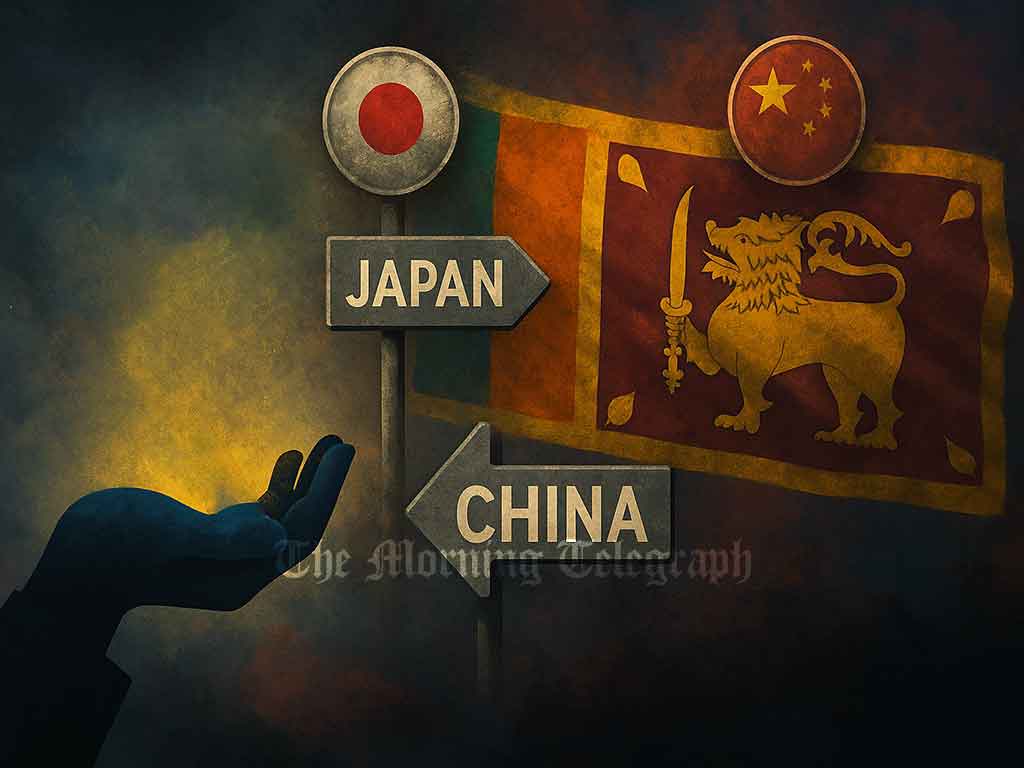
Sri Lanka has once again been drawn into a financial gamble, as President Anura Kumara’s administration opted for an expensive Chinese loan over far more favourable Japanese terms, raising alarm about the country’s growing debt trap and diplomatic vulnerability.
During his 2024 election campaign in Kandy, President Anura Kumara proudly told supporters that he had secured Japan’s willingness to assist with the Kandy Expressway project after requests from the Mahanayake Theros. Japan, known for offering long-term low-interest financing, had previously extended loans for Sri Lanka’s airport development at a minimal 0.18 percent interest rate. Many expected the government to seize this opportunity to finance the much-awaited highway on similar concessional terms.

Yet, in a move that baffled both economists and lawmakers, Anura’s government turned instead to China. The Mirigama–Kadawatha section of the expressway was launched using a Chinese loan, which came with a steep 3.5 percent interest rate. Soon after, Parliament’s COPF Chairman Harsha de Silva warned that the terms were heavily skewed against Sri Lanka. Originally, China had offered a one billion dollar loan at a fixed 2.5 percent rate, but this was reduced to 500 million dollars and tied to a floating interest rate of 5.5 percent. According to Harsha de Silva, such restructuring clearly left Sri Lanka disadvantaged and exposed to further financial instability.
The politics surrounding the deal added another layer of controversy. Just before the expressway inauguration, the Chinese Ambassador met both former President Mahinda Rajapaksa and former Prime Minister Ranil Wickremesinghe. Officially, these visits were described as routine diplomatic meetings and opportunities to deliver invitations for China’s National Day. However, speculation soon followed that the ambassador had sought assurances from the Anura administration that Mahinda Rajapaksa would not face political harassment.
The ambassador later joined the opening ceremony of the Mirigama–Kadawatha section, where he praised Anura’s government and highlighted the benefits of Chinese financing. For China, the deal not only brought financial gain but also allowed it to strengthen influence over influential Buddhist clergy, including the Mahanayake Theros, thereby securing political goodwill in Sri Lanka.
Reports further suggested that whenever the Chinese Ambassador met the Mahanayake Theros, he raised the subject of the Kandy Expressway. Observers believe that this interest could have been leveraged by the government to negotiate better loan terms, especially since Japan’s financing model had proven far cheaper in previous projects. Yet, the Sri Lankan administration failed to seize that chance, leading critics to claim that the country had once again been trapped in the debt cycle first set in motion during Mahinda Rajapaksa’s presidency.
The bigger concern is the timing. Sri Lanka’s economy has already collapsed under the weight of unsustainable debt, inflation, and a fragile recovery process. At such a critical juncture, experts argue that choosing an expensive loan over a concessional one undermines the prospects of stabilizing the economy. Instead of reducing financial strain, the government has deepened dependence on Chinese credit, which many view as part of a broader pattern of strategic entrapment.
For ordinary citizens, the impact is likely to be felt through prolonged debt repayments, higher taxation, and fewer resources available for social development. The decision also sends worrying signals to international lenders and investors, who may see Sri Lanka as increasingly tied to unfavourable financial commitments.
Ultimately, the choice to pivot from Japan’s affordable offer to China’s costly loan has reignited the debate on how Sri Lanka navigates its foreign relations and financial survival. While the government insists the project will spur development, critics warn it could be another step toward deepening vulnerability at a time when the nation can least afford it.