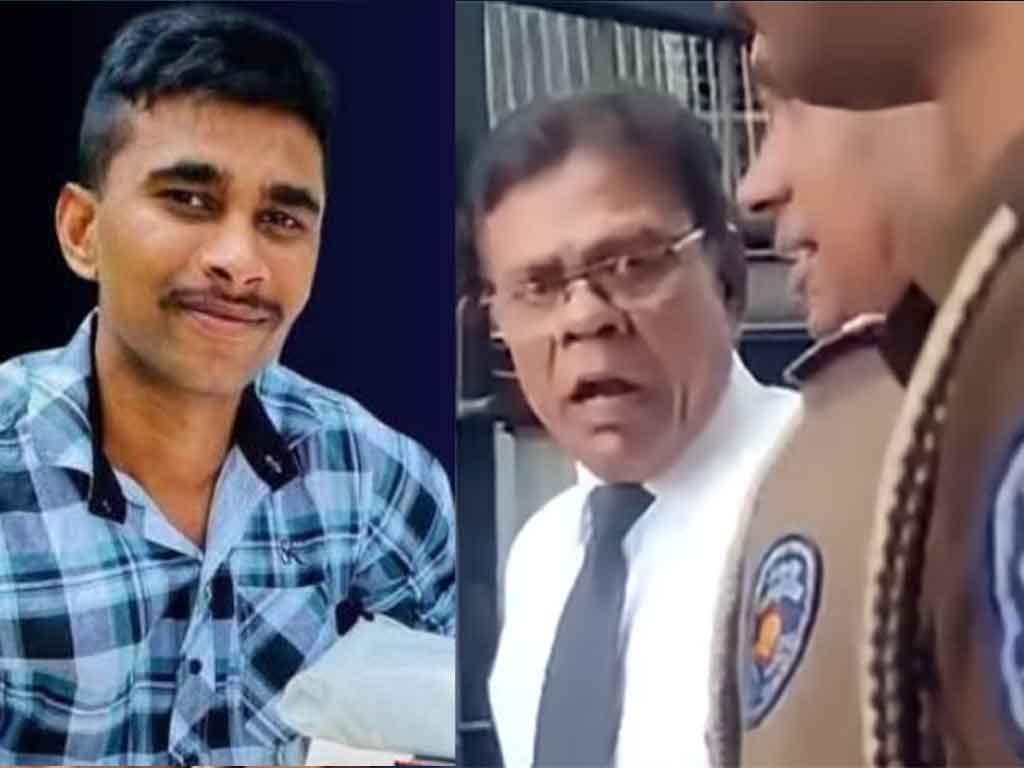
The high-voltage confrontation at the Mount Lavinia Magistrate’s Court has taken a dramatic turn, with attorney Gunaratne Wanninayake summoned to the Mount Lavinia Police Headquarters. The lawyer faces investigations over allegations of criminal intimidation, coercion, and verbal abuse directed at a police constable, while the police force insists that the officer at the center of the storm will not lose his job and will receive full legal assistance.
The incident, captured in video footage now widely circulating on social media, has ignited fiery debates across the country. Public opinion remains sharply divided, with some rallying behind the embattled constable and others questioning the influence wielded by sections of the legal profession. Acting Police Media Spokesperson Minura Rashantha Senarath addressed the controversy directly in a Facebook post, confirming that the Special Investigation Unit has begun parallel inquiries: one into the lawyer’s conduct and another into the initial process that led to the constable’s remand order.

The police insist that the constable, who was merely carrying out his duties to ensure the safe passage of a prison bus within court premises, has nothing to fear regarding his job security. “The officer’s job is safe. He will be provided legal assistance tomorrow,” Senarath assured, signaling strong institutional support for rank-and-file officers who often feel vulnerable when confronted by powerful professionals.
However, the clash has exposed deep fractures in Sri Lanka’s justice system, where questions of influence, privilege, and accountability repeatedly surface. Critics argue that this episode reflects a wider culture where some lawyers, shielded by social standing and institutional backing, behave as if the law is subservient to their personal ego and connections. On the other hand, supporters of the attorney claim that the incident is being politicized, with certain factions using it as ammunition to discredit the legal community at large.
The police spokesperson did not mince words in his note, accusing “those fishing in troubled waters” of trying to break the morale of ordinary officers. “Some are shedding crocodile tears because of the grudges they have with the police,” Senarath wrote. “Our officers should not be disappointed. We have repeatedly gone beyond our duty to protect the public, and we remain responsible for their safety.”
The case has now become more than a local courtroom scuffle. It has grown into a national test of accountability, institutional integrity, and the delicate balance between law enforcement and the legal profession. As investigations continue, both the public and professional bodies will be watching closely to see whether this incident is resolved with transparency and fairness or whether it deepens the mistrust already eroding faith in Sri Lanka’s justice system.
Sri Lanka now stands at a crossroads. Will this clash be remembered as yet another episode where influence trumped justice, or could it set a precedent that no individual—lawyer or otherwise—is above the law? The answer will shape how ordinary citizens view not only their police but also their courts in the years to come.