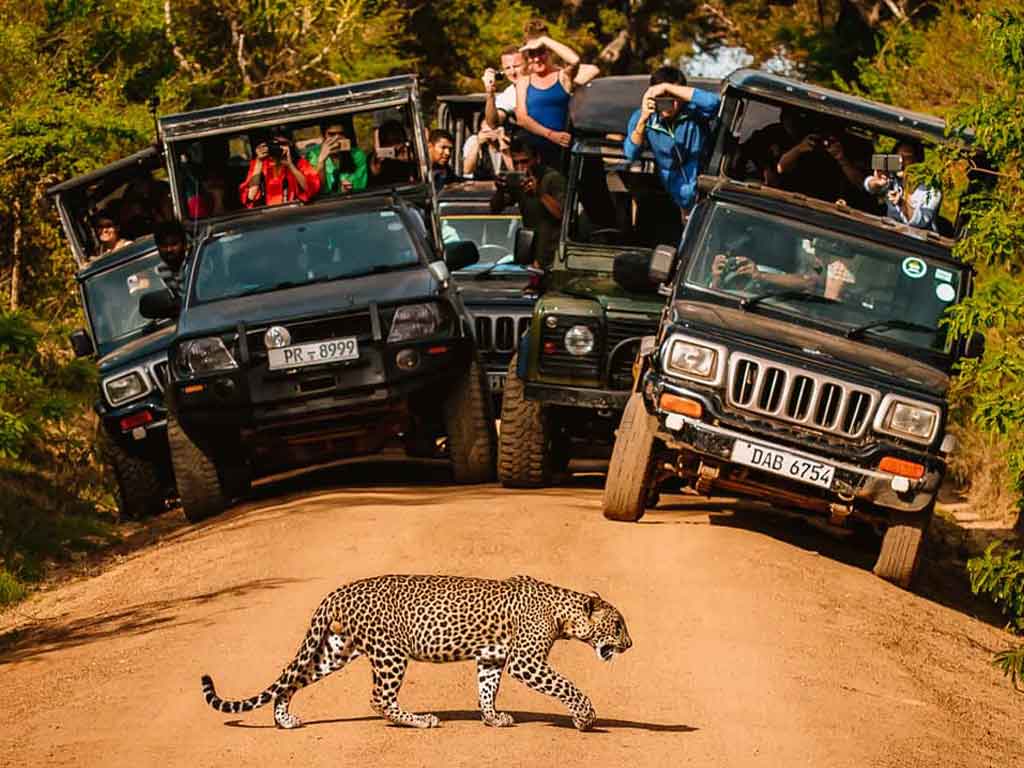
An audit has exposed the ugly truth behind Sri Lanka’s wildlife tourism boom—overcrowding, neglect, crumbling facilities, and a staffing crisis threaten to turn the island’s prized natural wonders into a cautionary tale of mismanagement.
Sri Lanka’s wildlife tourism, hailed as one of the island’s biggest economic lifelines, is now trapped in a dangerous imbalance. The latest review by the National Audit Office, included in the Department of Wildlife Conservation’s (DWC) 2024 Performance Report, has sounded the alarm. While blockbuster parks like Yala groan under the weight of uncontrolled crowds, dozens of other national parks are wasting away through sheer neglect, outdated infrastructure, and shocking administrative inaction.

The numbers paint a picture of both success and crisis. In 2024, wildlife tourism raked in Rs. 8.815 billion in revenue, a figure that underscores its role in Sri Lanka’s economic recovery. But almost all of that wealth comes from just a handful of destinations. Yala led the charge with a staggering 646,704 visitors, split between 293,058 locals and 353,646 foreigners. Horton Plains followed with 349,398 visitors, while Udawalawe saw 276,081. These three parks alone dominate the tourism landscape, leaving ecosystems battered by excessive footfall and wildlife increasingly pressured by overexposure.
This intense concentration of visitors has not only endangered fragile habitats but also created a bottleneck that limits the sector’s ability to grow sustainably. Parks such as Minneriya and Kaudulla, which could relieve the pressure, remain crippled by neglect. The Minneriya museum, designed as an educational hub, is in such poor condition that it fails to serve its purpose. In Kaudulla, the much-discussed Manik Sorowwa Bungalow is still closed to the public despite funds being allocated. Even heavily visited sites like Horton Plains have not escaped scrutiny, with auditors highlighting the crumbling state of basic sanitary facilities.
Tourists, both local and foreign, increasingly find themselves stranded without access to basic needs. In Minneriya and Kaudulla, visitors struggle to access drinking water, an essential requirement for any travel destination. The lack of such fundamental amenities pushes tourists back to Yala and other “safe bets,” creating a vicious cycle of overcrowding in some parks and abandonment in others. This imbalance undermines the entire wildlife tourism ecosystem that Sri Lanka depends on.
Looming over these structural failures is an even deeper problem: the collapse of human resources within the Department of Wildlife Conservation. Out of an approved cadre of 2,820 staff, the department currently operates with a staggering 930 vacancies. That amounts to a one-third shortage of personnel across critical roles. With fewer rangers, administrators, and conservation experts in the field, the DWC is ill-equipped to monitor ecological impacts, manage visitor pressure, or even maintain the facilities that could help distribute tourism more evenly.
This human resource vacuum cripples the ability of the DWC to take corrective action. Projects are delayed, conservation strategies remain unimplemented, and the already fragile balance between tourism and conservation continues to tip toward exploitation. The audit makes it clear: without urgent staffing and management reforms, the revenue boom risks collapsing into a long-term ecological and financial disaster.
The dual threat of overcrowding and neglect is a ticking time bomb. Popular parks such as Yala and Horton Plains are being pushed to breaking point, their ecosystems battered by relentless traffic. Meanwhile, underdeveloped parks like Minneriya and Kaudulla are starved of investment and attention, unable to shoulder their share of the tourism load. Unless Sri Lanka rebalances this equation, it risks losing not only its biodiversity but also its reputation as a premier wildlife destination.
The audit’s findings serve as more than just a bureaucratic warning. They are a roadmap to disaster if ignored. Sri Lanka’s wildlife parks are not simply tourist attractions but vital natural assets that safeguard biodiversity and underpin the country’s global image. The future of the sector depends on decisive action: balancing visitor numbers, fixing neglected infrastructure, restoring basic amenities, and, above all, filling the gaping human resource void in the Department of Wildlife Conservation. Without these steps, the next audit may not be reporting on a crisis—it may be chronicling a collapse.