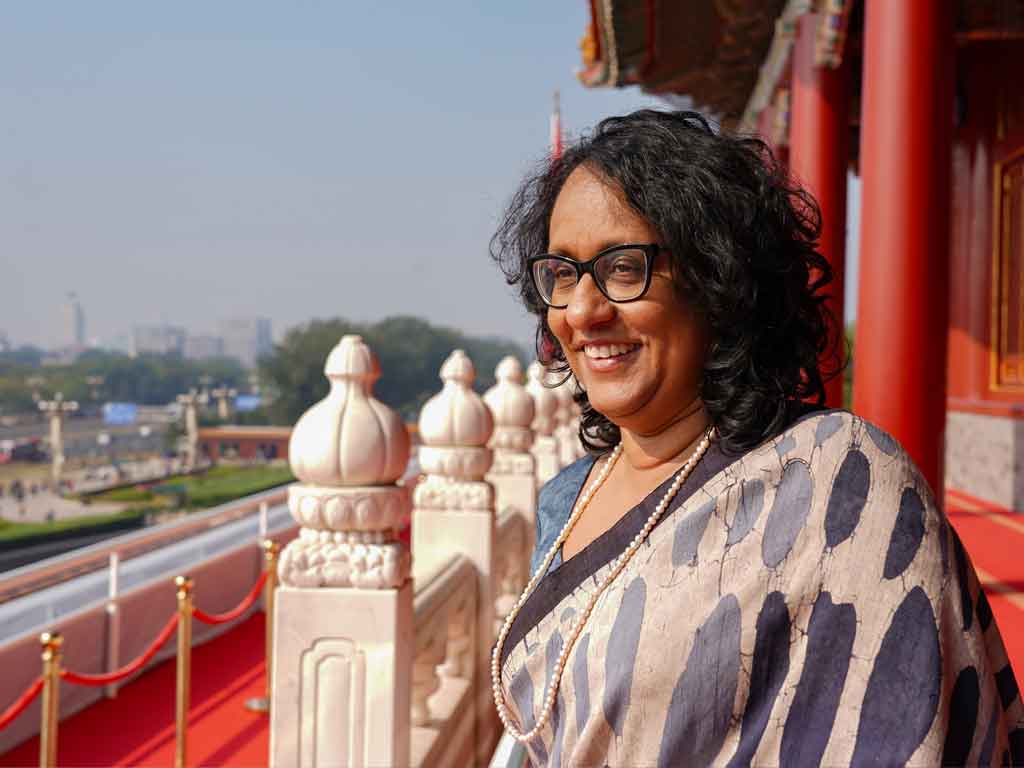
Prime Minister Harini Amarasuriya’s back-to-back invitations from China and India have shaken up the JVP’s influence over Sri Lanka’s foreign affairs, exposing the uneasy tug-of-war between international charm and party control.
Prime Minister Harini Amarasuriya has quickly become the face of Sri Lanka’s foreign policy intrigue, as her rising international profile now threatens the JVP’s tight grip over foreign engagements. The tension began with a circular issued by the government in January, requiring that any minister or government official seek presidential approval before meeting foreign dignitaries or envoys. While framed as a blanket rule, opposition figures claim it was designed with Harini in mind, a direct move to limit her growing global presence.

Harini, educated in both India and the United States and a former employee of an American-funded NGO, has steadily cultivated deep ties not just with Washington and New Delhi but also with other Western capitals. As a National List MP, she had already played an instrumental role in bridging the JVP’s standing with Western governments, a role that did not go unnoticed within her party. Her foreign ties, once seen as an asset, have now become a political liability as the JVP wrestles with the perception that her influence abroad eclipses their authority at home.
The suspicion intensified when it became clear that her foreign trips were being carefully monitored and, according to political chatter, restricted by the JVP itself. Yet her recent invitation from China shifted the equation. Unlike with her Western connections, the JVP did not oppose this visit, which was arranged by the Chinese ambassador in Colombo. Beijing initially downplayed her presence, but once India extended its own invitation, including a meeting with Prime Minister Narendra Modi, China recalibrated, with the embassy reportedly advising leaders in Beijing to attach greater importance to her visit.
Reports suggest that Harini’s earlier attempt to secure a meeting with the Chinese President’s wife was met with resistance. However, following confirmation of her India trip, she now appears poised to gain the high-level access previously denied. Her eventual meeting with the Chairman of the Chinese People’s Political Consultative Conference has further highlighted the significance of her engagement. The irony was not lost on observers that JVP General Secretary Tilvin, who visited China earlier in the year, was not given a similar opportunity.
China, keenly aware of the political hierarchy in Sri Lanka, knows that Tilvin is second only to the President. Yet Harini’s appeal clearly lies elsewhere. For Beijing, her established links with the United States, Europe and India position her as a figure worth watching closely. This makes her more valuable than any internal party title could dictate.
Adding another twist, NDTV India invited Harini to meet Modi, though the timeline of whether this occurred before or after China’s invitation remains unclear. Regardless, the dual visits have sparked growing unease within the JVP, a party suddenly confronted with the reality that their Prime Minister may be leveraging international diplomacy to chart her own path. For the JVP, the challenge is no longer about managing Harini’s foreign trips but confronting the uncomfortable truth that their internal authority could be diluted by her expanding global influence.