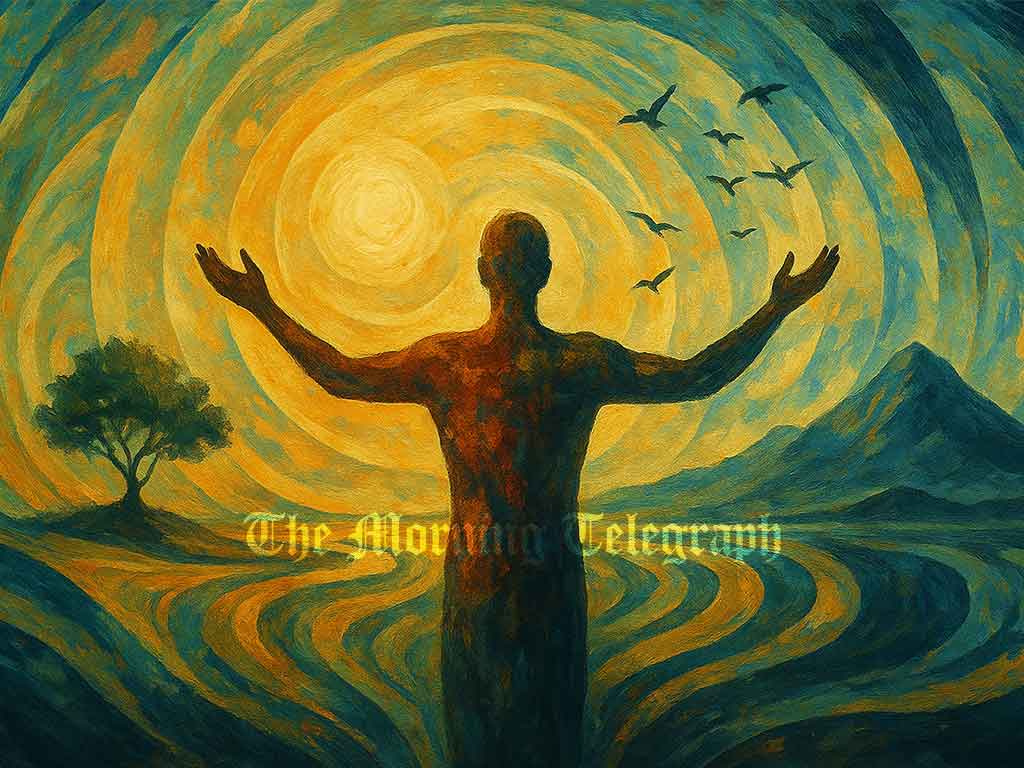
An invitation to see how human intelligence, when realigned with dignity, can restore balance where our systems have broken harmony.
By Roshan Jayasinghe
When we pause long enough to observe, nature reveals her quiet rhythm.
The sun rises and sets.
Storms arrive and clear.
Harvests flourish, then fail.
Life opens, life closes.
This is duality, nature’s reminder that all things move in cycles. Yet, unlike the river or the tree, humanity carries something more: intelligence. We were given the ability to see the wheel turning and to respond with awareness, to rise above reaction and live in alignment with dignity.
But somewhere along the way, we turned against that wisdom. In our effort to control, we built systems to manage life, economy, politics, religion, and borders, that slowly hardened into illusions. They were meant to organize us; instead, they began to divide us.

Unmasking the Constructs
Money, once a simple tool of exchange, now measures worth itself. It determines not only what we can buy, but often how much we believe we matter.
Politics, designed to represent the people, survives today by separating them, left and right, for and against, victory or defeat.
Religion, once a language of love, now too often guards the walls of its own identity rather than living the spirit of unity it was born to teach.
Borders, meant to protect, have become lines that deny belonging.
Each of these human inventions has forgotten its original purpose. They all share the same failure, the forgetting of dignity.
Dignity is not an idea or a prize. It is a natural constant, like gravity, holding life in balance. When we remove it from any system, economic, political, or spiritual, we fracture the human experience at its core.
The Disruption: When Intelligence Turns Against Its Own Purpose
If nature’s duality was meant to teach balance, human intelligence was meant to create alignment. Yet much of our suffering begins when that intelligence turns against its own purpose.
Greed replaces gratitude.
Control replaces cooperation.
Dominance disguises itself as leadership.
Profit is mistaken for progress.
Through these distortions, systems that were meant to serve humanity began to feed upon it.
Economy became a game for the few, rewarding accumulation over contribution.
Politics turned into performance, where winning mattered more than wisdom.
Religion began to defend its name rather than embody its essence.
Borders became tools of exclusion rather than organization.
Over time, these patterns shaped an invisible code, one that tells us competition is survival, wealth is worth, and power is privilege. Humanity began to live as though compassion were weakness and exploitation were strength.
The result is everywhere around us:
• A planet overworked and exhausted.
• Communities losing connection.
• Individuals running faster, yet feeling emptier.
• Leadership guided more by self-interest than service.
This is not intelligence, it is intelligence misused. It is human potential diverted into fear, greed, and control.
Yet these are not fixed realities. They are habits, chosen, reinforced, and passed down. And what has been chosen can be unchosen.
Realignment begins the moment we see these distortions for what they are and decide no longer to serve them.
When we stop rewarding manipulation and begin to value mindfulness; when we stop admiring dominance and start honoring integrity; when we stop measuring success by profit and start measuring it by well-being, the correction begins.
It begins quietly, in individual hearts and everyday choices. But multiplied across people and nations, it becomes a turning point for the human race.
The Defining Question
Pause here and consider this with your own intelligence:
We already coordinate global supply chains, elections, financial markets, and information systems with astonishing precision. We already spend fortunes and lifetimes maintaining structures that too often produce scarcity, rivalry, and harm. If we can organize this much effort around what diminishes life, why can’t we organize the same effort around what dignifies it?
Why do we accept as “normal” that some must go without food and water in a world of surplus; that some must die for a lack we collectively manufacture; that some must be silenced so others can dominate? These are not laws of nature. They are outcomes of choice, coded into policy, culture, and habit.
So here is the defining question for our time:
If we can build systems that harm at scale, why won’t we commit to building systems that heal at scale?
If we can be this disciplined about profit, can we be equally disciplined about well-being?
If we can reward dominance, can we choose instead to reward service?
Realignment is not a mystery. It is a decision, to measure success by how life improves for all, to retire practices that dehumanize, and to rebuild incentives so that dignity is not the exception, but the rule.
Personal Reflection:
- What do I reward in my work, purchases, and words, extraction or contribution?
- What “that’s just how it is” beliefs keep harmful systems alive?
- What can I redirect, one act, one habit, one decision, toward dignity today?
The Call to Realignment
Realignment begins not with policy, but with people.
Imagine a generation of children taught not only letters and numbers, but truths of being human:
- That every life holds equal worth.
- That caring for one another is natural.
- That difference is variety, not hierarchy.
- That the earth is inheritance, not trophy.
As these children become youth, their education matures. They are invited not just to work, but to help shape society, to strengthen communities, refine what already exists, and create not for rivalry, but for contribution.
Then adulthood becomes guardianship, a season of stewardship.
Leadership measured not by victory, but by the well-being of all.
Power made transparent and accountable.
Resources circulated, not hoarded.
Economies aligned with this spirit would still reward effort and ingenuity but never at the cost of another’s survival. Politics would still debate fiercely but unite when decisions are made.
The Body and the Spirit in Harmony
From childhood play to adult sport, the body can teach us one of life’s simplest lessons: competition does not need to be hostility.
To win with grace and lose with dignity is to live equality in motion.
And spirit, too, can return to its root. True reverence lies not in repetition but in compassion lived in kindness, humility, and shared humanity. Temples, churches, mosques, and shrines may remain, but their true purpose must be unity through understanding, not separation through dogma.
Four Pathways to Collective Realignment
- Universality – Every person guaranteed the basics of life: food, water, shelter, health, and education.
- Resilience – Systems designed to absorb shocks, economic, climatic, or social, instead of amplifying them.
- Transparency – Power and decision-making conducted in light, not secrecy.
- Cooperation – Progress measured by how widely benefits are shared, not how narrowly they are claimed.
Applied with sincerity, these principles do not erase difference, they guide it into harmony.
Sometimes we forget that intelligence was never meant to dominate life but to harmonize with it. Nature offers contrast so we can learn, not divide.
When we return to this knowing, we begin to see that the solutions we long for have always been within reach, quiet, simple, waiting in our shared humanity.
Stepping Into the Sanctuary
Picture a world where food and water are treated as shared inheritance, where energy flows clean from sun and tide, where forests and oceans are tended as living temples.
Imagine nations that still celebrate their unique identity yet meet each other as partners, not adversaries.
Children would grow in security, not scarcity.
Youth would create from purpose, not rivalry.
Adults would lead as stewards.
Elders would guide as wisdom-keepers.
Borders would remain, but they would no longer wound. Languages, colors, and cultures would enrich rather than divide. Even competition among nations would evolve, from who exploits more to who uplifts better, regenerates faster, shares more wisely.
This is not an impossible vision. The knowledge, resources, and tools already exist. What we lack is alignment, the collective decision to act from the intelligence nature has already placed within us.
Final Reflection
Nature will continue her cycles. Storms will come; harvests will fade and return. But humanity’s own cycles of inequality and division are not laws of nature, they are patterns of choice.
Each time we choose compassion over cynicism, dignity over domination, and cooperation over fear, we restore balance to the human story.
The sanctuary of humanity is not a place, it is a practice. It lives wherever intelligence meets empathy and action serves life itself.
It begins now, in every conscious act of care.
Author’s Note
This reflection is part of my continuing inquiry into how we, as human beings, might live in greater alignment with the natural order. I write not as a critic of our systems, but as a witness to how far we have drifted from what is simple and true. My hope is that these words inspire reflection, dialogue, and a rekindling of the inherent dignity that unites us all, beyond culture, belief, or boundary.
The sanctuary I speak of is not a dream for later generations; it begins in the smallest gesture of integrity, the quietest act of kindness, and the willingness to see another as oneself.
Creative advanced abstract image for the above story in 16:9 without headline in it.
Editor’s Note
In this essay, Roshan Jayasinghe continues his exploration of human consciousness and collective well-being. The Sanctuary of Humanity examines how the systems we have built can evolve beyond competition and control into cooperation and dignity, a call to see humanity not as divided nations or economies, but as one shared family in motion.