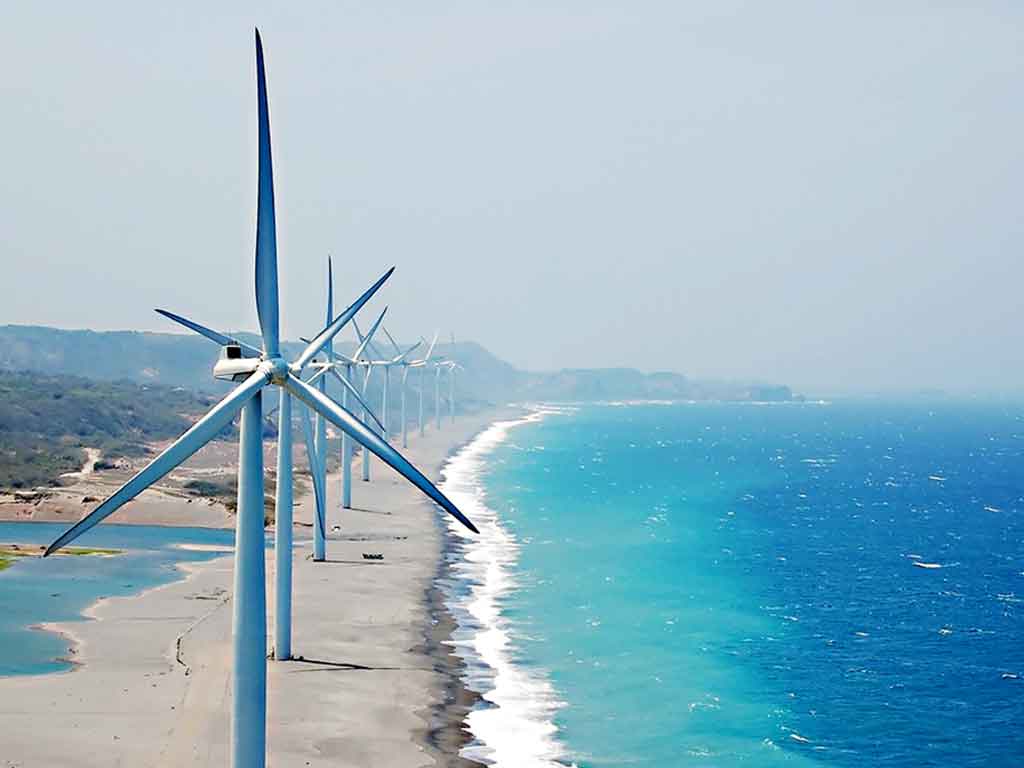
Mannar Island, a sanctuary of fishermen, mangroves, turtles, and millions of migratory birds, is being turned into a battlefield between clean energy ambitions and the survival of people and biodiversity. What was meant to be a green future is fast becoming a tale of vanishing rights, blocked wetlands, and broken promises.
Our studies have revealed that the people and biodiversity of Mannar Island are currently facing a huge threat due to the wind farm project plans prepared jointly by the Sri Lanka Sustainable Energy Authority, the Ceylon Electricity Board and the Asian Development Bank. All the wind farm plans prepared by these institutions have focused solely on studies aimed at energy production. There has been no attention paid to the future survival of the people living on Mannar Island or the survival of the biodiversity, as well as the nature of the land use of Mannar Island or the nature of its current national plans.
The Asian Development Bank has prepared the research reports necessary to make Mannar Island the center of green energy, making the provision of loan assistance its priority. Moreover, the main objective of this is to open up investment opportunities for companies in wind power projects on Mannar Island. It is a major shortcoming that the Asian Development Bank has not paid any attention to the principle of Just Transition in its approach to sustainable energy. Therefore, in making Mannar Island a sustainable energy hub through wind power plants, attention has not been paid to the impacts on the fishing community, fishing resources, farming community, cultivated lands and its natural systems. Moreover, the Asian Development Bank has prepared plans to make Mannar Island a sustainable energy hub without paying any attention to the international conventions on the biological community of Mannar Island.

Violation of the principle of a just transition to clean energy
A just transition to clean energy is about ensuring fairness and equity, while avoiding inequalities and negative impacts, by focusing on the economically affected, displaced and disenfranchised communities in the transition to clean energy. Moreover, all affected parties must be represented at the center of decision-making mechanisms.
This is a concept enshrined in the Paris Agreement. As a country that ratified the Paris Agreement on Climate Change, adopted by 196 member states at the 21st Conference of the Parties to the United Nations Framework Convention on Climate Change held in Paris, France on 12 December 2015, on 21 September 2016, Sri Lanka should pay special attention to the conceptual principle of just transition specifically mentioned therein.
At the 26th Conference of the Parties to the United Nations Framework Convention on Climate Change, a set of common principles related to just transition was announced in accordance with the Paris Agreement. Accordingly, multilateral development banks including the Asian Development Bank have pledged to protect the principle of climate change mitigation and just transition.
However, it does not appear that the Sustainable Energy Authority or the Electricity Board are paying attention to this when Sri Lanka is moving towards sustainable energy. Moreover, the Asian Development Bank has not paid attention to this issue when providing loan assistance to make Mannar Island a sustainable energy hub. Due to this, the people of Mannar Island are currently facing a number of problems.
Sustainable Energy Authority’s plan to destroy the livelihoods and natural resources of Mannar Island
After the Sustainable Energy Authority declared Mannar Island as an energy development area, the attention of investors was drawn to the implementation of wind power projects that would affect the livelihoods of the people there. By Gazette Notification No. 1858/2 dated 17th April 2014, published in accordance with Section 12(1) of the Sri Lanka Sustainable Energy Authority Act No. 35 of 2007, 76.11 square kilometers of Mannar Island, which falls under the Mannar Town Divisional Secretariat Division of the Mannar District, have been declared as an Energy Development Area. The total land area of Mannar Island is about 143.21 square kilometers and accordingly 53 percent of the total land area of the island has been declared as an Energy Development Area.
In declaring Mannar Island as an Energy Development Area in this way, the Sustainable Energy Authority has omitted many facts about this island. The population of Mannar Island is about 66087. More than 17,835 families live here and there are about 12,840 housing units. Most of the islanders are engaged in the fishing industry, with a large number engaged in both agriculture and fishing. Mannar Island is considered the second largest fishing area in the Northern Province. Its average annual fish harvest is about 17,500 metric tons.
In addition to the population of Mannar Island, there are many natural ecosystems associated with it. Many natural ecosystems such as mangrove forests, salt marshes, thorn scrub forests, coastal plant communities and sand dunes can be found on this island. These natural ecosystems have been declared as protected areas under the Wildlife and Plant Protection Ordinance. In it, the seagrass beds, mudflats, coral reefs, sandbanks and reef ecosystems in the shallow seas associated with Mannar Island have been declared as protected areas.
The salt marshes and mangrove ecosystems extending along the southeastern edge of Mannar Island have been declared as the Vankale Sanctuary and have been given a protected status. This sanctuary, which covers an area of 4839 hectares, was declared as such by Gazette Notification No. 1566/3 dated 8th September 2008, in accordance with Section 2(2) of the Wildlife and Plant Protection Ordinance. Due to the ecological and biological values of this wetland sanctuary, the 4839 hectares of Wankale Sanctuary was declared as the 4th Ramsar Wetland of International Importance in the country on 10th July 2010, in accordance with the Ramsar Convention on the Conservation of Wetlands and Waterfowl Habitats of International Importance, adopted on 2nd February 1971, to which Sri Lanka became a party on 15th June 1990. The lagoon and large shallow marine area of Mannar Island associated with the sanctuary has been declared as the Vedithalathisvu Nature Reserve, covering an area of 29,180 hectares, by Gazette Notification No. 1956/13 dated 1st March 2016, in accordance with Sub-section 2(1) of the Wildlife and Flora Protection Ordinance.
In addition, a large area of mangroves, salt marshes, thorn scrub forests, sand dunes and shallow seas on the northwestern tip of Mannar Island has been declared as the Adam’s Bridge Marine National Park, covering an area of 18,990 hectares, by Gazette Notification No. 1920/03 dated 22 June 2015, in terms of Sub-section 2(2) of the Wildlife and Plant Protection Ordinance.
This Marine National Park and Nature Reserve has been declared based on the Integrated Strategic Environmental Assessment of the Northern Province of Sri Lanka prepared in 2014 with the financial assistance of the United Nations Development and Environment Programme.
According to the Land Use and Land Cover of Sri Lanka report published by the Department of Land Use Policy and Planning in 2019, Mannar Island has 914 hectares of salt marshes and 25 hectares of mangrove forests. In addition, there are about 1050 hectares of thorny scrub forests. Out of these, salt marshes and mangrove forest areas are breeding grounds for fish, crabs and shrimp species living in the shallow sea. The livelihood of the fishing community and the fishing industry depend on these ecosystems.
There are about 20 fishing piers around the coast of Mannar Island. All of these are piers declared under the Fisheries and Aquatic Resources Act. This has not been taken into account when declaring energy development areas.
In addition to fishing, agriculture is also carried out on this island. Short-term crop cultivation including vegetables, peanuts, and salt is prevalent on this island. In addition, the islanders are engaged in many jobs related to the palm oil industry.
Several long-term plans have been prepared to provide a planned economy to the islanders of Mannar, who have built a nation in this way. For this, the entire Mannar island has been declared an urban development area by Gazette Notification No. 759/1 dated 22 March 1993, in accordance with the amended Urban Development Act No. 41 of 1978. Accordingly, the Mannar Development Plan 2021 – 2030 has been prepared in accordance with Sub-section 8(a) of this Act and the said plan has been published as an approved plan by Gazette Notification No. 2236/24 dated 13 July 2021. According to this plan, the Mannar Island has been zoned and the southern coast has been allocated for sustainable energy projects and the northern coast for the development of the fishing industry.
It is regrettable that the Sustainable Energy Authority has not realized that by using a large area of land on an island with multiple uses and approved plans for the future economic development of the people for the construction of wind power plants, not only will its natural systems and the people associated with it be destroyed, but that poverty will increase due to the collapse of development plans based on the economic development of the people. It is a fact that the entire society knows that meeting the energy requirement through wind power plants is a very correct method. However, the Sustainable Energy Authority has not realized that if the entire system is damaged and affected in resorting to it, there is no use in generating that sustainable energy. Therefore, the residents of Mannar Island and its biological community have had to experience adverse consequences due to the harmful sustainable energy generation plans of that authority.
The Asian Development Bank’s plans that have destroyed the people and biodiversity of Mannar Island in violation of international conventions
The report for the Proposed Wind Park in Mannar Island prepared in 2012 under the Asian Development Bank’s Green Power Development and Energy Efficiency Improvement Investment Program revealed that wind farms could be constructed across the entire Mannar Island and generate a power capacity of 375 megawatts. Based on this report, the Environmental Impact Assessment Report prepared in 2017 for a $157 million loan from the Asian Development Bank to construct the 100 megawatt “Thambapawani” wind farm project on the southern coast of Mannar Island also emphasized the feasibility of constructing a 375 megawatt wind farm on Mannar Island.
In preparing these reports, the Asian Development Bank has violated a number of international conventions. The Ramsar Convention on the Conservation of Internationally Important Wetlands and Waterfowl, adopted on February 2, 1971, the Bonn Convention on the Conservation of Migratory Species of Wild Fauna and Flora, adopted on June 23, 1979, and the Paris Agreement on Climate Change, adopted on December 12, 2015, have been violated. Moreover, the precautionary principle, which is an international legal principle, has not been taken into account.
The high-voltage power transmission line system to connect the electricity generated by the “Tambapawani” wind farm to the national power grid, which was implemented with the Asian Development Bank’s preliminary studies, feasibility studies and loan assistance, has also been prepared through the Wanakale International Ramsar Wetland in accordance with the agreements of the Asian Development Bank.
According to studies conducted by the Sri Lanka Birding Society since 1983, there are about 2 million shorebirds in the two major wetland systems, the Vankale Sanctuary and the associated Vedithalathistu Nature Reserve in the southeastern part of Mannar Island, and in the entire wetland system of Mannar Island.
According to the report “Status of Waterbirds in Asia, Results of the Asian Waterbirds Census, 1987-2007” published by Wetland International in 2009, Mannar Island has been identified as one of the main areas with the highest number of wetland birds in the country.
Moreover, millions of wintering migratory birds from northern Siberia arrive in Sri Lanka via the Central Asian Flyway, and a large number of them enter the country through Mannar Island. It is the first stopover for these migratory birds on their continuous flight. By constructing a wind farm system on such a unique island, the complete blocking of the migration routes of these migratory birds and the degradation of their feeding grounds will cause millions of years of migration from the Northern Hemisphere to the Southern Hemisphere. These birds, who migrated to avoid the winter season, have lost their home range to wind farms in a very short period of time. The Asian Development Bank cannot be exempted from the responsibility of preparing and implementing such a massively destructive plan and from the responsibility of violating the Ramsar Convention on the Protection of Internationally Important Wetlands and Waterfowl.
In addition, the coast around Mannar Island is home to three of the eight species of sea turtles in the world. These are the hawksbill turtle (Chelonia mydas), the leatherback turtle (Eretmochelys imbricata) and the olive ridley turtle (Lepidochelys olivacea). The “Tambapawani” power plant project, which was built along a 12.5 km stretch of coastline on the southern coast of this island with the assistance of the Asian Development Bank, has led to a rapid decline in the number of turtles that come to lay eggs on this coast. Several reasons have been attributed to this. Our studies have revealed that the continuous noise from wind turbines at night and the lighting of the area, as well as the 14 km long road along the coastline to access the wind turbines, have blocked and fragmented the turtle nesting areas. These conditions have made the beach unusable for turtles.
The Asian Development Bank has violated the Bonn Convention on the Conservation of Migratory Species by planning and providing loans to build wind farms that have deprived migratory birds and turtles of their habitats for wintering.
In the implementation of the “Thambapawani” wind farm project, salt marshes, mangrove lagoons and 26 canals connecting them to the ocean have been reclaimed and blocked to make way for the wind turbines and the road network connecting them. As a result, the northeast monsoon winds block the natural flow of rainwater through the canals and lagoons during the months of December, January and February, when Mannar Island receives the most rainfall, resulting in the complete inundation of the surrounding villages. Over the past few years, more than 400 fishing families have been affected by continuous flooding. The people of this island meet their daily water needs, including drinking water, by using wells. It is costly to restore these wells after they are submerged. In addition to these stressful conditions, we also note that the wind farms are also causing various obstacles to the fishing community in engaging in fishing activities on the southern coast of Mannar Island. Studies have revealed that.
Accordingly, the “Thambapawani” wind farm project has deprived the people of Mannar Island of the opportunity to live freely, live in a place of their choice, and engage in a profession without impact. It is a violation of the principle of just transition as stated in the Paris Agreement on Climate Change. The Asian Development Bank cannot be exempted from this responsibility either.
The feasibility studies prepared by the Asian Development Bank for the wind farm have failed to provide any prior warning about the blockage of migratory bird migration routes, the impact on the feeding grounds of coastal wetland birds, and the impact on the livelihoods of the islanders due to the “Thambapawani” project. Any development process that may affect the continued existence of the environment should be predicted and preventive measures should be taken to prepare alternatives or mitigation or compensation methods. The principle is important. This principle was defined by the United Nations as Principle 15 of the Rio Declaration of 1992 at the Rio Conference on Environment and Development.
It states that no mitigation measures should be abandoned in cases where significant or irreversible environmental damage is likely to occur due to delay in taking action to prevent environmental damage, lack of capital or full scientific judgement, or lack of information. This principle was given a broader interpretation at the 1998 Wingspread Conference on the Precautionary Principle. According to that interpretation, when an activity poses a risk of harm to human health or the environment, precautionary measures should be taken, even if a cause-and-effect relationship has not been fully established scientifically. In this context, the proponent of an activity bears the burden of proof, rather than the public. The process of implementing the precautionary principle should be open, informed, and transparent. and democratic and should include the affected parties. It should also include examining the full range of alternatives for a given course of action. By omitting this, the Asian Development Bank has committed a historic mistake by endangering the survival of natural systems and the livelihoods of the people.
As an institution that has been lending to the country since 1966 and has provided loans worth about $12.7 billion to 522 projects since its inception in 1966, and as a development bank that has provided loans to 57 projects in the energy sector, the Asian Development Bank has a special responsibility for the future survival of Sri Lanka. They cannot commit such mistakes to destroy the future survival of the country’s people and natural resources. This is because the sustainable survival of the Asian Development Bank depends on the labor, tax money and survival of the natural resources of the people of this country.
According to the Asian Development Bank’s plans, the Janadiviya wind farms on Mannar Island are under
The Environmental Impact Assessment Report for the first wind farm project on Mannar Island was opened for public comments in 2017 under the technical guidance of the Asian Development Bank. According to the plan, 56 wind turbines were to be installed on the southern coast of Mannar Island. However, following the lobbying process of environmental organizations including the Sri Lanka Birding Association, the Environmental Justice Center and local residents, as well as technical comments, the project was implemented to generate 103.5 MW of electricity by 30 wind turbines with a capacity of 3.45 MW each, located 150 to 160 meters from the shoreline, along a 12.5 km stretch of coastline from Thoddaveli to Palavi. It will be constructed in the Grama Niladhari Divisions of Thoddaveli, Thullukuduyiruppu and Kaddakarandiyiruppu on Mannar Island. Yes.
The loan agreement for this project was signed with the Asian Development Bank on 22 November 2017. Out of the total cost of the project, which was $256.7 million, which was higher than the initial plan, the construction of this project was carried out with a loan of $200 million from the Asian Development Bank and the remaining $56.7 million from the Sri Lanka Electricity Board. Accordingly, this project, named “Thambapawani”, was inaugurated on 08 December 2020. The wind turbines for this project were supplied by the Danish wind turbine manufacturing company Vestas.
Initially, the public was informed that about 1.5 acres of land would be used to install one wind turbine, but at the time of implementation of this project, 6 acres of land had been acquired to install one turbine. A large area of land has been acquired along the southern coast of the island to build a 14 km long main road to access these turbines, and 26 canals connecting the lagoon system to the ocean have been blocked during the construction. This has not only caused flooding due to the complete blockage of the rainwater drainage mechanism, but has also adversely affected the breeding process of fish species, crabs and shrimp species that come from the shallow ocean to lay eggs in the lagoon system. According to the small fishing community on the island, the fish harvest in the shallow sea has decreased significantly with the implementation of this project.
A large area of land has been lost to the people on the southern coast of Mannar Island for the construction of wind turbines, road construction, and the construction of a high-voltage power line system connecting the electricity to the national power grid. This is affecting the current and future livelihoods of the people. Without taking this into account, several other projects have been prepared for environmental impact assessment reports based on the Asian Development Bank’s plans.
In October 2022, the Environmental Impact Assessment Report for the “Mannar Wind Power Project – Phase 1 Extension” was opened for public comments. According to the report, a total of 182 acres of land was to be acquired, consisting of 139 acres of land, 6.63 acres for each turbine, and 43 acres for the construction of 11.5 km of roads to connect these turbines. The project will use the southeastern coast of the southern coast of Mannar Island as well as the inland part of the country about one kilometer from the coast.
Subsequently, in January 2024, the Environmental Impact Assessment Report titled “Proposed 250 MW Wind Energy Project Mannar Phase 111” was opened for public comment. According to the report, Adani Green Energy Sri Lanka Limited was set to implement this as a $420 million investment project. It was planned to generate electricity through 52 wind turbines of 5.2 MW each, and the turbines of this project were to be installed in the center and northern coast of Mannar Island. According to this project, about 7 acres of land are to be acquired for the installation of each turbine. Accordingly, it was proposed to acquire 500 acres of land for this entire project. The investment company in this project has faced a lot of controversy in the past, but the project plan has not been withdrawn yet.
Meanwhile, a project to generate 20 megawatts of electricity through 4 wind turbines is currently underway on Mannar Island. In recent days, there has been strong public opposition to this project due to the huge impact that these wind power plants are having on Mannar Island.
This project is being implemented as an investment project of Liege Capital Holding Pvt Ltd, located at No. 66, Galpottha Road, Nawala, Rajagiriya. It is being implemented as a project called Windscape Mannar by Ceylex Renewables Pvt Ltd, which is associated with this company. Rs. 6.5 billion has been obtained as a loan from the National Savings Bank and the Commercial Bank.
No information has been published about the cabinet approvals and environmental approvals related to this project and it has not been possible to obtain information about it from government institutions. However, the relevant project is being implemented.
Sajeewa Chamikara
Land and Agricultural Reform Movement