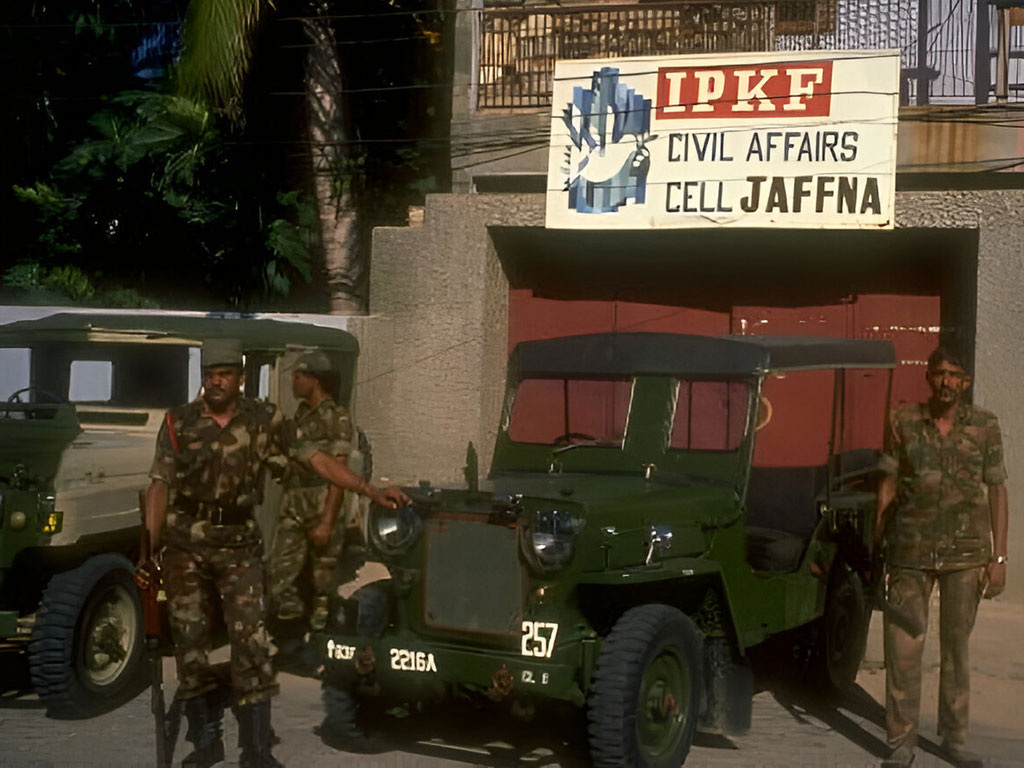
For decades, survivors of the Jaffna massacre carried only their grief. Now they carry a $15 million reparations claim against India, accusing its so-called peacekeepers of killings, rape, and destruction that still scar families and generations.
The deployment of the Indian Peacekeeping Force under the Indo Lanka Accord in 1987 was presented as a mission of peace. But for the Tamil civilians of Jaffna, it turned into a nightmare that left bodies in the streets, deep trauma in families, and unanswered questions that have echoed for thirty five years. The International Truth and Justice Project, working in partnership with the Valvettithurai Citizens’ Committee, has finally turned that grief into a formal demand for accountability. In October 2025 they submitted a reparations claim worth fifteen million US dollars to the Sri Lankan Office for Reparations. This claim seeks compensation for the August 1989 massacre in Valvettithurai in which at least sixty five civilians were killed and thirty four more injured by the Indian Peacekeeping Force.
This is the first time in Sri Lankan history that victims have filed a comprehensive compensation claim for atrocities committed by foreign troops on local soil. Valvettithurai, a coastal town in the Jaffna Peninsula, witnessed killings, disappearances, and rapes committed under the very flag of peace. Survivors recount how Indian soldiers shot civilians in groups, tortured detainees, sexually assaulted women, and systematically destroyed homes and businesses while the town was under curfew. Eyewitnesses who lived through one of the darkest nights in Jaffna’s history are now on record.

One witness described the horror inside a house where families had gathered for protection. “The kneeling pairs were shot in the presence of their mothers, wives and children and other relatives. The horrible sight was over in five minutes. The IPKF threatened to shoot anyone who cried.” Another testimony details a brutal gang rape by IPKF soldiers. “At 4pm soldiers came and demanded to search the house. I tried to step outside, but was forced back and taken into a room at gunpoint.” The woman recalled how her child was made to sit in a corner while two soldiers raped her in turn, with a third soldier clamping his hand over her mouth. She was warned to keep silent or the entire family would be killed. These are not whispers but sworn statements collected by investigators and submitted as part of the reparations framework.
The reparations claim is ambitious. It calls for restitution of property, recognition of legal rights, financial compensation for quantifiable losses, rehabilitation through health and psychological support, and satisfaction in the form of a formal apology from the Government of India. Guarantees of non repetition through legal and institutional reform are also demanded. The damages are calculated based on 1989 valuations adjusted for interest using Sri Lankan treasury rates, mirroring methodologies in commercial dispute resolution. The aim is not just to put a price on lives but to show that justice can be quantified when political will is absent.
Survivors insist that this claim is not only about money but about acknowledgement. For thirty five years they have lived with silence, displacement, and intergenerational trauma. Their children have grown up in poverty, often without recognition that their families were victims of mass atrocity. As Yasmin Sooka, Executive Director of the International Truth and Justice Project, said in a press release, this submission is a historic step in seeking accountability for foreign military abuses on Sri Lankan soil and sets a precedent for other communities to demand justice where states have failed them.
The claim was filed in Sri Lanka but the finger clearly points at New Delhi. The Citizens’ Committee has emphasized that ultimate responsibility lies with the Government of India under whose command the Indian Peacekeeping Force operated, though Sri Lankan authorities bear the duty to initiate reparations under local law. The debate over accountability is already tense. Retired Colonel Ramani Hariharan, who served as head of intelligence for the Indian Peacekeeping Force, dismissed the very idea of an apology with a defensive remark. “Who are you to ask me to apologize? Who am I to apologize for IPKF? I was a soldier serving the army to whom I am accountable.”
That kind of arrogance is precisely what has convinced survivors that both Indian and Sri Lankan institutions have failed them. Thirty five years later the soldiers walk free, commanders deny responsibility, and institutions avoid shame, while the families of Jaffna still bury their dead in memory every August. The reparations demand also confronts the politics of apology. India continues to describe its role in Sri Lanka as stabilizing while conveniently ignoring the executions and rapes its soldiers carried out. The Valvettithurai claim seeks to shatter that narrative by forcing recognition that if Sri Lanka is serious about transitional justice, then even foreign forces once invited under an accord must be scrutinized.
Yet the very suggestion of apology or accountability triggers denial. For some in India, acknowledging Valvettithurai means rewriting official history that portrays the Indian Peacekeeping Force as victims of Tamil militancy rather than perpetrators of civilian massacres. For the survivors, however, no reparation package is complete without India saying what it has refused to say for decades: we were responsible.
It is grotesque that in a country where politicians such as S. B. Dissanayake and Ranjan Ramanayake have been jailed for contempt of court, foreign troops can commit mass killings and still avoid even symbolic punishment. Survivors note that for decades they have lived without recognition, compensation, or formal justice. Their displacement became permanent, their trauma inherited by children who were not even born when the massacre happened. The reparations claim is designed not just to heal wounds but to expose hypocrisy. Sri Lanka prosecutes its own dissenters while shielding foreign allies. India, the self styled democracy, avoids accountability by drowning Jaffna in silence.
The Sri Lankan Office for Reparations has not yet issued a public response. Whether out of fear of offending India or institutional inertia, the silence is telling. Survivors know this silence all too well because it has been their companion since 1989. But ignoring the claim is no longer an option. The International Truth and Justice Project’s submission has internationalized the issue, drawing attention from human rights groups and transitional justice advocates worldwide. If Sri Lanka wishes to present itself as a nation committed to accountability, it cannot afford to bury this case under files.
The phrase “Butcher’s Bill” has long been used to describe the human cost of war. In this case it is cruelly fitting. The Indian Peacekeeping Force arrived as supposed peacekeepers and left as butchers. The price of that hypocrisy is now tallied in billions of rupees but also in wounds that no sum can mend. Survivors are not asking for the impossible. They are asking for truth, recognition, and justice. Whether Colombo and New Delhi continue their silence or finally face the past remains the real question. Until then the blood of Jaffna’s civilians continues to haunt both capitals, demanding that someone pays the butcher’s bill.