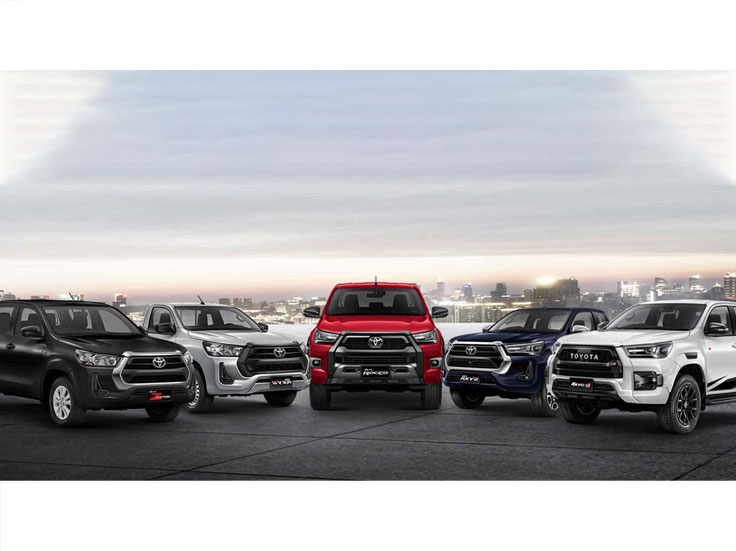
A massive government tender worth over Rs. 40 billion for nearly 1,800 diesel-powered double cabs has sparked concern after the Finance Ministry allowed an unusually short bidding window, skipping even the standard pre-bid meeting.
The Ministry of Finance, Planning and Economic Development announced last Thursday that sealed bids are being accepted for the urgent purchase of 1,775 diesel double cabs. According to the notice, vehicles must be equipped with a four-wheel drive system and automatic transmission and must be submitted under the National Competitive Bidding Procedure. Bid documents became available on October 23 and will close on November 3, with the final submission deadline set for November 4, 2025, at 2.00 p.m.

Market analysis revealed by the Sunday Times shows that the price of a single double cab with automatic transmission currently ranges between Rs. 23 million and Rs. 24.7 million. Based on these figures, the Finance Ministry has set the minimum value of the tender at Rs. 40.8 billion, raising further scrutiny about why such a large procurement is being rushed through in just under two weeks.
Adding to the controversy, the Ministry confirmed that no pre-bid meeting will take place due to “urgency.” However, no official explanation has been provided on why the tender is closing so quickly or why standard practices are being bypassed.
The eligibility criteria for bidders also appear unusually strict. Companies applying must demonstrate that during the period 2017 to 2019, prior to the nationwide vehicle import ban, they maintained a minimum average annual turnover of at least Rs. 10 billion. Additionally, they must own and operate at least ten service and repair centers across the country, with five located outside the Western Province. The tender will not accept applications from business franchises or associated institutions, further narrowing the pool of eligible participants.
Sources reveal that in September, the Finance Ministry had already begun gathering details from Ministry Secretaries, Provincial Council Chief Secretaries, and Department Heads about the urgent need for new vehicles. Officials were asked to outline shortages in order to justify the procurement of double cabs and machinery to support government development programs.
A circular issued by Finance Ministry Secretary Harshana Suriyapperuma outlined the rationale. It argued that continuous development projects in agriculture, irrigation, land management, wildlife, forest conservation, and local administration had been significantly slowed due to a lack of sufficient vehicles and the high maintenance costs of aging fleets. The circular also confirmed that the Cabinet had approved the immediate purchase of a limited fleet of double cabs as part of a broader 2025 state vehicle procurement program.
Still, critics are raising questions over the urgency, the enormous price tag, and the bypassing of regular procurement safeguards. Observers note that the government’s justification, improving efficiency in public sector projects, does not explain why such an expensive fleet must be purchased under rushed conditions without adequate transparency.
The lack of a pre-bid meeting, which usually allows prospective bidders to clarify technical and financial questions, only fuels suspicions. For taxpayers, the Rs. 40.8 billion figure is staggering, an amount that could fund dozens of hospitals, expand public transport systems, or significantly improve rural infrastructure.
As the November 4 deadline approaches, concerns continue to mount about who will benefit from this procurement and whether public interest is being sidelined in the name of urgency.