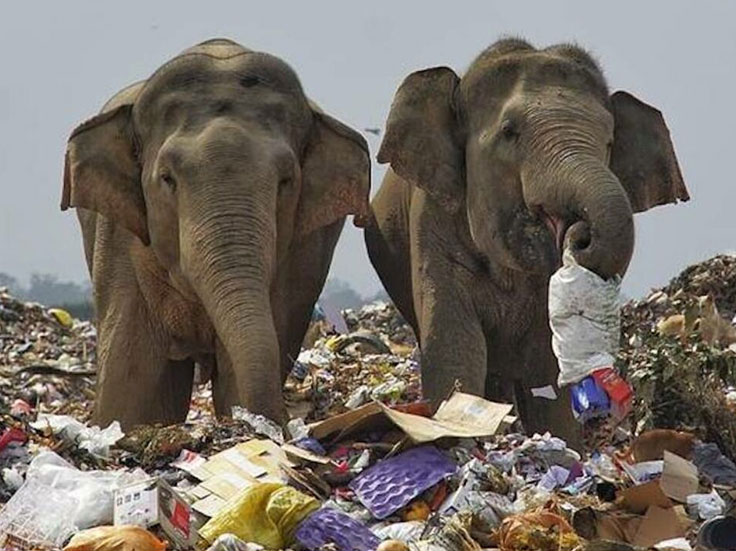
A national tragedy unfolds as Sri Lanka’s elephants face extinction, with deforestation, failed policies, and rising human conflict pushing the crisis to dangerous new heights.
Sri Lanka is grappling with one of the worst ecological and humanitarian crises in its history as the human-elephant conflict escalates to unprecedented levels. Both elephant and human deaths have reached record highs, painting a grim picture of a nation at war with one of its most iconic species. The year 2023 alone witnessed the highest number of elephant deaths since independence, with 488 elephants killed. At the same time, 187 people lost their lives to elephant attacks, the highest figure ever recorded. Conservationists warn that projections for 2025 indicate an even sharper rise, threatening to push the crisis into unmanageable territory and cementing its status as a national emergency.

From 2011 to mid-2025, an estimated 4,600 elephants and 1,528 people have died in incidents linked to the escalating conflict. These shocking statistics highlight a bitter struggle between expanding human settlements and a rapidly shrinking elephant population. Experts stress that the rise in conflict is not a result of an increase in elephant numbers but rather a consequence of severe habitat loss. The last national elephant census in 2011 recorded 5,879 elephants, yet the loss of 4,600 since then signals an alarming decline. The frequent killing of strong male elephants has skewed the natural gender ratio, while the loss of unique genetic traits further weakens the species and threatens its long-term survival.
Historical data demonstrates the scale of the devastation. Between 1950 and 2000, Sri Lanka recorded 3,949 elephant deaths, averaging around 80 per year. However, from 2000 to mid-2025, the figure has skyrocketed to 6,773 deaths, averaging a staggering 270 annually. This more than threefold increase points directly to habitat destruction and fragmentation as the key drivers of conflict.
According to the 2010 Forest Conservation Department census, the island’s forest cover stood at 1.95 million hectares, or 29.7% of total land area. Elephants primarily inhabit dry mixed evergreen forests, intermediate monsoon forests, grasslands, and thorny scrubland—together covering about 26.5% of Sri Lanka’s landscape. But these habitats are being steadily fragmented and isolated by expanding agriculture, highways, and urban settlements. Forced out of their natural ranges, elephants increasingly raid villages and farmlands in search of food and water. These encounters often turn fatal for both humans and elephants, perpetuating a vicious cycle of violence.
The roots of this crisis can be traced back to controversial policy decisions made after 2010, when deforestation accelerated to make way for large-scale agricultural and infrastructure projects under the National Physical Plan and various international lending programs. Many of these projects, tied to commercial agriculture and multi-purpose irrigation schemes, destroyed vast stretches of elephant habitat. Remaining forests were dissected by roads, railways, and settlements, leaving elephants with little space to roam. What began as a localized conservation issue has now spiraled into a nationwide ecological emergency.
Conservationists have long argued that the government must adopt a comprehensive, science-driven approach to mitigate the crisis. Among their most urgent proposals is the creation of a connected system of elephant habitats managed jointly by the Forest Conservation Department, Wildlife Conservation Department, and related state bodies. Experts recommend removing poorly planned electric fences that block traditional elephant corridors and replacing them with strategically placed, reinforced barriers combined with biological defenses such as lime hedges and cactus fences. At the same time, they call for a strict legal framework to regulate, approve, and monitor all future electric fence installations.
Another proposal gaining traction is the construction of tunnels and overpasses along highways and railways to ensure safe elephant crossings. Such structures, already successful in countries like India and Kenya, could dramatically reduce the number of road and train-related elephant deaths. Conservationists also stress the importance of legalizing and protecting elephant corridors, clearing garbage dumps that attract elephants near human settlements, and banning cattle grazing in protected forests to minimize conflict over limited resources.
Restoring degraded habitats is also seen as vital. This includes removing invasive plant species that choke out native vegetation, converting monoculture forest plantations into grasslands, and rehabilitating traditional water tanks that once supported wildlife during droughts. These measures, experts argue, are essential to restoring ecological balance to elephant ranges and reducing the likelihood of encounters with humans.
The crisis has also been exacerbated by illegal cultivation and mining activities in reserved forests, along with weak enforcement against land encroachment. Analysts emphasize that unless flawed development policies under the National Physical Plan are reassessed, the problem will only worsen. They call for a fundamental shift toward sustainable land use, one guided not by short-term political or commercial agendas but by ecological science and long-term environmental stewardship.
To achieve lasting solutions, conservationists propose establishing an Elephant Conservation Fund to secure long-term financing for protection efforts, along with a National Land Commission to coordinate a coherent land-use policy. These measures, they argue, must involve communities at every stage to ensure participation and accountability. Without grassroots involvement, they warn, even the best policies risk failure.
The gravity of the crisis cannot be overstated. The current human-elephant conflict is no longer just a conservation concern but a full-blown national emergency that threatens biodiversity, agriculture, and rural livelihoods. Without immediate, science-based action to restore habitats, enforce protective laws, and reform reckless development, Sri Lanka risks losing not just its elephants but also the ecological balance that sustains its people. The tragedy unfolding across the island is both a warning and a call to action: unless leaders act decisively now, one of Sri Lanka’s most iconic species could be pushed to extinction within a generation.
For rural farmers, the crisis is not a statistic but a daily reality. Crops are destroyed overnight, lives are lost, and communities live in fear of herds wandering into their villages. For elephants, survival means navigating a fragmented landscape where every step risks conflict. The tragedy is shared, and so must be the responsibility to resolve it.
Elephants have long been symbols of Sri Lanka’s culture, religion, and heritage. They grace temples during peraheras, appear on ancient carvings, and hold a sacred place in the island’s identity. To lose them would not only be an ecological disaster but also a cultural wound from which the nation may never fully recover.
The future of Sri Lanka’s elephants now hangs in the balance. Conservationists, environmentalists, and communities are calling on the government to act swiftly and decisively. The solutions are clear: protect habitats, regulate development, enforce laws, and promote coexistence. What remains uncertain is whether Sri Lanka’s leaders will summon the political will to prioritize conservation over profit and science over short-term gain.
The fate of the elephants is tied to the fate of the people. Protecting them is not merely an act of compassion but a matter of survival for the island itself. If Sri Lanka fails to rise to this challenge, the loss will echo not only through its forests but across its history, marking a dark chapter of neglect and irretrievable loss.