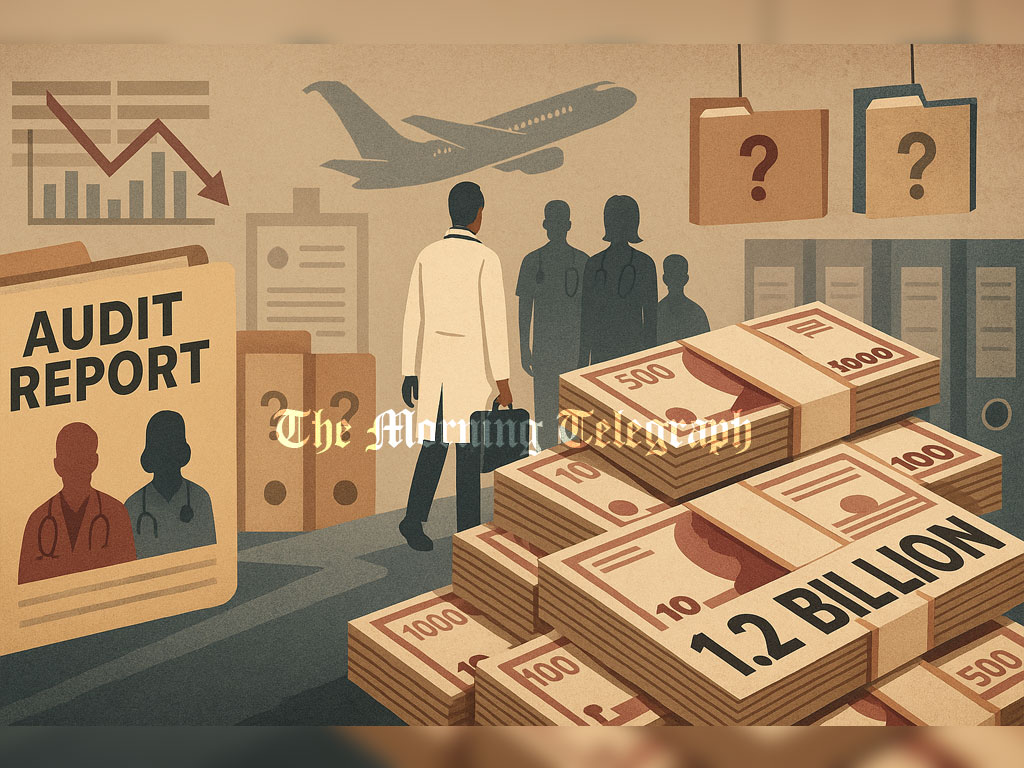
A colossal failure of governance has rocked Sri Lanka’s health sector, as a National Audit Office report reveals that 705 doctors have defaulted on service bonds, skipping out on over Rs. 1.2 billion in dues. The damning special audit exposes a culture of impunity, systemic record-keeping failures, and decades of negligence by the Ministry of Health, allowing a massive financial drain amid the country’s deepening healthcare crisis and doctor exodus. This colossal financial loss, a significant fraction of public investment, underscores a critical threat to the nation’s free healthcare model and highlights an urgent need for accountability and drastic structural reform.
The special audit uncovered one of the most alarming financial and administrative failures in the country’s public health system. It meticulously tracked the unpaid dues owed by 705 medical officers, painting a stark picture of weak enforcement, chaotic record-keeping, missing files, and a decades-long pattern of neglect that allowed these professionals to breach their service contracts without facing consequences.
The severity of these findings is amplified by the current context, as Sri Lanka’s healthcare system is already under immense strain. The nation is battling a severe financial crisis, struggling with chronic shortages of medicines and equipment, and coping with an accelerating exodus of medical professionals seeking better opportunities abroad. The audit concluded that as of October 31, 2024, the government had failed to recover the precise sum of Rs. 1.277 billion from the 705 defaulting medical officers who went overseas for training or employment and subsequently failed to fulfill their mandatory service obligations.

The Crumbling Foundation of Public Healthcare
For many years, Sri Lanka was a regional model, taking great pride in its accessible and efficient free public healthcare system despite limited resources. Yet, the foundations of this model are visibly cracking. The country is experiencing a profound brain drain, with doctors, specialists, and nurses departing in large numbers, drawn by higher salaries, superior career prospects, and better working conditions overseas.
The audit unequivocally confirms that this large-scale migration has resulted in devastating financial consequences for the state. Many doctors secured crucial postgraduate training or specialized placements abroad, often facilitated through government sponsorship, sanctioned study leave, or agreements with foreign hospitals. The fundamental condition of these arrangements was that they would return to serve their mandatory service periods upon completion. However, a significant number of these individuals either failed to return or resigned prematurely, effectively defaulting on their contracts and the public investment made in their professional development.
While legally binding agreements and service bonds were in place specifically to safeguard the public investment, the report tragically shows that their enforcement has been almost entirely nonexistent. Doctors who should have repaid millions simply vanished into lucrative foreign jobs. In a striking number of cases, resignations were only processed years later, with their entire periods of absence retroactively regularized as “unpaid leave,” thereby neutralizing the financial obligation. In other equally concerning instances, crucial service records were missing entirely, making the necessary process of tracking and penalizing defaulters administratively impossible.
The Scale of Financial Default
The numbers detailed in the audit report provide shocking evidence of how widespread the problem of financial default and contract violation has become across the healthcare service. The financial liabilities owed by the doctors who broke their agreements are categorized as follows:
- Rs. 695.2 million owed by 204 doctors who took paid foreign study leave but failed to return to service. This represents the largest single category of loss.
- Rs. 444.2 million owed by 480 doctors who left on unpaid leave and subsequently failed to return to their posts.
- Rs. 6.25 million owed by eight doctors who utilized a combination of both paid and unpaid leave entitlements.
- Rs. 10.7 million owed by 13 medical officers who went abroad with their spouses on paid study leave.
- An additional Rs. 119.4 million in fines and bond obligations was owed by 116 doctors who had never submitted updated personal files to the Ministry.
In total, these liabilities combine to form the final figure of Rs. 1.277 billion by the end of October 2024. The staggering magnitude of this sum leaves no doubt about the Ministry’s profound failure to adequately protect and manage crucial taxpayer funds.
Broken Systems and Record-Keeping Chaos
A major factor enabling the immense financial losses was the appalling administrative disarray and the abysmal state of record-keeping within the Ministry of Health. The audit uncovered a pervasive and alarming environment of administrative neglect:
- Missing or Incomplete Files: Thousands of personal files were incomplete or entirely missing.
- Untraceable Guarantors: Of 230 guarantor files specifically requested by the auditors, the Ministry could only produce 132.
- Incomplete Registration Data: The Sri Lanka Medical Council provided registration records for 1,437 doctors linked to the audit. Even this vital data was fragmented:
- 860 had maintained their registration up to 2024.
- 270 had failed to maintain their registration.
- 288 had no updated records whatsoever.
- Database Inaccuracies: The Medical Services Division’s database was riddled with profound inaccuracies and omissions:
- Over 9,000 medical officers had no personal file numbers recorded.
- Nearly 400 had no listed workplace or designation.
- As of March 2025, 1,451 file numbers were entirely missing.
- 91 records had no job position attached.
- 449 officers were merely marked as being on leave without any details of when the leave was taken or officially approved.
These fundamental administrative weaknesses made the process of enforcing fines or initiating bond recovery virtually impossible. Without accurate contact details, verified service records, or proper personal information, the Ministry was entirely unable to track down the defaulting doctors. Even worse, the Ministry demonstrated a critical failure to establish or maintain essential coordination with the Department of Immigration or Sri Lankan embassies abroad, which are standard mechanisms for tracing missing individuals.
Case Studies of Administrative Impunity
The audit highlights several highly egregious examples that illustrate a deep-seated culture of impunity and administrative indifference within the Ministry:
- Unauthorized Employment: Doctor 14070 was granted three months of unpaid leave in August 2005 but never returned. Instead, this doctor was employed with the United Nations for 11 years. Their resignation was only formally processed in 2016, with the entire intervening period being inexplicably treated as unpaid leave, and no fines were ever collected.
- Overseas Promotion: Another doctor was promoted while officially overseas, despite being on documented unauthorized leave, showcasing a complete breakdown in the basic personnel management structure.
- Salary Overpayment: A doctor resigned in June 2016 but continued to receive their salary for that month. Auditors found zero evidence that the improperly paid money was ever recovered.
- Legal Failures: The Attorney General’s Department was forced to close multiple files that had been submitted for legal prosecution because the Ministry of Health consistently failed to provide the necessary, adequate information required to pursue court action against the defaulters.
These cases collectively demonstrate that medical officers who openly broke their agreements faced virtually no consequences and, in some unbelievable instances, were actually administratively rewarded or facilitated in their default.
The Failure of Postgraduate Training
The audit also exposed major inefficiencies and failures within the system of postgraduate medical training. Doctors are required to complete a critical one-year period of overseas training to successfully qualify for full board certification. Yet, many failed to either complete their training or report back to work in the country.
- 71 doctors who were sent abroad failed entirely to return to Sri Lanka.
- A further 68 doctors did not successfully complete their postgraduate degrees at all.
The substantial public funds spent on their training, including various allowances and foreign placement fees, represents a total waste of public money. This systemic failure has directly contributed to the acute shortage of specialists across Sri Lanka’s hospitals, leading to:
- Patients enduring unacceptably long waiting times for care.
- Severely limited access to specialized medical services.
- A clear decline in the overall quality of service.
For patients suffering from complex or chronic conditions like cancer or heart disease, this shortage directly translates into critically delayed treatment and consequently, much poorer health outcomes.
Chronic Governance Deficiencies
The audit paints a dire picture of the governance failures that have become chronic within the Ministry of Health. Key administrative deficiencies were clearly identified:
- Reporting Failures: Reports detailing doctors who had left the service were not submitted to the Public Service Commission every six months, a mandatory legal requirement.
- Lack of Response: At least 16 audit letters sent to the Ministry by the auditors up to July 2025 went completely unanswered, indicating a profound disregard for external oversight.
- Data Admission: The Health Secretary formally admitted in writing that the critical data concerning doctors’ training and service records had not been properly updated by the subject officers responsible for the task.
- Uninvestigated Irregularities: Payroll irregularities that were identified and flagged by the auditors were never investigated by the Ministry.
- Calculation Errors: In specific instances, the fines owed were calculated incorrectly, a technical error that inadvertently reduced the amounts that were legally recoverable, further contributing to the financial loss.
The cumulative impact of these systemic weaknesses was the creation of a system where doctors could easily exploit administrative loopholes with little fear of repercussions, while the public taxpayers were left to bear the substantial financial burden.
Public Fallout and the Brain Drain Context
The severity of the revelations has provoked widespread and intense public anger among citizens, who are already struggling with the dire realities of shortages of doctors, drugs, and essential equipment in public hospitals. For many, this scandal is viewed as yet another glaring example of egregious waste and mismanagement at a time when the country is financially fragile and struggling with a massive national debt burden.
The issue is directly intertwined with the wider national debate on the brain drain. Hundreds of highly skilled doctors leave Sri Lanka every year for more stable and lucrative professional environments in the UK, Australia, Canada, and the Middle East. While professional migration is a global trend, Sri Lanka’s catastrophic failure to properly enforce its service bonds and recover financial penalties has made its public health sector uniquely vulnerable to this massive loss of essential talent and public funds.
The disparity is stark when compared to regional and international counterparts:
- India: Doctors who breach service agreements face swift, serious legal enforcement and recovery actions.
- Singapore: Breaches of medical bonds result in the imposition of heavy financial penalties and immediate court action.
In sharp contrast, Sri Lanka has endured years of chronically weak governance, often compounded by instances of political interference, which has fostered a deeply ingrained culture of non-compliance and financial unaccountability within its most critical public institution.
The Auditor General’s Urgent Recommendations
Acting Auditor General G. H. D. Dharmapala has put forth a set of urgent and non-negotiable recommendations aimed at addressing the crisis and recovering the public funds. These recommendations call for immediate, structural reforms:
- Immediate Recovery: The immediate recovery of the full Rs. 1.277 billion owed by all defaulting doctors.
- Digital Centralization: The creation of a modern, centralized, digital database to accurately track all medical officers’ appointments, transfers, training status, and overseas leave records.
- File Verification: The complete and accurate updating of all personal files with current, verifiable information.
- Stronger Enforcement: A dramatic strengthening of the enforcement mechanisms for fines and the prompt recovery of all funds expended on doctors who fail to return from their foreign leave.
- Inter-Agency Coordination: Establishing robust coordination channels with immigration authorities and Sri Lankan embassies abroad to efficiently trace the whereabouts of doctors currently residing overseas.
The Auditor General issued a serious warning, cautioning that without the decisive and immediate implementation of these essential measures, the financial losses would continue to escalate, and the entire public health sector faces the very real risk of collapsing under the overwhelming weight of chronic mismanagement and debt.
Beyond Money: The Human Cost to Healthcare
While the sheer financial loss of Rs. 1.277 billion is devastating to the national economy, the subsequent human cost is far more severe and affects every citizen. The continuous, unmitigated departure of highly trained doctors without replacement has left public hospitals critically understaffed, placing an immense burden on the remaining staff.
Rural areas in particular are suffering from acute shortages of specialists, forcing vulnerable patients to travel long distances, often at great personal expense, to seek specialized care. Furthermore, the immense waste of government funds on uncompleted postgraduate training directly results in a reduced availability of qualified specialists within the country. This systemic failure results in:
- Critically delayed treatment for patients with serious or chronic illnesses.
- Poorer overall health outcomes for the population.
- A profound erosion of public trust in the health sector and the government’s competence.
Citizens are left questioning how such a cascade of administrative failures could be allowed to persist and deepen for decades without any meaningful action or accountability taken against the doctors who broke their agreements and the officials who enabled the financial hemorrhaging.
A Call for Accountability and Restoration
The National Audit Office’s special report serves as more than just a financial audit; it is a critical exposure of a profound crisis of governance within the heart of Sri Lanka’s essential healthcare system. With a staggering Rs. 1.277 billion in public funds at stake and public hospitals struggling to function, the findings demand immediate, non-negotiable structural reform.
The core of this crisis lies in a devastating lack of accountability: doctors who violated their service contracts, public officials who habitually ignored their primary responsibilities, and leaders who failed to act decisively despite repeated warnings and evidence of failure. Without immediate and decisive steps to recover the lost funds, to fundamentally strengthen the administrative systems, and to rigorously enforce the rules, the debilitating brain drain will continue unabated, public funds will be endlessly wasted, and the entire public healthcare system will continue to deteriorate.
For the people of Sri Lanka, this issue is about more than recovering money. It is about demanding justice, ensuring fairness, and asserting the non-negotiable right to a functioning, reliable, and equitable healthcare system. The government must act now, not merely to recover what has been lost, but to decisively restore public faith in an institution that is tasked with the ultimate responsibility of protecting the health and well-being of every single citizen.