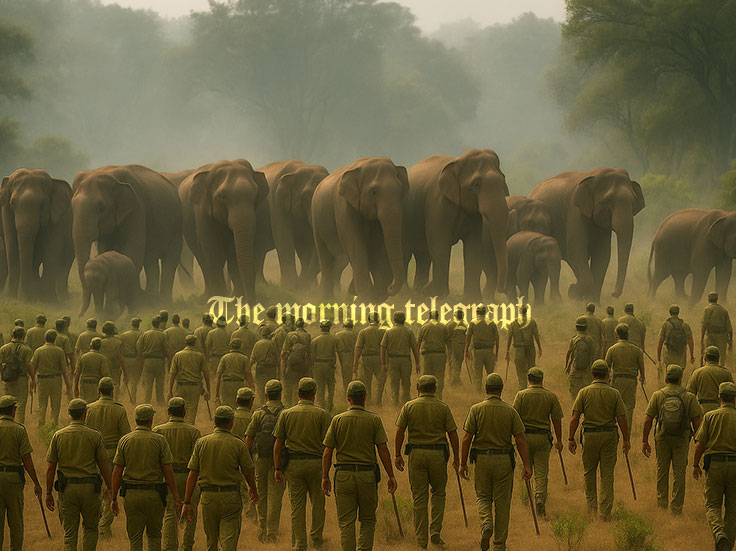
Experts warn that the planned Hambantota elephant drive will not solve human–elephant conflict but instead trap starving herds into shrinking, degraded habitats, repeating the same deadly mistake Sri Lanka made decades ago.
Hambantota, one of Sri Lanka’s most intense human–elephant conflict zones, is preparing for a large-scale elephant drive — a 21-day operation involving around 80 wildlife officers, farmer groups, and state agencies. The government claims the mission will push elephant herds out of villages and back into the Hambantota Managed Elephant Range, but conservationists say the move is scientifically outdated, ecologically destructive, and destined to fail.
Environmentalists call this operation a repetition of a historical mistake, pointing to research that proves elephant drives do not reduce human–elephant conflict. Instead, the practice forces herds into already degraded areas, causing long-term starvation, stress, aggression, and death among elephants. Conservationist Supun Lahiru Prakash warns that the targeted sections of the Managed Elephant Range are already overcrowded, with limited food and water due to years of habitat fragmentation. Confined elephants will eventually starve, an outcome documented during previous drives in the early 2000s.

Hambantota is estimated to hold roughly 400 elephants. Large-scale infrastructure projects during the Rajapaksa era disrupted their migration routes and home ranges, pushing elephants into villages. To respond, elephant biologist Dr Prithiviraj Fernando first proposed the Managed Elephant Range in 2009 — a 23,000-hectare science-based landscape model separating elephant-preferred zones from development areas. The plan was only gazetted in 2021, and illegal encroachment has eroded its effectiveness. According to conservationist Sameera Weerathunga, some problem elephants being “driven out” are actually being forced out of their original habitat because it is no longer viable.
Dr Fernando’s scientific studies show that elephant drives create overcrowded herds, food shortages, water scarcity, weakened immune systems, and high mortality. Female elephants and calves are usually the ones driven out, while adult males tend to evade the operation, disrupting herd balance and breeding patterns. Explosions, fireworks, and human aggression also traumatise elephants, increasing violent behaviour — which ultimately worsens human–elephant conflict. Research further shows that over 70% of Sri Lanka’s elephant range overlaps with human landscapes, meaning there is no “empty wilderness” to relocate them to.
Villagers, however, are desperate as elephants now move through areas that never saw elephant activity before. With shrinking forests and unpredictable food patterns, elephants are exploring new routes, creating fresh hotspots of conflict. Weerathunga says the government must prioritise both human safety and elephant welfare, not choose one at the expense of the other. With recent rains increasing natural food supply in forests, conservationists urge postponement of the drive until science-based mitigation plans are updated.
The government insists the Hambantota operation is a targeted effort, not a mass relocation. Deputy Environment Minister Anton Jayakody says the State is working on long-term solutions, including habitat enrichment to increase natural food availability. But environmentalists argue that until development policies stop fragmenting elephant habitats, temporary solutions such as fencing, drives, and firecrackers will only escalate the crisis.
Sri Lanka’s most infamous elephant drive — Lunugamwehera, 2006 — ended in tragedy, with elephants starving inside fenced zones and conflict spreading wider than before. Conservationists fear Hambantota may soon repeat that failure on an even bigger scale.
SOURCE :- THE SUNDAY TIMES