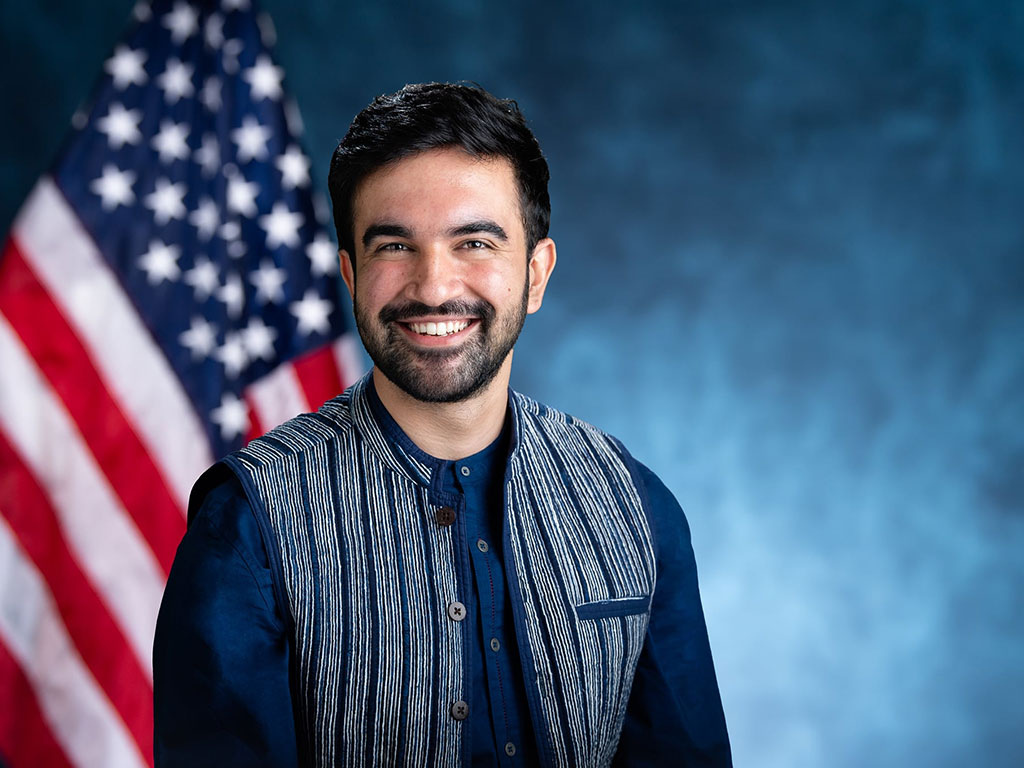
New York City has entered a new political era as 33-year-old Zohran Kwame Mamdani becomes the first Muslim, first South Asian and youngest mayor ever elected to lead America’s largest city.
With the final results confirmed, Mamdani’s victory marks a defining moment not just for New York, but for the future of progressive urban politics in the United States. His win reflects a major shift in the city’s voter base and a strong endorsement of his economic justice-driven platform.
Born on October 18, 1991, in Kampala, Uganda, Mamdani is the son of globally respected academic Mahmood Mamdani and award-winning filmmaker Mira Nair. After living in South Africa, the family migrated to New York when he was seven. He attended The Bronx High School of Science and later earned a Bachelor of Arts in Africana Studies from Bowdoin College. Before entering politics, he worked as a housing-counselor in Queens, defending low-income families from foreclosure and eviction, an experience that shaped much of his political identity.

Mamdani entered electoral politics in 2020, winning a seat in the New York State Assembly for the 36th District, covering Astoria, Ditmars-Steinway and Astoria Heights in Queens. He took office in January 2021 and quickly built a reputation for pushing aggressive legislation on tenants’ rights, housing affordability, and public transit funding.
In 2025, he launched an ambitious bid for mayor. He won the Democratic primary after defeating former Governor Andrew Cuomo, a political upset that shocked the establishment. With his general election victory now certified, Mamdani becomes the first mayor of New York City with South Asian roots and the first Muslim to ever hold the post.
His campaign focused heavily on the high cost of living and economic inequality. Key elements of his policy agenda include free bus transit, major expansion of affordable housing, stronger rent protections, increased taxes on corporations and ultra-wealthy residents, and large-scale public investment in childcare and social services. He also promised public safety reforms and a shift away from policing-only strategies toward community-based services.
Supporters say his election signals a demand for radical change in housing, transit and economic policy. Critics, however, question whether he has enough governing experience to lead a city of over eight million people. Mamdani has also been accused by several Hindu-American organisations of making “Hinduphobic” remarks, particularly after past comments in which he referred to Indian Prime Minister Narendra Modi as a “war criminal.” The controversy resurfaced during his Diwali outreach event, where he invoked a vision of a pluralistic India and positioned himself against right-wing nationalism.
He also clashed publicly with former President Donald Trump during the campaign, framing himself as a progressive immigrant voice ready to challenge Trumpist politics on a national stage.
While his victory is widely celebrated among progressives and immigrant communities, his policy agenda will face significant resistance from corporate lobbies, establishment Democrats, state government, and conservative media. Whether he can convert campaign promises into concrete policy will define his leadership and determine whether his win represents a symbolic milestone or the start of a transformative political era.