- Note that the above image is AI generated
Donald Trump’s comeback has shaken South Asia’s power balance, forcing India to confront its contradictions between global ambitions and domestic realities — and to decide whether its “strategic autonomy” is strength or self-deception.
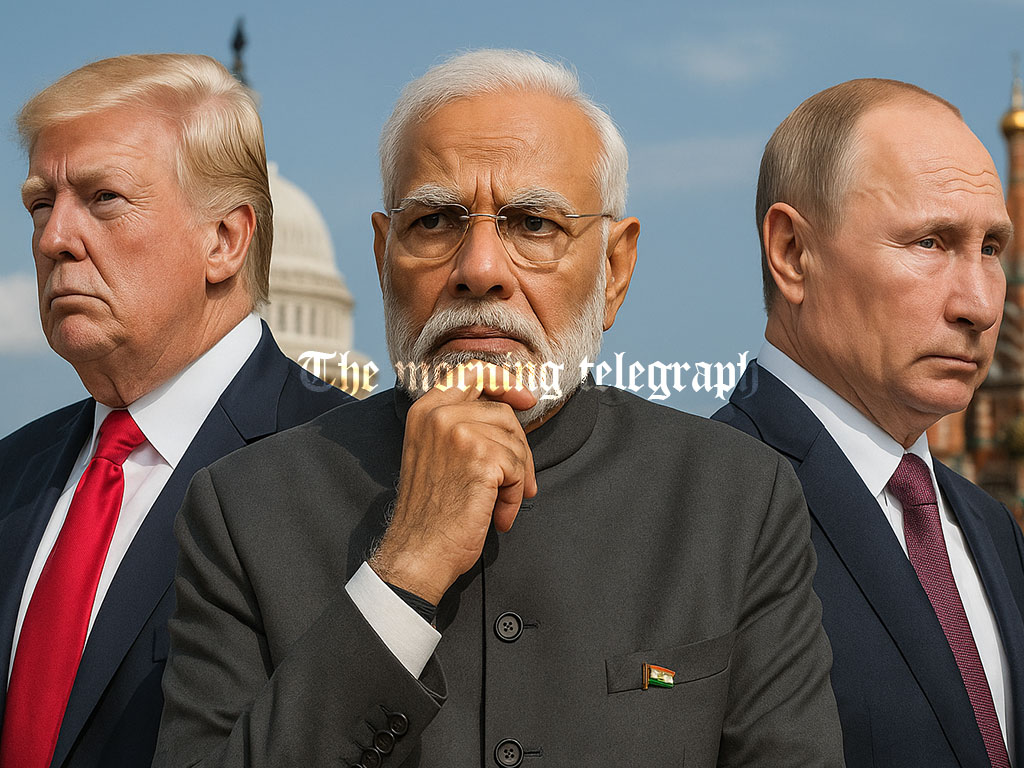
Donald Trump’s return to the White House has reignited old geopolitical tensions and thrown South Asia’s delicate balance into uncertainty. His administration’s renewed pressure on global partners has once again placed India in the spotlight, testing its identity as both a U.S. ally and a nation pursuing “Atmanirbhar Bharat,” or self-reliance. The United States has long viewed India as a crucial pillar in its Indo-Pacific strategy, primarily through the QUAD alliance that includes Japan and Australia. But Trump’s new policies and rhetoric are reshaping that equation, directly challenging India’s dual approach of maintaining ties with both Washington and Moscow.

In his latest remarks, President Trump warned India against actions that could “destabilize Pakistan” and against continued oil trade with Russia. Washington sees such trade as undermining its sanctions regime and diluting its leverage in the Russia-Ukraine conflict. For New Delhi, however, the issue is one of pragmatism — sustaining energy security while juggling its strategic independence. Yet this balance increasingly looks like a tightrope walk, as India’s pursuit of self-reliance often collides with its dependency on both Western capital and Russian resources.
Trump’s foreign policy, characterized by transactional alliances and economic coercion, is already transforming India’s long-held assumptions about its global standing. The once-celebrated “strategic partnership” with Washington is being tested by demands for transparency, reciprocity, and alignment in global crises. The U.S. now expects clear loyalty from partners, not ambiguity. This shift has placed India’s foreign policy doctrine under scrutiny and exposed its contradictions between its democratic image abroad and its social fissures at home.
Domestically, India’s ruling Bharatiya Janata Party (BJP) faces mounting criticism for policies that many international observers consider discriminatory. Reports by the United Nations Special Rapporteurs, the European Parliament, and Amnesty International have documented systemic violence and legislative measures targeting minorities, particularly Muslims. The anti-conversion laws and demolition of minority homes have been condemned as violations of human rights. While the government frames these policies as national security measures, they weaken India’s credibility as a pluralistic democracy — a narrative central to its soft power diplomacy.
According to global watchdogs, such domestic trends threaten to fracture India’s democratic fabric, creating communal divisions and long-term instability. These developments cast doubt on India’s claim of being the “world’s largest democracy” and complicate its efforts to project itself as a responsible global leader. Washington, under Trump’s assertive approach, is unlikely to overlook these contradictions, especially as they undermine the democratic values underpinning the U.S.-India partnership.
Meanwhile, India’s economic diplomacy faces new strains. The ongoing Russia-Ukraine war has deepened New Delhi’s dependency on discounted Russian crude oil, with imports exceeding 1.9 million barrels per day. This deal directly challenged Western sanctions and drew sharp criticism from Washington and Brussels. While India framed the purchases as an act of economic necessity, the optics were damaging. Trump’s administration sees this dual alignment as evidence of India playing both sides — a strategy that may soon invite repercussions in the form of trade penalties or diplomatic downgrades.
Despite sanctions, India continues to balance its ties with Russia to secure defense cooperation and energy supplies. But this balancing act has come at a cost. The U.S. and Europe have signaled growing impatience, arguing that India’s actions undercut the broader Western coalition against Moscow. The result is a subtle yet significant erosion of trust between India and its Western allies.
Economically, India’s dependency on global markets makes its “self-reliance” narrative even more complex. In 2024, India exported $79.44 billion worth of goods to the U.S., its largest trading partner, while still lobbying Washington for tariff relief under the Generalized System of Preferences (GSP). Losing access to the GSP program costs India nearly $6 billion annually. Such figures reveal the gap between rhetoric and reality — a nation seeking self-sufficiency yet deeply enmeshed in the very trade networks it claims to transcend.
Trade tensions with the European Union further complicate matters. Since 2007, EU-India negotiations have been stalled due to high tariffs and limited market access. The Trump administration’s decision to impose 25 percent tariffs on Indian goods was both a warning and a reality check. It signaled that India’s dependence on Western markets remains significant, and that self-reliance without economic reform or trade liberalization may remain a slogan rather than a strategy.
Trump’s renewed presidency has exposed the fragile equilibrium India has maintained between great powers. For years, New Delhi has tried to play mediator — aligning with Washington in security cooperation while relying on Moscow for defense and Beijing for trade. But in the era of sharper global polarization, such nonalignment is increasingly untenable. Trump’s foreign policy makes it clear: neutrality carries a cost.
India’s dilemma is further compounded by its domestic political choices. The BJP’s assertion of majoritarian nationalism resonates domestically but clashes with its international ambitions. Global audiences, particularly in the West, expect India to embody democratic inclusivity and rule of law — not religious nationalism or censorship. As such, the gap between India’s external image and internal realities risks undermining its credibility as a global leader in the Indo-Pacific.
For India, the challenge ahead is not simply diplomatic but existential. Can it sustain its claim of self-reliance while remaining dependent on foreign energy, trade, and technology? Can it reconcile its domestic political identity with the expectations of its democratic partners abroad? These questions define the crossroads at which India now stands.
As Trump reshapes U.S. foreign policy with characteristic unpredictability, India finds itself under new scrutiny. Washington wants clear alignment; Moscow expects loyalty; and global markets demand openness. Navigating this complex terrain requires more than rhetoric — it requires decisive, values-driven leadership.
In the end, Trump’s return has forced India to confront its own myth: that it can be simultaneously independent, neutral, and globally integrated. As the geopolitical order shifts, India must decide whether to deepen its ties with the democratic West or double down on its transactional pragmatism with Russia and other authoritarian powers. Whichever path it chooses, one truth remains: strategic autonomy is no longer a slogan — it is a test of India’s will, consistency, and identity on the world stage.